

Careers Wire · Deep dive · The mechanism, the 30 companies, the tax playbook, the traps named.
The college kid on $100k
On r/developersIndia last winter, a thread titled "how common is $100k salary for a contractor from India" pulled the usual pessimism. Then one commenter, u/arasaka-man, replied with the version of the story nobody wanted to hear.
"Very rare but alot of the VC funded startups give this kind of money, I'm getting $100k and they don't even care if I'm still in college."
"A very niche topic in generative modelling using diffusion. I met the founder through discord and starting making open source contributions because I found their work interesting, and they agreed to sponsor my research, before offering me a contract."
"Basically video world models, which you can interact with using keyboard and mouse interactions. It's a popular technique for generating frames."
— u/arasaka-man, r/developersIndia
A student. On $100k. Because he picked a niche (video-world-models diffusion), showed up in the founder's Discord, and started shipping open-source pull requests before anyone offered him a job. No degree gate. No campus placement. No recruiter.
This piece is that mechanism, mapped honestly. It is not a top-10 list of "US companies hiring remote in India". It is not Turing. It is not Deel-as-EOR-employee. It is not Andela. It is not the LinkedIn-shaped commodity ladder where a Y3 IIT student ends up as line 200 in a services shop's applicant tracker. It is the ~30-company underground where niche skill plus public reputation plus one cold email lands offers between $80k and $300k. Every claim traces to a source. Every trap gets named.
The math you're negotiating against
Before the mechanism, the number. Levels.fyi's latest India Software Engineer band caps out at ₹48.34L.
"The average Software Engineer Salary range in India is from ₹17,14,495 to ₹48,34,038."
— Levels.fyi, India Software Engineer
At 83 INR per USD, a $100k USD contract is roughly ₹83L. That is 1.7x the top of Levels.fyi's Indian ceiling, before you even talk about the tax structure. Every time you weigh a Bangalore MNC offer, this is the arbitrage you are choosing against. A mid-tier US remote contract already dwarfs the best-case Indian trajectory Levels.fyi has ever recorded.
The 30-company universe
Three clusters. Each has a mechanism that is verifiable, and a hiring pattern that is public. This is the shortlist that actually pays dollarized bands to India-based engineers, not the LinkedIn commodity ladder.
The YC dev-tools cluster. Y Combinator's public remote-engineer jobs board lists roles with fully explicit USD bands: Numeral (W23) at $175k–$300k, Y/n (S23) at $120k–$300k multi-country, Naïve (P25) at $185k–$220k, Runway (W21) at $80k–$150k multi-country. AiPrise (YC S22) is the concrete anti-Turing model: an explicit "Remote (IN; Bengaluru, KA, IN)" tag on its Staff Software Engineer role, published bands of ₹4.5M–₹6M INR for Staff, ₹3.5M–₹4.5M INR for SWE-III, and a US counterpart at $150k–$200k. Human Archive (W26) is hiring seven India engineering roles right now. Attack Capital (W22) has an $800k–$1.6M India band for a Head of GTM, which is the ceiling for what YC now thinks "India remote" can pay. Supabase runs 280+ people across 55+ countries with no location adjustment, and third-party listings surface India-tagged Site Reliability roles at $108k–$150k.
The reality check. Not every "remote-first" company is India-eligible. Linear publicly restricts its four open engineering roles to "Europe, North America" only. Vercel, the poster child of the OSS-to-hire story, publishes zero explicit remote or India-eligible engineering roles. All Vercel engineering listings are Austin, NYC, SF, London, Berlin, Australia or generic "United States". If you were building your career around "contribute to Next.js and Vercel will hire you", the public listings do not support the plan.
The niche contract platforms. This is where Braintrust and Contra earn their space. Braintrust is talent-owned, charges 0–10% fees, and its knowledge workers earn "nearly $100/hour on average", with mid-to-senior focus and transparent bidding. Contra takes 0% commission from freelancers and their average developer clears $35k–$65k a year on the platform, with the global freelance developer average sitting at $101/hr and AI specialists at $100–$200/hr. These are not Turing and not Toptal. Use them for calibrated freelance income and portfolio, not as your professional identity.
| # | Company | Category | Verified signal | TC band (public) | Screening focus |
|---|---|---|---|---|---|
| 1 | AiPrise (YC S22) | KYC / compliance AI | Explicit "Remote (IN)" tag on YC jobs | ₹25L–₹60L (Staff), $150–200k US band | Backend / APIs |
| 2 | Supabase | Postgres BaaS | Fully remote, no location adjustment | $60–150k range (third-party listings) | Postgres, TS, OSS |
| 3 | PostHog | Product analytics | Remote (EST / Europe timezone) + $1,000 paid trial | Not published | Full-stack + product intuition |
| 4 | Ethereum Foundation | Crypto protocol | Ashby jobs board, explicit Remote Sr Core Developer | Not public | Consensus / protocol |
| 5 | Cognition (Devin) | AI code agents | India-listed APAC deployment eng | Not public | Deployment / customer |
| 6 | Traycer | AI dev tools | Reddit-verified ₹1L/mo intern (2nd year) | ₹1L/mo intern | Projects-first, no DSA |
| 7 | Numeral (YC W23) | Sales tax | "Remote" + $175–300k | $175–300k | Backend eng |
| 8 | Y/n (YC S23) | Multi-country remote | "Remote (Multiple countries)" $120–300k | $120–300k | Full-stack |
| 9 | Vitalize (YC W23) | Wellness | "Remote (US)" $180–260k | $180–260k | Full-stack |
| 10 | ParadeDB (YC S23) | Postgres search | "Remote (US; CA)" | $150–250k | Postgres internals |
| 11 | Human Archive (YC W26) | Consumer wearables | Explicit "India" listings | ₹18L–₹35L | Firmware / embedded / mech |
| 12 | AIOS (YC W20) | Multi-region growth | "IN available" band | $200–400k + 0.15–0.50% equity | Growth (senior IC / lead) |
| 13 | Model ML (YC W24) | AI / ML | "IN available" | $120–200k | Growth |
| 14 | SigNoz (YC W21) | OSS observability | India / Remote-US ex-Founder listings | Not public | Distributed systems / eBPF |
| 15 | Spenmo (YC S20) | Fintech | SEA & India SWE + Sr SWE listings | Not public | Fintech backend |
| 16 | Braintrust | Talent network | 0–10% fee, ~$100/hr avg | ~$100/hr on avg | Portfolio + bidding |
| 17 | Contra | Independent talent | 0% fee, portfolio-only | $25–200/hr self-set | Portfolio |
| 18 | Wasmer (YC S19) | WASM runtime | "Remote (Madrid + Remote)" | $60–90k | OS / runtime engineer |
| 19 | Runway (YC W21) | Multi-country | "Remote (Multiple countries)" $80–150k | $80–150k | Full-stack |
| 20 | Naïve (YC P25) | AI startup | "Remote" $185–220k | $185–220k | Founding eng |
| 21 | Scispot (YC S21) | Lab-info tools | "Remote (Multiple countries)" | $80–120k | Full-stack |
| 22 | Klavis AI (YC P25) | AI infra | "Remote (US)" | $150–200k | AI eng |
| 23 | Noora Health (YC W14) | Healthtech | Bengaluru + Remote CTO listing | Not public | Eng leadership |
| 24 | Heroic Labs (YC S15) | Games infra | London / PT + Remote SRE | Not public | DevOps / SRE |
| 25 | GoGoGrandparent (YC S16) | Senior tech | "Remote" $80–180k | $80–180k | Full-stack |
| 26 | Coverage Cat (YC S22) | Insurance | "Remote" hourly contract | $15–25/hr contract | Full-stack |
| 27 | Anthropic | AI lab (frontier) | All-timezone interviews via Meet | Not published (US-primary) | Research / infra |
| 28 | Modal Labs | Serverless GPU cloud | NY / SF / Stockholm; DevRel + FDE roles | Not published | Rust / distributed systems |
| 29 | Deel (as EOR gateway) | Payroll infra | $599/mo + ~15% employer taxes | N/A (gateway) | Any (compliance stack) |
| 30 | Sourcegraph | Code search | India employees confirmed, careers open | Not detailed | Backend / search |
The mechanism, not the list
A list is not a plan. The mechanism is a plan. Here is what actually gets founders to reply.
"You can get it as a senior dev in a startup. It's not that uncommon. Imagine you know Golang really well, you are active on various forums for a while and have some reputation among the community members. You see a startup launching in US who are looking for a remote dev, now seniors engineer in US would be costly plus would ask for benefits to make the switch worth the risk. Then you mail the founder how you have been using Golang for x years are he can verify your credentials because you are an active member of the community. He agrees to pay you 120k which is huge in India."
— u/o_x_i_f_y, r/developersIndia (41 upvotes)
He follows up with the credibility ladder: "Open source contribution to popular frameworks. Active partiticaption in forums like discord. Having blogs etc." That is the whole thing. Skill plus presence plus one cold email. The list of companies is downstream. Reputation is upstream.
Guillermo Rauch, who founded Vercel, is the canonical origin story of this pattern.
"Guillermo Rauch owes much of his career to the Web and Open Source. He spent his early teens advocating for and teaching people how to use Linux and later developed a passion for JavaScript and Web development. After joining the MooTools core team, he got his first full-time job as a frontend engineer at 18 years old and relocated to San Francisco, CA."
"His other conviction is that open source is a great equaliser. It's what gave him his career."
— We Are Founders, on Guillermo Rauch
Rauch did not have a degree. He did not have a network. He had a MooTools commit history. That was the ladder. u/arasaka-man from the cold open: same mechanism, same year (2026), different niche (video-world-models diffusion instead of MooTools). And here is the recovery arc that proves the mechanism works even when the traditional path collapses:
"I resigned. Interestingly, even after I resigned, the professor still approached me to continue working as a volunteer. He knew that if I kept volunteering, I could maintain my visa status. But I had already moved on. After that, I started working on small side projects and sharing them with people. While doing that, I noticed a gap: there was no simple open source tool that let teams review videos, images, and webpages while collaborating… Now it has crossed 100 GitHub stars."
— u/Mushroom_Large, r/developersIndia (188 upvotes)
Visa exploited. Job gone. Path forward: build something in public. 100 stars later, a real portfolio, a real reset. That is the shape of the mechanism when everything else fails.
The mechanism is not a hack. It is a compounding reputation game. Skill, then presence, then reach out. The credential (the IIT tag, the FAANG stint, the CS degree) is downstream of the reputation you build in public, not upstream of it. Public means GitHub commits. Public means Discord answers. Public means Hacker News comments that actually add something. Public means one technical blog post a month where you explain a mechanism well enough to teach it. Every founder scanning candidates in 2026 is triangulating from that surface, not from your resume.
The screening reality
The mechanism gets you into the room. What happens in the room is the second surprise.
"I'm a 2nd year CS undergrad and joined Traycer about 15 days ago as a Software Engineering intern. The stipend is 1 lakh/month, which I never imagined touching this early in college."
"The hiring process was honestly very refreshing. There were no DSA rounds, no trick puzzles. It was mostly profile + resume driven, followed by one interview. The vibe of the interview was collaborative, they cared about what projects I had built and how I thought through problems."
"don't obsess over grinding 500 LeetCode questions. Focus on building solid projects, polish your fundamentals, and learn to explain your thought process clearly. Treat interviews as conversations, not viva exams."
— u/Intelligent-Nebula16, r/Btechtards (108 upvotes)
PostHog runs the same idea, formalised. From their public careers page: "candidates complete 2-3 interviews, then work on real projects during a 'PostHog SuperDay' (paid $1,000) before receiving an offer." They also add: "We are open to paying well beyond these ranges for exceptional talent." A $1,000 paid trial where you do real work is the anti-take-home-assignment. It respects your time. It also reveals what you actually think while working.
And the 21-year-old, no-degree, US-based-frontend-engineer AMA on r/Btechtards is the most complete field manual anyone has posted on how to teach yourself to the level a founder will hire:
"stay away from bhaiya did who sells course ; make sure u have a fixed place where u grind like table or chair ; make a notion account. ; choose a skill that u want to learn, and read about it from docs and from people who themselve created that technology or working on it, makes note in notion. ; u will be alone, to be extraordinary ; college people themself can't crack high paying job how they will help u to get, so take matter on you own hand. ; there is no fixed roadmap, as u start learning, u say oh wow"
— u/Expensive-Resident12, r/Btechtards (82 upvotes)
Portfolio beats LeetCode. Paid trial beats take-home. Original docs beat YouTube tutorials. Every good screening process is designed to reveal actual thought, not memorised patterns. This is the exact opposite of the Bangalore MNC campus screening that ranks you on how well you remembered a Striver sheet.
The Turing trap
Now the commodity side of the wall.
"Turing, Crossroad, BrainsDev all are a scam. Stay away."
— u/imperiex_26, r/developersIndia (31 upvotes)
The thread goes deeper. u/Potential-Rest-6201: "Well the only thing Ik it came on campus and some students were selected I knew 2 of them. Turns out the work isn't that great and they fired them 3-4 months later because no work was available." u/One-Quality-4207: "They track yours activities. Expects work being done in rules. Restrictions. Pay only for work they are satisfied with."
And here is what it looks like from the US side, in a thread that scored 323 upvotes on r/cscareerquestions after a US company offshored a whole team to India and watched the results.
"There are some amazing Indian engineers, they just don't work for consulting companies, same as in the USA." — u/zoe_bletchdel (169)
"From what I've noticed, the offshore engineers at my company are below average while the good ones from India the company is more than willing to sponsor for H1Bs." — u/krissynull (64)
"yeah, same; it's like the dead sea effect of offshored workers, the h1b'ed ones are usually okay to great, offshore are abysmally bad, because the okay-to-great usually get sponsored (or they're good at taking advantage of the system), leaving a higher proportion of bad engineers offshore." — u/entrepronerd (31)
— r/cscareerquestions, "Joined a remote US company from India" (thread: 323 upvotes)
The dead-sea effect is real. The wall between "H1B-worthy India devs" and "offshore bodyshop devs" is exactly the wall the underground path lets you stay on the right side of. Once your resume reads Turing, Andela, or Crossroad, you spend the next five years explaining what you actually did. That is a brand tax you cannot un-pay.
Braintrust and Contra sit on a completely different axis. They are talent-owned platforms with transparent rates, not bodyshop pipelines. Use them for calibrated freelance income on your own terms and to build a public portfolio. Do not use them as identity. Your identity is your GitHub, your Discord presence, and your writing.
The 44ADA and FIRA tax playbook
Now the part every YouTube "start an LLP" video gets wrong.
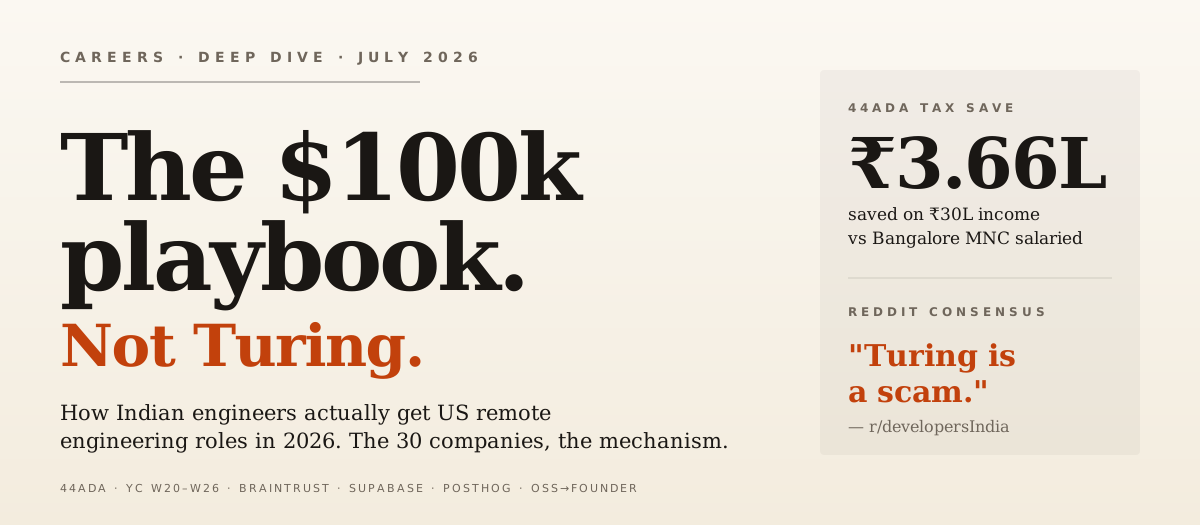
"On ₹30 lakh annual income, contractors using 44ADA pay ₹1,09,200 yearly tax versus ₹4,75,800 for employees—saving ₹3,66,600 annually."
— Kiran Johns, Remote Salary Guide
Section 44ADA is the Indian presumptive-taxation scheme for professionals. You declare 50% of gross receipts as taxable income, tax the remainder at your slab, and skip the audit. The enhanced limit is ₹75 lakh per year, provided cash receipts stay under 5% of total. On a $90k gross-receipts contract, this is a legal, direct way to compress your effective tax rate to roughly 3.6% of gross. The Bangalore-MNC comparison at the same income sits near 15.9%.
Everyone tells you to start an LLP for the "professional look". Skydo's Section 44ADA guide is explicit:
"Limited Liability Partnerships do not qualify. The document specifies the scheme applies to 'Individuals running their professional practice' and 'Partnership firms (but not Limited Liability Partnerships).'"
— Skydo, Section 44ADA guide
You form an LLP, you lose 44ADA. The r/developersIndia tax voices are equally direct.
"why do you need a 'company' ? you will loose out on a LOT of benefits. Taxes, slab rate, presumptive taxation, then there is the case of corporate compliance costs. I would suggest you use your own current account, your personal name/PAN and start working."
"you have to get GST registration once your 'sales' cross 20L in a year, once registered, get an LUT and start issuing invoices. That's it. You wont have to pay any GST, just this compliance of filing returns."
— u/Archiver_test4, r/developersIndia
| Structure | Tax on ₹30L | Complexity | Loan eligibility |
|---|---|---|---|
| Salaried (Bangalore MNC) | ₹4.76L (~15.9%) | Low | High |
| Contractor (44ADA sole prop) | ₹1.09L (~3.6%) | Low-medium (GST + LUT + FIRA) | Low (banks treat as unsalaried) |
| LLP | Doesn't qualify for 44ADA | High (audit, filings) | Medium |
Now the counterpoint you should understand from the employer's side. Every US startup thinking about hiring you evaluates two paths: contractor invoicing, or Employer of Record via Deel.
"Deel pricing in 2026 starts at $599 per employee per month for Employer of Record (EOR) services. The estimated employer cost is 13.1% of the employee's basic salary + INR 75, or INR 1,950 per month if electing for the fixed contribution for Provident Fund contributions. Markets with complex labor laws or work permit requirements like India carry surcharges of $50–$150/month above the base EOR rate."
— Deel, India hiring pricing
Roughly 40% total employer load once you stack platform fee + employer taxes + India surcharges. This is exactly why US startups quietly prefer contractor invoicing over EOR for solo Indian hires. It is cheaper for them AND better for you. The EOR route is designed for enterprise-scale India hires, not for a two-person startup adding its third engineer. When a founder offers you contractor terms, that is not them lowballing you. That is the tax code doing the negotiation for both sides.
The honest downsides
No LinkedIn post lists the trade-offs. Here they are.
"$30/hr sounds great until you realise they only need you for like 10 hours per week."
"In a contractor role it's difficult to do that but can work sometime. The other reason why contractor roles pay higher is because there are no further benefits attached and they can fire you anytime without notice. The initial contract term is 3 months and at the end of it, the contract may not get renewed. Finally if you ever fall into the home loan or car loan trap, contractor roles are not considered salaried positions for loan processing."
"10 years experience here with 15 LPA - lol | kudos to you ❤️"
— u/SaracasticByte + u/Boring-Bad2616, r/developersIndia
Loan eligibility is the underappreciated tax on this path. Indian banks read "contractor" as "unsalaried" and treat you like a small-business owner. If you want a home loan in your late 20s, your paperwork gets 3x harder. The founding-engineer weekend load is the other one:
"expect work in weekends as well, mine had 6 days work and that one day left was also not spared many times. no accountability from people at leadership. All f*ckups related to product will be your responsibility although leadership decisions caused it. coming to leadership, most of the time comprises of incompetent people who are there cause they are friends with CEO."
— u/Altair_malsure, r/developersIndia (12 upvotes)
And on timezone burn, from a Redditor watching colleagues do the US-hours grind: "time zone differences are real and I've seen my colleagues suffer because of it." This path has real costs. Isolation. Layoff exposure with 3-month renewal cycles. No loan eligibility. Sleep debt. No team culture that you can walk into a Bengaluru office and share. Name them. Do not sell the dream.
The Aravind Srinivas hook, and the 90-day build plan
Aravind Srinivas joined IIT Madras in electrical engineering. He tried to transfer into computer science and missed the GPA cutoff. He went to Berkeley, then OpenAI, then founded Perplexity, which Levels.fyi now benchmarks at $350k median SWE total compensation and which entered India in 2025 via a Bharti Airtel partnership. Two sentences about him and we move on. The point is not that IIT worked for Aravind. The point is that his EE grade let him down and the mechanism still delivered him a $20B company. Reputation built in public, at the level of research and shipped products, is the ladder. The IIT tag is not.
What that looks like as a 90-day plan, if you are a Y3 IIT student or a 0-3 YOE MNC dev reading this:
- Weeks 1–4. Pick ONE niche. Not "AI". A niche inside AI: video-world-models diffusion, or Postgres internals, or WASM runtimes, or quant infra, or Rust distributed systems. Find one OSS project used by 3+ YC startups you would work at. Read the last 100 commits. Understand the codebase's architecture at a whiteboard level. If you cannot draw the module graph on a napkin by end of Week 4, you have not picked a niche small enough yet.
- Weeks 4–8. Ship ONE non-trivial PR to that project. Not a typo fix. A feature, a bug hunt, or a benchmark comparison the maintainers have not run. Write one long-form technical post explaining a mechanism you now understand well enough to teach. Publish on your own blog, or on dev.to. Cross-post to two subreddits where the audience already cares.
- Weeks 8–12. Be visible. Join the project's Discord. Answer 5 issues a week. Reply substantively on 3 Hacker News threads that touch your niche. Then mail the founder of the startup whose product depends on your niche. One paragraph. Reference your PR, reference your post, name a specific problem you have noticed in their product. This is the founding-engineer line, and it is the line u/o_x_i_f_y described in one Reddit comment.
Ninety days does not guarantee a $120k offer. Ninety days puts you inside the mechanism. From there the compounding starts.
The Devin macro risk
One more thing to name before the closer. The junior-market ladder that used to absorb every fresh Indian engineer is under pressure.
"Infosys stated that experimentation with Devin over the past six months has resulted in material productivity gains, with projects traditionally viewed as time-intensive and manpower-heavy, such as complex COBOL migrations and JCP servlet modernisation, now being completed significantly faster. The announcement has fuelled concerns among early-career engineers who view the move as a potential signal of reduced demand for fresher hiring and junior developer roles."
— Storyboard18, Infosys × Cognition Devin rollout
The Bangalore MNC ladder that used to absorb every IIT, NIT, VIT and Manipal fresher is not going to look the same in 2027. Which makes the underground path more valuable, not less. The roles that survive AI code agents are the ones that require domain judgment. Those are exactly what the niche 30-company universe hires for. If you spend the next 90 days memorising the Striver sheet, you are optimising for a screening layer Devin already passed.
Closer
This is not a career post that promises anything. It is a shape. If the shape fits, if you would rather build reputation in public for two years than grind ₹18L to ₹28L to ₹42L on the campus-recruit ladder, then this is the playbook. If the shape doesn't fit, that is also fine. But now you know it exists and you cannot pretend you didn't.
The college kid on $100k via Discord is real. u/arasaka-man is real. u/o_x_i_f_y is real. Rauch's MooTools origin is documented. u/Mushroom_Large's GitHub project has 100 stars. This is not a pitch. It is a map. Do the walking yourself.
Last updated: 12 July 2026.