
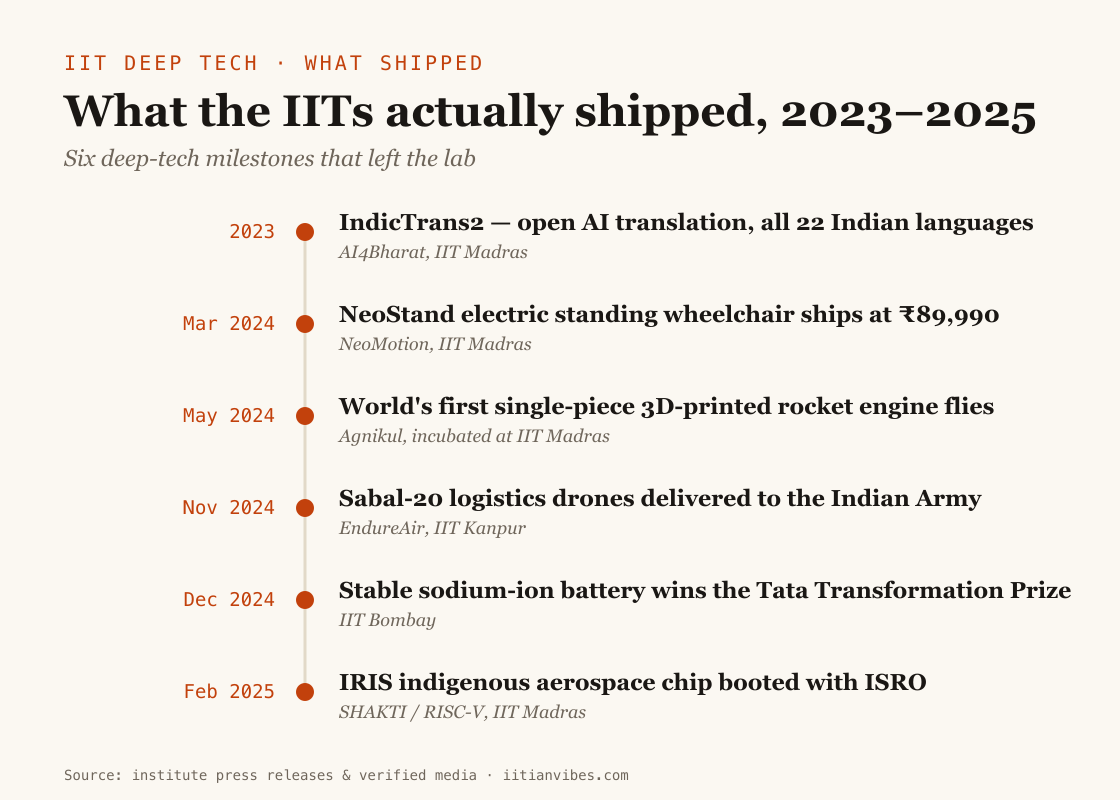
An IIT-incubated startup flew the world's first single-piece 3D-printed rocket engine; an IIT–ISRO team booted India's own aerospace-grade chip; and the AI that translates across all 22 official Indian languages was built at an IIT. Beyond the placement headlines, the IITs run a real deep-tech engine — and India's national missions in quantum, AI and semiconductors are routed straight through them. Below is who builds what, which IITs anchor the national missions, and an honest look at where IIT research still trails the world's best.
What deep tech are the IITs actually building?
Not slideware — shipped processors, launched vehicles, deployed devices. Here is who leads which domain, with one concrete recent milestone each.
| Domain | IIT | Lab / project | Recent milestone | Source |
|---|---|---|---|---|
| Semiconductors | Madras | SHAKTI (RISC-V) | IRIS aerospace chip booted with ISRO on SCL 180nm (2025) | Careers360 |
| Space | Madras | Agnikul (incubated) | Agnibaan SOrTeD — world's first single-piece 3D-printed engine flies (May 2024) | Wikipedia |
| AI — Indic languages | Madras | AI4Bharat | IndicTrans2: open translation across all 22 scheduled languages (2023) | AI4Bharat |
| AI — foundation models | Bombay | BharatGen | India's first govt-backed multimodal LLM initiative (2024) | DST |
| Quantum — communication | Madras | NQM T-Hub (+ C-DOT) | One of 4 national quantum hubs (2024) | DST |
| Quantum — sensing | Bombay | NQM T-Hub | Quantum fabrication facility inaugurated on campus (2024) | NewsOnAir |
| Quantum — materials | Delhi | NQM T-Hub | National quantum materials & devices hub (2024) | DST |
| Robotics / drones | Kanpur | EndureAir (incubated) | Sabal-20 logistics drones delivered to the Indian Army (Nov 2024) | Defense Post |
| Med-tech — mobility | Madras | R2D2 / NeoMotion | NeoStand electric standing wheelchair ships at ₹89,990 (2024) | IIT Madras |
| Med-tech — diagnostics | Delhi | Corosure | "World's most affordable" RT-PCR kit at ₹399 base (2020) | ThePrint |
| Clean energy | Bombay | Na-ion battery group | Stable sodium-ion chemistry wins Tata Transformation Prize (Dec 2024) | IIT Bombay |
Which IITs anchor India's national tech missions?
The country's biggest science bets run through a handful of IITs. The National Quantum Mission (₹6,003.65 crore, 2023–31) named four technology hubs — and three are at IITs: communication at IIT Madras, sensing & metrology at IIT Bombay, and materials & devices at IIT Delhi (the fourth, computing, is at IISc) (PIB). The IndiaAI Mission (~₹10,372 crore) is scaling shared GPU compute past 38,000 cards, with IIT-linked groups like AI4Bharat and Sarvam AI central to the sovereign-LLM effort (DST). And on the translational side, IIT Madras filed 417 patents in FY2024–25 — more than one per working day (IIT Madras).
Is IIT research actually world-class?
Honestly — strong, but not yet at the global frontier, and the data says so. In the Nature Index 2025 (which counts high-quality journal output), the top Indian academic institution is IISc, not an IIT; IIT Bombay is India's #2 and even saw its adjusted research share fall year-on-year (Nature Index). The IITs' teaching brand and global ranking prestige still outrun their frontier-research footprint. Where they genuinely excel is translation — turning research into shipped products and companies (the patent count, the 100+ startups a year out of IIT Madras alone). The honest summary: world-class at building and commercialising; still catching up on Nobel-tier fundamental science. Scholars debate this candidly too — see, for instance, an r/Indian_Academia discussion on how much independent research you actually get to do at an IIT.
The IITs are better at shipping technology than at topping journal-citation tables — and for a country building its own chips, rockets and AI, that may be the more useful strength.
How this is sourced
- Every milestone is a shipped or deployed thing — a flown vehicle, a delivered device, a booted chip — not a "researchers are working on" claim, each with a primary or credible source.
- Mission figures (NQM ₹6,003 cr, IndiaAI ₹10,372 cr) come from DST/PIB releases; some government pages block automated access, so verify the live page if you re-cite.
- The research-quality view uses the Nature Index 2025 (high-quality journal share), which is the fairest cross-institution measure of frontier output.
Last updated: June 2026. We refresh this as new milestones ship. Proud of the campuses building India's deep tech? See our IIT merch collection.