
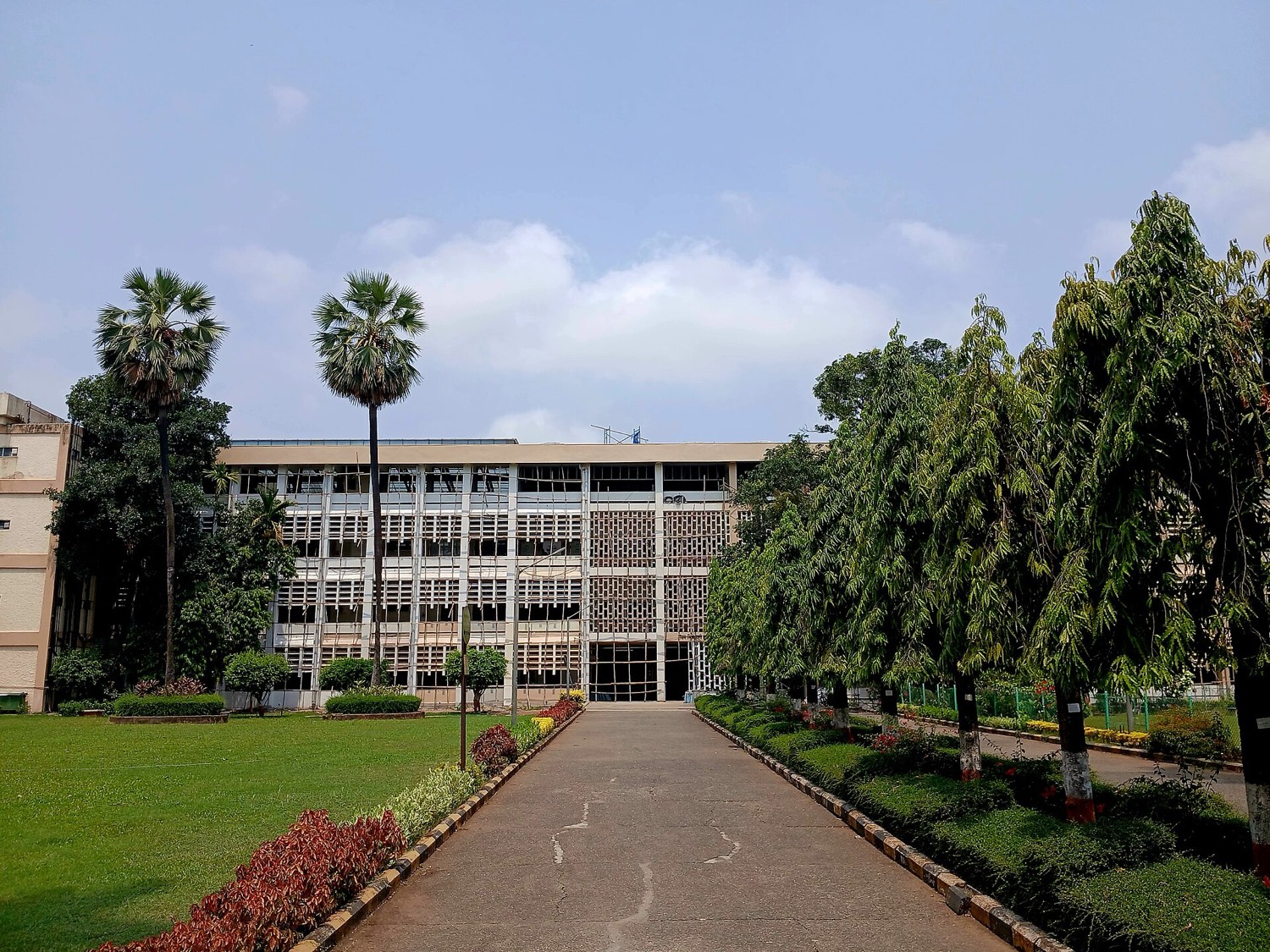
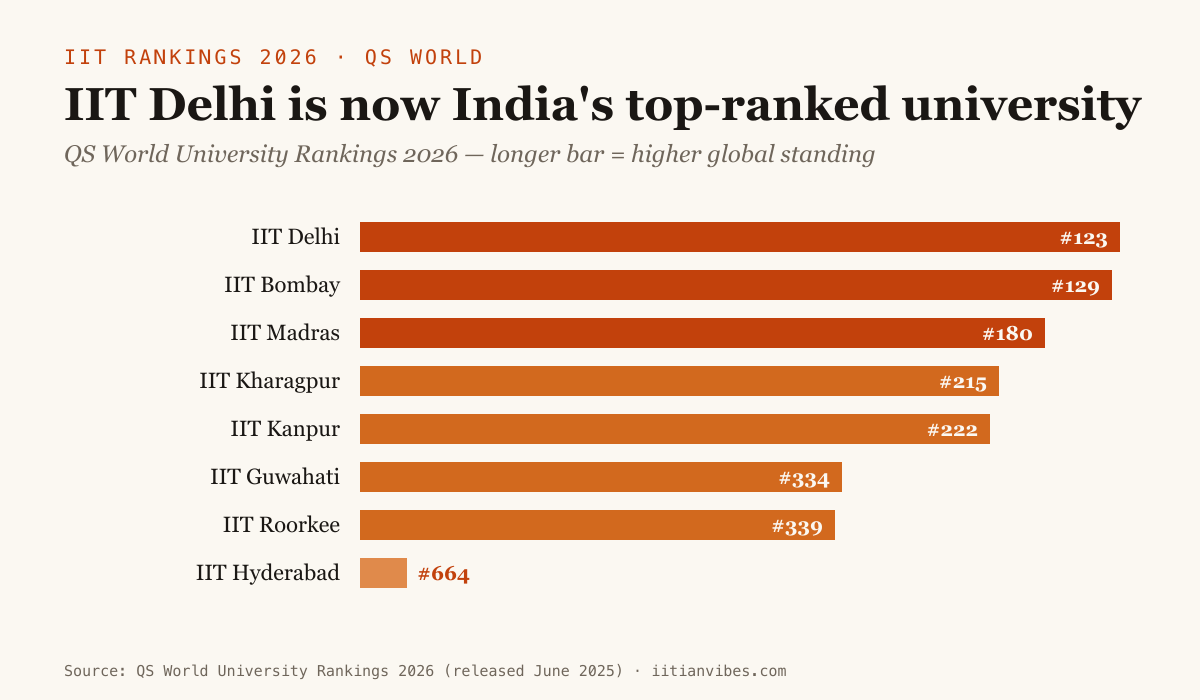
IIT Madras tops the NIRF 2025 engineering rankings for the tenth year running — but on the global QS World University Rankings 2026, IIT Delhi is India's highest-ranked institution at #123, its best-ever placement. Both statements are true, and that contradiction is the single most useful thing to understand about IIT rankings: the "best IIT" changes depending on which list you read. Below is the latest NIRF and QS data for the top IITs in one sourced table, why the two lists disagree, and what genuinely changed across the IITs in 2025–26 — from new campuses abroad to a first-ever penalty in how NIRF is scored.
Which is the best IIT in 2026?
There is no single answer, and anyone who gives you one is quoting just one ranking. On NIRF 2025 (the government's ranking, released 4 September 2025), the order is Madras, Delhi, Bombay, Kanpur, Kharagpur. On QS World 2026, it flips: Delhi (123) leads, then Bombay (129), then Madras (180). The table below puts both side by side, every figure sourced.
| IIT | NIRF 2025 rank | NIRF 2025 score | QS World 2026 | QS Asia 2026 | Source |
|---|---|---|---|---|---|
| Madras | 1 | 88.72 | 180 | 70 | Careers360 |
| Delhi | 2 | 85.74 | 123 | =59 | IIT Delhi |
| Bombay | 3 | 83.65 | 129 | 71 | Careers360 |
| Kanpur | 4 | 81.82 | 222 | =77 | Careers360 |
| Kharagpur | 5 | 78.69 | 215 | =77 | Careers360 |
| Roorkee | 6 | 75.44 | 339 | 114 | Careers360 |
| Hyderabad | 7 | 72.31 | 664 | — | NewsOnAir |
| Guwahati | 8 | 72.24 | 334 | 115 | Careers360 |
| (BHU) Varanasi | 10 | 67.24 | — | — | Careers360 |
| Indore | 12 | 66.65 | — | — | IIT Indore |
NIRF ranks are confirmed across multiple reports and institute pages; scores are as reported for NIRF 2025 (the official NIRF portal was unreachable at publication, so scores should be treated as reported figures, not portal-verified). QS Asia 2026 ranks shown where available. NIT Tiruchirappalli (#9) is excluded as a non-IIT.
Why does IIT Madras top NIRF but IIT Delhi top QS?
It's the scoring method, not a real disagreement about quality. NIRF weights teaching, learning & resources, research, graduation outcomes (placements), outreach and perception — much of it India-specific and data the institute submits. QS weights global academic and employer reputation surveys, international faculty and student ratios, and citations per faculty — areas where IITs structurally lag global peers. So IIT Madras can be India's clear #1 domestically while sitting third among IITs globally, behind Delhi and Bombay. Read the ranking that matches what you actually care about — domestic placements and resources (NIRF) or global research reputation (QS).
The same IIT can be #1 in India and #180 in the world in the same year. The ranking didn't change — the question did.
What's changed at the IITs in 2025–26?
The biggest story is internationalisation, alongside a quieter shake-up in how the IITs are ranked and admitted to.
- IIT Delhi–Abu Dhabi is expanding. It adds Electrical Engineering from AY2026–27 — a fourth undergraduate programme alongside CSE, Energy and Chemical Engineering — with its CAET entrance test held in November 2025 (IIT Delhi).
- IIT Madras Zanzibar opened its fourth-batch admissions for 2026, inaugurated a new hostel block at its permanent Fumba campus, and reported 100% placement for its 2025 M.Tech batch (IIT Madras).
- IIT Madras launched "IITM Global" in January 2026 — a research foundation, unveiled by External Affairs Minister S. Jaishankar, aimed at making it the world's first multinational university (Careers360).
- NIRF is adding negative marking for retracted research papers from its 10th edition — the first penalty mechanism in NIRF's history, meant to curb research gaming (Careers360).
- JEE Advanced 2026 raised fees for foreign candidates (US$150 → US$200), with only two overseas centres (Abu Dhabi, Kathmandu); Indian candidates' fees are unchanged (Careers360).
- Movement inside the top 8: in NIRF 2025, IIT Hyderabad rose to #7 and overtook IIT Guwahati (#8), while IIT Indore jumped from #16 to #12 (IIT Indore).
Can a "lower-ranked" IIT beat the famous ones?
On the right subject, yes — and it's the most underused fact in the whole ranking conversation. In the QS World Rankings by Subject 2026, IIT (ISM) Dhanbad ranks 21st in the world in Mineral & Mining Engineering — India's best in that field and far ahead of where Dhanbad sits on any overall list (NewsOnAir). IIT Delhi, meanwhile, leads India with six top-50 subject entries and IIT Madras with four (Careers360). For a specific branch, the overall pecking order can mislead — check the subject table before you decide a campus is "lower-tier."
Do these rankings actually matter? What students say
Student communities are openly skeptical, and not without reason. On r/Btechtards a widely-read thread simply asks "are nirf rankings reliable or no"; others go further — "Is NIRF ranking a scam??" and "NIRF ranking being extremely inaccurate." The substance behind the skepticism: NIRF is computed largely from self-reported, unaudited data institutions submit themselves, which favours those good at presenting numbers (Scroll.in) — exactly the gap the new negative-marking rule is trying to close. The practical takeaway students keep landing on: for a specific goal, branch and peer cohort matter more than a one- or two-place difference in any overall ranking.
How to use these rankings (and how this is sourced)
- Match the list to the question. NIRF for domestic teaching/placements/resources; QS/THE for global research reputation and international exposure.
- Check the subject table, not just the overall. A campus outside the top 10 overall can be world-class in one branch.
- Editions matter. Figures here are NIRF 2025 (released 4 September 2025) and QS World/Asia 2026. Note that QS World 2027 has since been released (18 June 2026), moving IIT Delhi to #118 — see our QS 2027 breakdown for the current table. NIRF India Rankings 2026 had still not been released as of August 2026.
Last updated: June 2026. Rankings are NIRF 2025 and QS 2026 editions. Hero photo: IIT Bombay Main Building by Shishirdasika, CC BY-SA 4.0, via Wikimedia Commons. Want to rep your campus? See our IIT merch collection, including IIT Delhi and IIT Bombay gear.