
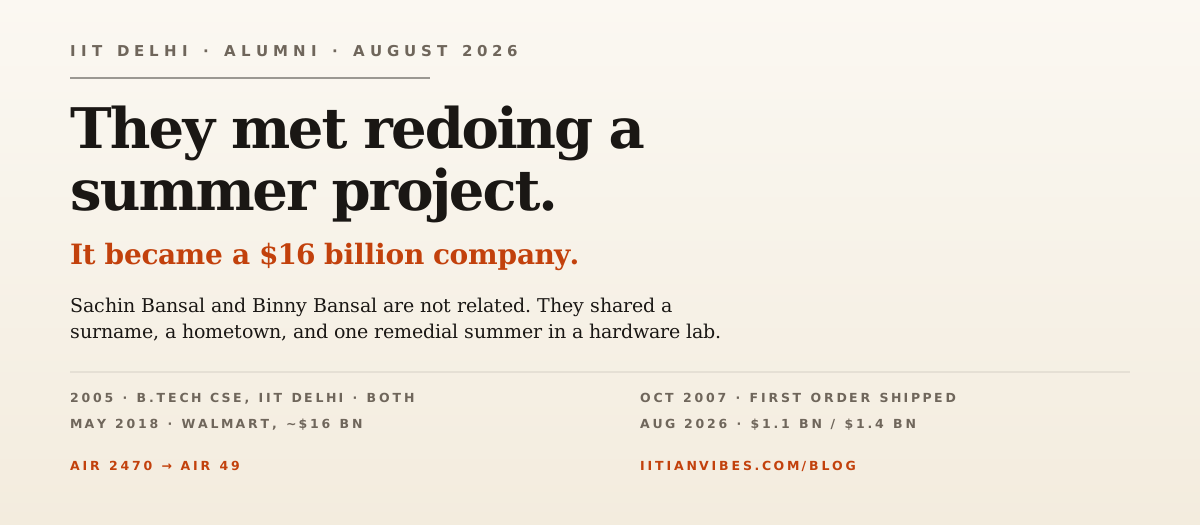
Profile · IIT Delhi · August 2026 · The two men who built Flipkart, and what happened to them after they left it.
The summer of 2005, in a hardware lab at IIT Delhi. Two final-year computer science students were redoing project work they had not scored well enough on the first time. Neither of them wanted to be there. One was 24, the other 23. They shared a surname and a hometown, and until that summer they had barely spoken, because one had joined a year ahead of the other. Two years later they started a bookstore out of a flat in Koramangala with two computers and their own savings. Eleven years after that, Walmart paid approximately $16 billion for approximately 77 percent of it.
This is the story of Sachin Bansal and Binny Bansal, who are not brothers, not cousins, and not related in any way. It is also a story about what happens after you win.
2470, then 49
On 29 May 2000, the Chandigarh Tribune ran its annual round-up of local students who had cracked the IIT-JEE. Fourth on the list was a boy who had sat the exam twice.
"The fourth on the list is Sachin Bansal, who gave the test for the second time in order to improve his rank," the paper reported on 30 May 2000. "Happy at the 49th position this time, he told us, 'Last time, I was ranked 2470. It was then that I regularised my schedule even more. It took me a lot of hard work and a steady study schedule.'"
AIR 2470 to AIR 49, on the second attempt. The piece does not identify him as a future anything, because in May 2000 he was a 19-year-old from Chandigarh who had improved his rank by roughly 2,400 places. The identification rests on the name, city and year lining up, and it is the same contemporaneous record Wikipedia cites.
Binny Bansal's JEE rank has never been published anywhere credible, and this piece is not going to invent one. What is on record is his own account: he described himself as "passionate about sports, and okay in studies," and said he was "lucky" to get into the Computer Science Department at IIT Delhi.
The year Sachin lost to Quake
Here is a fact that almost every account of Flipkart gets muddled, and it is worth slowing down for.
IIT Delhi's own alumni records state that Sachin Bansal received his B.Tech in Computer Science and Engineering in 2005, and that Binny Bansal received his B.Tech in Computer Science and Engineering in 2005. Same degree, same branch, same year. Business Standard and Mint both called them classmates. But Accel's write-up of Binny's first podcast interview after leaving Flipkart says Sachin was "a year senior to him."
Both are true, and Binny explained why himself at an event in 2018.
"Right from college days, Sachin was a big gamer," he said. "He actually took one more year to complete his degree because he was gaming too much. He joined one year before me and passed out with me."
So: Sachin entered in 2000, which is exactly what the Tribune's JEE record implies, and took five years. Binny entered in 2001 and took four. They graduated together in 2005. Senior by admission, classmates by graduation. Every age datapoint fits, including the 24 and 23 reported for that summer, and the 45 and 43 that Forbes lists today.
It also explains why they only met at the end. They were not in the same classes for four years. They met because both had to spend a summer at the FPGA hardware lab to improve their project scores. India's largest home-grown e-commerce company exists because two students had to redo coursework.
On the campus itself, Binny remembered the hostels more than the classrooms. "IIT Delhi has a unique hostel culture," he said. "You were more loyal to your hostel than your department, course or batchmates. The rivalry between the different hostels was intense, and played out during sporting events, and cultural shows." IIT Delhi's Jwalamukhi Hostel counts the founders of Flipkart among its alumni, though its page names neither man individually, so which of them lived there is not something this piece will assert.
Rejected twice, bored in two months
Binny graduated into Sarnoff, a computer vision research outfit, in 2005. He lasted about a year, and left for a reason that reads like an engineer's audit rather than a founder's origin myth.
"In like a year, I kind-of realised that the work is great and the learning on our technology is great but Sarnoff is never going to be great business because the solution is just not ready for application, so they will never be able to make money," he said.
He then interviewed at Google. Twice. He did not get in either time.
"Next best option was Amazon, and within two months I was bored," he said. "The work was boring, and I was doing much more interesting stuff at Sarnoff. That's when I thought why not start something?"
Sachin had joined Amazon about a year earlier, and referred Binny in, collecting a referral bonus for it. Binny quit after eight months, which meant Sachin had to pay the bonus back. "He is still bitter about that," Binny said in 2018, eleven years later.
What Binny said about the decision to leave inverts how most people describe it: "Working within Amazon looked very risky, as against doing something on my own. A safe job looked way riskier than actually getting your hands dirty and learning something."
One note on what you will read elsewhere. Many profiles say Sachin worked at a firm called Techspan and then joined Amazon Web Services. That traces to a single low-authority blog cited by Wikipedia, no major outlet carries it, and the AWS detail is almost certainly wrong, since AWS launched in 2006 as a US cloud unit. It is not repeated here.
There was no point comparing bad companies
The first idea was not a bookstore. It was a price comparison engine, which is the obvious thing for two engineers to build.
"For two people who know how to code, the easiest thing to do is write code to compare different websites that are selling stuff, and send people to the lowest price or something like that," Binny said. "But, when we started building that out, we saw all ecommerce companies that existed at the time were very bad. There was no point in comparing bad companies."
So they built one instead. The naming process was governed entirely by cost. "As we did not have the money to buy a great domain name, we wanted the cheapest Rs 500 domain name," Binny said, "hence Sachin came up with the rules: it should not be more than eight characters as it becomes difficult to type, it should sound cool, make the brand stand out, and be available for cheap." They shortlisted eight to ten names. Flipkart, with a K, was available.
On the founding capital, the figure you will see everywhere is ₹4 lakh, ₹2 lakh from each of them. Forbes India used it as recently as February 2026. Inc42 used it too, while openly describing it as a tale that "has been told and retold numerous times," which is a fair description of how it has travelled.
Binny's own number is larger. "The co-founders started Flipkart with their savings of Rs 7-8 lakh," he said, putting his personal share at ₹4-5 lakh. Two outlets repeating ₹4 lakh is repetition, not corroboration, and the founder's own account is the better source. What is not in dispute is how little they spent: "Initially when we started, we had to be very frugal. Our monthly operating cost was Rs 15,000-20,000." Their parents sent ₹10,000 a month for roughly 18 months. Flipkart did not raise outside money for its first two years.
The last copy in Bangalore
In late October 2007, a man named V V K Chandra in Mahabubnagar, in what was then undivided Andhra Pradesh, wanted John Wood's memoir Leaving Microsoft to Change The World. No shop near him had it. He found Flipkart because, beneath one of his posts online, a user identifying himself as Sachin had left a comment with a link.
That became the first real order in Flipkart's history, and by the company's own account it nearly did not get fulfilled. "We looked for the book for two days across 50 bookstores in Bangalore and even called up a few in Delhi and Mumbai," Binny recalled. He found it at Sapna Book Store in Indiranagar. It was the last copy and it was not in good shape: "The pages were yellowish but thankfully they were not torn." He arrived at five in the evening, soaking wet, and realised he had left his wallet behind. "I borrowed money from one of my roommates to pay for the book."
They asked the customer whether he would accept a battered copy. Binny quoted the reply: "I have been searching for this book for three-four years and if I can read it, send it to me. I don't care about the condition."
The order shipped on 31 October 2007. The first of November is Kannada Rajyothsava, a state holiday in Karnataka, so it reached Mahabubnagar on 2 November. A precise timestamp for this order circulates online, down to the second. It appears in no credible source and is not used here.
One detail says everything about 2007: the customer paid in dollars, through PayPal, because Flipkart had no payment gateway. "We were first wondering how did anyone find Flipkart, and had the guts to pay online in dollars," Binny said.
By the year ending 31 March 2010, filings with the Registrar of Companies showed Flipkart Online Services Private Limited earning ₹11.61 crore against a loss of ₹91.27 lakh. It bought 2,34,934 books that year and sold 2,25,847 of them. A twelve-crore book business, losing under a crore.
Why Flipkart had to become UPS as well as Amazon
The single best explanation of what made Flipkart hard came from Bloomberg in 2014, and it is a chain of consequences rather than a strategy.
"In 2007, when Indian software engineers Sachin Bansal and Binny Bansal were starting their online bookstore Flipkart.com out of a two-bedroom apartment, they faced a challenge Amazon.com founder Jeff Bezos never had: how to collect payment," Bloomberg wrote. "At first the two, who aren't related, accepted credit cards, but because few Indians use them, they needed a way to conduct e-commerce in cash. Payment-on-delivery was the obvious solution, but Flipkart didn't want third-party couriers to carry large quantities of its money. So in 2010 the company decided to remake itself as a version of both Amazon and United Parcel Service."
Cash on delivery was not a growth hack. It was the only way most Indians could pay. And once you are collecting cash at the door, you cannot hand it to someone else's courier, so you build your own logistics arm. That arm became Ekart. India had no standardised street addressing either. Flipkart's former logistics VP Ashok Banerjee put it plainly in the same piece: "You cannot leave anything outside the door, because it will just disappear."
By June 2011 Flipkart had raised $31 million in total, and Sachin was already naming logistics as the defence against a competitor who had not yet arrived. "It's not easy to build the infrastructure in India that we've established over the past few years," he told TechCrunch.
Amazon India launched in 2013.
Twenty-four hours in July 2014
In March 2014, Flipkart crossed $1 billion in annual gross merchandise value, a year ahead of its own forecast. In an internal note, the founders said it represented 100x growth since March 2011, when the company was doing around $10 million.
Then came two days that defined the decade.
On 29 July 2014, Flipkart announced it had raised $1 billion, led by Tiger Global and Naspers, at a reported $7 billion valuation. It was the largest round in Indian startup history. The company announced it on Twitter: "Massive milestone for us… we have raised $1 billion in fresh funding. Huzzah!"
The next morning, Amazon said it would invest $2 billion in India. Double, within 24 hours. "At current scale and growth rates, India is on track to be our fastest country ever to a billion dollars in gross sales," Jeff Bezos said.
Flipkart had 22 million registered users and was shipping five million items a month. It had bought Myntra in May for a price never officially disclosed, reported at close to $300 million, and committed another $100 million to it. And it was now in a spending war with the richest e-commerce company on earth.
"Yesterday, we failed that trust"
Ten weeks later, Flipkart ran Big Billion Day on 6 October 2014. The date was chosen for sentimental reasons and marketed that way: flat 610 in Koramangala was where the two of them had started, so the sale ran on 6.10.
It hit its 24-hour target of $100 million in GMV in ten hours. A billion hits landed on the site. And it broke, publicly, in front of 1.5 million shoppers. Prices reverted to undiscounted rates for hours. Deals sold out in seconds. Orders were cancelled after being taken. The site went down repeatedly. Snapdeal ran a front-page newspaper ad the same morning mocking the discount claims, and bigbillionday.com redirected to Amazon India.
The next day the founders sent customers a letter. It is the most striking document in Flipkart's history, and it is worth reading as they wrote it.
"Yesterday was a big day for us. And we really wanted it to be a great day for you. But at the end of the day, we know that your experience was less than pleasant. We did not live up to the promises we made and for that we are really and truly sorry. […] we have worked very hard over the last seven years to earn your trust. Yesterday, we failed that trust. […] We had deployed nearly 5000 servers and had prepared for 20 times the traffic growth, but the volume of traffic at different times of the day was much higher than this."
Sachin and Binny, 7 October 2014
Five thousand servers, provisioned for twenty times normal traffic, and it was not close to enough.
From $15.2 billion to $5.58 billion
The peak came in 2015. Then the mutual funds that held Flipkart stock started writing it down, quarter after quarter.
By May 2016, four US mutual funds had cut their marks, and Flipkart's value had eroded from $15.2 billion to a little over $9 billion. Sachin, by then Executive Chairman, was dismissive: "I do not think anyone's valuation has changed just because somebody or small shareholders of these companies have changed their opinion."
It kept going. By November 2016, Morgan Stanley's sixth consecutive markdown valued its holding at $52.13 a share, against $142.24 in June 2015, implying a company worth $5.58 billion. Buried in that same report is a detail that ages beautifully: Walmart had already walked away from a $1 billion round over a valuation disagreement. Eighteen months later it would pay sixteen times that.
In September 2016 Flipkart announced 100 million registered users. The same article undercut the milestone: the figure excluded Myntra and Jabong, the company would not disclose monthly active users, online sales had fallen 19 percent in the January to March quarter, and Amazon was reported to have overtaken Flipkart on value of goods sold that June and July. The milestone and the erosion were announced in the same week.
"Sadly my work here is done"
In January 2016, Binny became CEO and Sachin became Executive Chairman. A year later, in January 2017, Kalyan Krishnamurthy became CEO. He had joined from Tiger Global, Flipkart's largest shareholder, seven months earlier. He was the first person to run Flipkart who had not founded it.
On 9 May 2018, Walmart announced the deal. The press release, filed with the SEC, listed the shareholders who would remain: "Flipkart co-founder Binny Bansal, Tencent Holdings Limited, Tiger Global Management LLC and Microsoft Corp."
Sachin Bansal's name is not on that list. That absence is how his exit was announced. He held about 5.5 percent, and estimates of what he received range from $800-850 million to around $1 billion. Walmart never disclosed per-shareholder proceeds, so the honest answer is that nobody outside the deal knows.
He never issued a formal statement. What exists is a Facebook post the next day.
"Sadly my work here is done and after 10 years, it's time to hand over the baton and move on from Flipkart," he wrote. "But I'll be watching and cheering from the outside." He said he would take time off, finish some personal projects, "catch up on gaming (and see what kids are playing these days) and brush up on my coding skills."
No reason. Ten years, and the explanation is "sadly my work here is done."
Binny stayed on as group CEO. The deal closed on 18 August 2018. Six months later he was gone too.
On 13 November 2018, Flipkart and Walmart stated that Binny Bansal had resigned following an independent investigation into an allegation of serious personal misconduct, that he strongly denied the allegation, and that while the investigation "did not find evidence to corroborate the complainant's assertions against Binny, it did reveal other lapses in judgement, particularly a lack of transparency." In his own email to staff, seen by the BBC, he said: "The allegations left me stunned and I strongly deny them."
He sold his remaining stake in 2023, alongside Tiger Global and Accel, in a round of transactions that valued Flipkart at $35 billion, and left the board on 27 January 2024. "I am proud of the Flipkart Group's achievements over the past 16 years," he said. "I have decided to step aside, knowing the company is in capable hands."
Bangalore and Singapore
Eight years on, the two men have diverged in a way that is almost too neat.
Sachin stayed in Bangalore and started again. Navi, founded in 2018 with his IIT Delhi batchmate Ankit Agarwal, is a lending, insurance and UPI business. He applied for a universal banking licence through Chaitanya India Fin Credit and the RBI rejected it on 17 May 2022, without giving a reason beyond the applicant not being "found suitable." He said there would "potentially be an appeal process." There is no public record of one since.
Navi's numbers are genuinely mixed and worth stating precisely, because most coverage picks one half. In the year to March 2026, revenue was about ₹3,091 crore and the net loss widened to roughly ₹466 crore, against ₹126 crore the year before. The company also says it reached consolidated profitability in the fourth quarter. Both are true. On 19 August 2026, Navi raised $100 million from Prosus, its first institutional capital in eight years, at about $1.3 billion. It had sought roughly $2 billion in 2024.
On the IPO, be careful what you read. Navi has not filed a current prospectus. It has hired four banks and is targeting a filing by December 2026 for around ₹3,000 crore. The SEBI-approved draft prospectus still cited in many articles is the 2022 one, which was deferred and then abandoned.
Binny moved to Singapore. Forbes lists his residence there and his citizenship as Indian. He runs 3State Ventures, a privately funded investment firm backed largely by his own capital, which has put $14.35 million into OppDoor, a cross-border commerce platform, per Singapore regulatory filings. In March 2025 he launched Opptra, which helps consumer brands enter Asian markets. He has given no substantive on-record interview since.
And then the part that undercuts every lesson anyone wants to draw from this. As of 24 August 2026, Forbes puts Sachin Bansal at $1.1 billion and Binny Bansal at $1.4 billion. The one who left in 2018 and has built nothing at Flipkart's scale since is worth more than the one who stayed in India and spent eight years building a bank that the RBI would not license.
What students actually say
The Bansals are treated as founding myth in Indian startup writing. On Reddit, where nobody is pitching anyone, the tone is sharper.
When Sachin described Navi's culture as 80 to 100 hours a week with no work from home, the most upvoted response in the r/developersIndia thread, with 777 votes, was u/weird_indian_guy: "work like the founders without having benefits of it? nah man."
The most useful comment in that thread, at 71 votes, drew the actual lesson. "If you ever have to work this hard, make sure it's for your own company," wrote u/TribalSoul899 on 2 April 2024.
On the sale, r/india was reading the cap table rather than the press release back in November 2018. "The Bansals had their run at their company, but the new owners don't want to have them running the business anymore," wrote u/ishmael99. "In the end, Bansals turned out to be mere pawns in the company they founded."
The day the exit was announced, the top-voted reaction in r/india, at 144 votes, measured it against the country rather than against other founders: "He is now wealthier than 5 average Indian MPs combined," wrote u/whatshappeningman. Someone in the same thread predicted Walmart would sell Flipkart back at a tenth of the price. Eight years on, Walmart still owns it, and it was valued at $35 billion in 2023.
The warmest thread is about money going the other way. When the two of them put ₹125 crore into IIT Delhi's endowment fund in October 2019, u/pizzafapper wrote: "This is why IIT's put out good research, because their alumni network is so strong and comes back to give back to the university." The top comment kept it in proportion: "It's a start, but we need to get to the 1 lakh crore rupees level before it starts being significant."
The record, with sources
| Date | What happened | Source |
|---|---|---|
| 29 May 2000 | Sachin Bansal, Chandigarh, AIR 49 in IIT-JEE on second attempt (previously 2470) | The Tribune |
| 2005 | Both receive B.Tech, Computer Science and Engineering, IIT Delhi | IIT Delhi Alumni |
| Oct 2007 | Flipkart launched; first order shipped 31 Oct, delivered 2 Nov | Flipkart Stories |
| FY2009-10 | Revenue ₹11.61 crore, loss ₹91.27 lakh, 2,25,847 books sold | RoC filings via Medianama |
| 29 Jul 2014 | $1bn raised at a reported $7bn valuation | TechCrunch |
| 30 Jul 2014 | Amazon commits $2bn to India, one day later | TechCrunch |
| 6-7 Oct 2014 | Big Billion Day; $100m GMV in 10 hours; public apology letter | YourStory |
| Nov 2016 | Morgan Stanley's sixth markdown implies a $5.58bn valuation | Business Standard |
| 9 May 2018 | Walmart to pay ~$16bn for ~77%; Sachin absent from continuing shareholders | Walmart, SEC |
| 13 Nov 2018 | Binny Bansal resigns; denies allegation; investigation did not corroborate it | Walmart, SEC |
| 27 Jan 2024 | Binny Bansal exits the Flipkart board | Business Standard |
| 19 Aug 2026 | Navi raises $100m from Prosus at about $1.3bn | TechCrunch |
What an IIT student can actually take from this
Not "follow your dreams." Five things that are specific to how this actually happened.
The rank is a door, not a verdict. Sachin went from AIR 2470 to AIR 49 by sitting the exam again, and then took five years to finish a four-year degree because he was playing too much Quake. Neither fact predicted anything.
Build for the constraint nobody else has to solve. Cash on delivery existed because Indians did not use credit cards. Ekart existed because you cannot hand your own cash to someone else's courier. Amazon had no equivalent problem, which is exactly why solving it was worth something.
Kill your first idea quickly. The plan was a price comparison engine. It died in weeks because, as Binny put it, there was no point comparing bad companies. The pivot took days, not a funding round.
Frugality is a hiring signal, not a virtue. ₹15,000-20,000 a month in operating costs, ₹10,000 from their parents, no outside money for two years. Binny's own advice: "Very frugal in the early days sets the right culture, the right mindset, going forward."
Nobody, including your first investor, can see the ceiling. Accel's Subrata Mitra, who wrote Flipkart's first cheque, said in August 2026 that a $200 million outcome would have made everyone happy at the time. "We went through 200 like that and nobody even looked back." Walmart paid eighty times that number. Mitra's other line is the one to keep: "I haven't seen one company that has gone straight up. Up and to the right. Not one. If somebody is telling you that, most likely lying."
In March 2026, Binny Bansal returned to campus for the opening of an exhibition hall with his name on it, on the ground floor of IIT Delhi's Main Administrative Building. "IIT Delhi is where it all began for me," he said. "I hope this exhibition hall becomes a space where students dare to imagine the future, showcase their ideas, and realise that the next great company or invention can begin right here on this campus."
It began, for him, in a summer lab session he was there to redo.
Wearing your campus is its own kind of alumni network. Our IIT Delhi hoodies are made for the people still on campus, and the ones who never quite left.
Last updated: August 2026.