
IIT News · Week 27 · 29 Jun – 5 Jul 2026
Seven of the 23 IITs made real news this week, and every one of them was about building outward rather than inward. Kharagpur graduated its Platinum Jubilee cohort. Bombay launched an entirely new engineering discipline in response to a new law. Delhi demonstrated indigenous surveillance kit and threw open its Abu Dhabi campus to UAE schoolchildren. Madras marked five years of a translational-tech vehicle that has now incubated 58 startups. Kanpur ran a hackathon to pick its first Bachelor of Cybersecurity batch. JoSAA finished Round 2 and cut the withdrawal window open. Four IIT-alumni startups closed funding rounds. Here's what actually shipped between 29 June and 5 July.
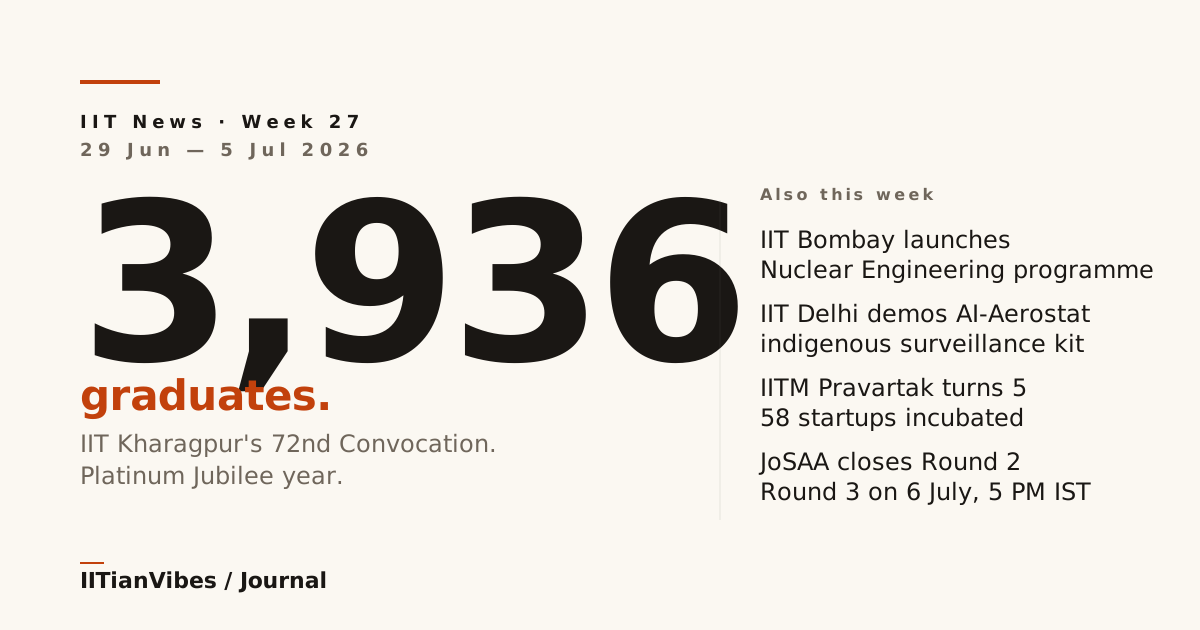
Deep dive: Kharagpur graduated 3,936 in its 72nd Convocation, Platinum Jubilee year
On Saturday, 4 July 2026, IIT Kharagpur held its 72nd Convocation — the ceremonial anchor for its Platinum Jubilee Year, marking 75 years since India's first IIT began teaching in 1951. Union Minister of State for Development of North Eastern Region and Education, Dr. Sukanta Majumdar, was chief guest. 3,936 students received degrees. Director Prof. Suman Chakraborty framed the event in the pre-convocation press briefing as "another important milestone in the glorious journey of India's first IIT" (Amader Bharat, Bengali wire, 3 July).
| Metric | Value |
|---|---|
| Convocation number | 72nd |
| Date | 4 July 2026 (Saturday) |
| Graduates | 3,936 |
| Chief Guest | Dr. Sukanta Majumdar, Union MoS (NE Region + Education) |
| Director | Prof. Suman Chakraborty |
| Year context | Platinum Jubilee (75 years of IIT Kharagpur) |
The ceremonial mood collided with a running low-frequency complaint from the KGP student body. Same week, on r/iitkgp, a third-year student posted: "The current scenario of KGP is getting out of hand.. Freshers getting their days postponed.. subject registration is nowhere to be seen.. Deans are playing games with Hall allotment .." (r/iitkgp, 3 July). Whether that is administrative overload during a Platinum-year event calendar or a structural issue, KGP's undergraduate reporting timeline and hall-allotment mechanics have publicly surfaced in the same week as the biggest convocation in the institute's history. Convocations are a lagging indicator of an IIT's decade; freshman-year logistics are a leading one.
For context on why this matters commercially: Kharagpur is currently the highest-revenue IIT for institute-branded merchandise across all 23 IITs, both by unique buyers and by average order value over the last 90 days — a small commercial signal that maps loosely to alumni engagement heat. See the IIT Kharagpur collection →
1. IIT Bombay launches a Nuclear Engineering Programme under the SHANTI Act
On 2 July, IIT Bombay launched a Nuclear Engineering Programme through its Green Energy and Sustainability Hub (GESH), the institute's coordinating body for clean-energy academic and research work. The programme was framed by Director Prof. Shireesh Kedare as a direct response to the SHANTI Act 2025, which opened Indian civil nuclear activity to private and academic participation. Kedare's line, carried through the press release wire: "The SHANTI Act has created the conditions for scale, innovation and wider participation." (Free Press Journal, 2 July; also on IIT Bombay press releases).
The programme is funded in part by a donation from an IIT-Bombay Hostel 4 alumnus, per the secondary coverage. This is one of the first Indian academic units set up specifically to take advantage of the post-SHANTI regulatory regime — worth watching as a signal for how quickly other IITs move into the same space over the next 12 months.
2. SBI Life signs MoU with IIT Bombay to build an insurance-sector AI & Cyber hub
Alongside the nuclear launch, IIT Bombay signed an MoU with SBI Life Insurance on 30 June to establish "Bharat's AI & Cyber Innovation Hub for Insurance" — a joint research centre focused on AI, cyber security, and quantum technologies for the insurance sector (The Tribune, 30 June).
Signed on the institute side by Prof. S.V. Kulkarni (Dean of R&D) and Vishal Bhatia (CIDO, SBI Life), witnessed by Director Prof. Kedare. Notable because Indian insurance-sector cybersecurity is one of the least academically-studied verticals despite being critical infrastructure, and because the framing — Bharat's AI & Cyber Innovation Hub for Insurance — reads as an attempt to plant a defensible academic flag before the sector consolidates around commercial vendors.
3. IIT Delhi demos indigenous AI-Aerostat surveillance system
Also on 2 July: IIT Delhi publicly demonstrated an AI-enabled tethered Aerostat surveillance system — an indigenous aerospace and surveillance capability built through a collaboration between academia, industry and deep-tech startups. The institute's own press language: "a significant step towards strengthening India's indigenous aerospace and surveillance capabilities" (IIT Delhi press, 2 July).
An Aerostat is a tethered lighter-than-air platform — cheaper than a satellite pass, longer-loitering than a drone, and useful for border and infrastructure monitoring. Adding indigenous AI to the sensor payload is the interesting part; it's the kind of programme that quietly becomes a strategic export five years later.
4. IIT Delhi's mPragati opens a CNC + Sterilization & Packaging Lab with ICMR DG as chief guest
The next day (3 July), IIT Delhi inaugurated a new CNC and Sterilization & Packaging Lab at mPragati, its national translational platform for medical device and diagnostics innovation. Chief guest: Dr. Rajiv Bahl, Director General of ICMR and Secretary of the Department of Health Research (IIT Delhi press, 3 July).
Medical devices are the quietest of India's manufacturing-import bills. mPragati is one of the more serious institutional attempts to change that from the design end. Having the ICMR DG inaugurate the facility is a signal that the government wants this pipeline to keep clearing — Delhi is the first IIT to build translational capacity at this depth in the medical devices space.
5. IIT Delhi–Abu Dhabi launches Al Ibtikar, its first outreach programme, with UAE schoolchildren
Third IIT Delhi story of the week: the Abu Dhabi campus launched Al Ibtikar ("innovation" in Arabic), its flagship school-outreach programme, via a three-day residential AI & Innovation Bootcamp scheduled at IIT-Delhi Abu Dhabi 6-8 July (Khaleej Times, 3 July).
An IIT foreign-campus running a school-outreach programme for local UAE students is a small event with a large strategic tell: Indian institutes overseas are now moving one grade down the funnel, competing for local schoolkids the same way IITs at home have always competed for JEE tops. The three-day residential format signals a serious feeder-pipeline intent, not a one-off marketing bootcamp.
6. IITM Pravartak marks 5 years — 58 startups incubated, 20 graduated, 23 commercialised
On 3 July, IIT Madras's DST-funded Technology Innovation Hub — IITM Pravartak Technologies Foundation — celebrated five years with a "Pravartak Impact Day" (India Education Diary, 3 July).
Cumulative numbers as reported: 58 startups incubated, 20 graduated out of the programme, 23 commercialised — decent conversion rates by Indian government-funded innovation-hub benchmarks. CEO Dr. M. J. Shankar Raman: "Technology has meaning only when it creates impact. Over the last five years, our endeavour has been to bring together academia, industry, government and startups to build capabilities that serve the Nation." Pravartak's next five years will be more usefully measured by the exit outcomes of those 23 commercialised startups than by new incubation counts.
7. IIT Kanpur picks first B.Cyber cohort via hackathon-format admissions test
Not through JEE Advanced. On 5 July, IIT Kanpur ran the in-person Bachelor of Cybersecurity (B.Cyber.) admission test at IITK, for 120 shortlisted candidates. Format: a hackathon-style assessment covering cryptography, web security, API security, network security, reverse engineering, and OSINT (IITK Wadhwani School of AI & Intelligent Systems; Careers360, 29 June).
Results are scheduled for 8 July. The programme sits under the Wadhwani School of AI & Intelligent Systems and is one of the first IIT Bachelor's programmes admitted via non-JEE testing — a small precedent worth tracking for how specialised bachelor's programmes get admitted going forward.
8. JoSAA finishes Round 2, opens 1-3 July withdrawal, previews Round 3 for 6 July
The 2026 JoSAA counselling cycle progressed on 30 June with the Round 2 seat allotment — the notice ran on josaa.nic.in as "Round 2 Seat Allocation Result for JoSAA 2026 has been announced" (JoSAA). Withdrawal window: 1-3 July. Round 3 allotment is scheduled for 6 July at 5:00 PM IST (Careers360 preview).
If you or someone you know is mid-JoSAA — this is the round where IIT seats consolidate. Anyone still holding a lower-preference seat should track Round 3 closely; it's the last high-mobility window before floating and freezing become permanent.
9. IIT Gandhinagar wins Rs 20 lakh MATRIx grant for indigenous cooling tech for EVs + AI data centres
An IIT Gandhinagar research team led by Associate Prof. Amit Arora won a Rs 20 lakh seed grant at MATRIx 2026 for "Advanced Chill Tech" — an indigenous liquid cold-plate cooling technology using Friction Stir Channeling, targeted at EVs, AI data centres, railways and defence. Patent filed jointly with Epsilon Engineering Pvt Ltd (Careers360, 1 July).
Prof. Arora, on why the incumbent tech has issues: "Brazing's success rate runs at only about 40% to 60% with a large fraction of plates being scrapped for hidden defects." AI data centre cooling is one of the biggest infrastructure cost lines in the current inference-and-training buildout; anything Indian-manufactured that can compete on price is a genuinely commercial win.
10. Four IIT-alumni startups closed rounds this week (plus a Vembu Japan mission)
The alumni-founder ledger for the week:
- Kapture CX (agentic AI for CX) raised $10M pre-Series B led by Bajaj Finserv Ventures — BFSV's first-ever AI investment. Co-founder & CPO Vikas Garg is IIT Guwahati B.Tech CS 2003-07 (Entrackr, 30 June).
- Lytmus AI (AI mentors for NEET aspirants) raised Rs 5 cr pre-seed led by Boundless Ventures. Founders Ajit Kumar (CEO) and Praveen (CTO) are both IIT Bombay alumni. Ajit's line: "Students prepare alone, with no one to guide their next step. We built Lytmus to close that gap, not with more content, but with mentorship that knows each student." (Indian Startup News, 29 June).
- Albatross Energetics (industrial cooling, incubated at SINE IIT Bombay) raised $1.05M pre-Series A led by Transition VC. Co-founders: Sudarsan M S (CEO, IIT Madras Mechanical) and Srihari Balaji (CTO, IIT Bombay PhD Mechanical) (Indian Startup Times, 2 July).
- Noon (product-design AI) acquired Bengaluru's FinalRun (mobile test-automation AI) for undisclosed terms. Noon co-founder Aditya Bandi is IIT Guwahati Design (American Bazaar, 30 June).
And separately, Sridhar Vembu, IIT Madras EE '89 and Zoho's founder, publicly announced a Japan mission on 2 July: "I am heading to Japan tomorrow. The agenda is to partner with small to mid-sized companies in small town Japan and bring them to small town and rural India." (NewsBytes, 2 July). Vembu-style: the announcement is one line, the strategic implication is bigger — a rural-industrial-partnership template that no other Indian tech founder is currently building.
The trend under this week's news
If there is a thread stitching this week together, it's this: the IITs are stopping the pretence that they are purely academic institutions. Bombay's Nuclear Engineering programme is a direct response to a market opened by legislation. Delhi's Aerostat demo, mPragati lab, and Abu Dhabi bootcamp are three different flavours of pushing kit and knowledge out into the world — defence, healthcare, foreign-schools respectively. Madras Pravartak is five years into a commercial-outputs framework and finally has enough graduated startups to be measured on outcomes. Gandhinagar filed a patent alongside its research grant. IIT-alumni founders closed roughly US$11.6M across three funding rounds and an acquisition in a single week; Albatross, one of those startups, sits inside SINE — IIT Bombay's tech-transfer arm — which is the tell.
The old IIT signalling loop was: rank in JEE, land in an IIT, get a placement, leave a research paper behind. That loop is still there, but it's been progressively swapped for a commercial loop where IITs are the venue for building, licensing, spinning-out, and exporting technology. This week was the first week in a while where every one of the top five IITs published an event that fit the newer loop rather than the older one. Kharagpur, notably, was the one IIT still holding the older ceremonial mode as the week's headline story — and even that came wrapped in Platinum Jubilee framing that is fundamentally about legacy compounding into commerce.
Coming next week
JoSAA Round 3 seat allotment drops on 6 July at 5 PM IST — expect a movement of IIT preferences at the middle-rank tier. IIT Kanpur announces its first B.Cyber cohort on 8 July. IIT Delhi–Abu Dhabi's Al Ibtikar bootcamp runs 6-8 July with actual UAE-based schoolkids on the IIT campus for the first time.
We're reading press releases from all 23 IITs so you don't have to. Sign up for the weekly roundup if you want this in your inbox every Thursday.
By Arun Raghav S · Co-founder, IITian Vibes · Published 6 July 2026 · Last updated 6 July 2026