Romesh Wadhwani: Rejected by IIT Bombay, Then He Bought It a Lab
A medical officer at IIT Bombay told him he could not walk the corridors. Fifty-seven years later, 52 students started a degree at a school with his name on it. What Romesh Wadhwani actually funded, what the $9.3 billion really meant, and what the money has not been shown to do.
The gatekeeper is often wrong and can sometimes be argued with in the room rather than appealed afterwards
Twenty years of self-described mediocre work is a normal input; Aspect was company three, started at 44
Read acquisition headlines for the currency and the date: $9.3bn in stock at a bubble peak is not $9.3bn
Institutions outlive grants, which is his stated reason for building schools rather than writing cheques
Two brothers, two IITs, two foundations, one surname: check whose money it actually is
14 August 2026. Fifty-two students walked into an orientation programme at IIT Kanpur for a degree that did not exist eighteen months ago. Thirty-two of them are enrolled at Kanpur and twenty at IIT Madras, on a jointly run Bachelor of Cybersecurity, alongside the first cohort of a B.Tech in Intelligent Systems. The school that admitted them is called the Wadhwani School of AI and Intelligent Systems. In 1969, the man whose name is on it was told by a medical officer at IIT Bombay that he would not be able to walk the length of the institute's corridors.
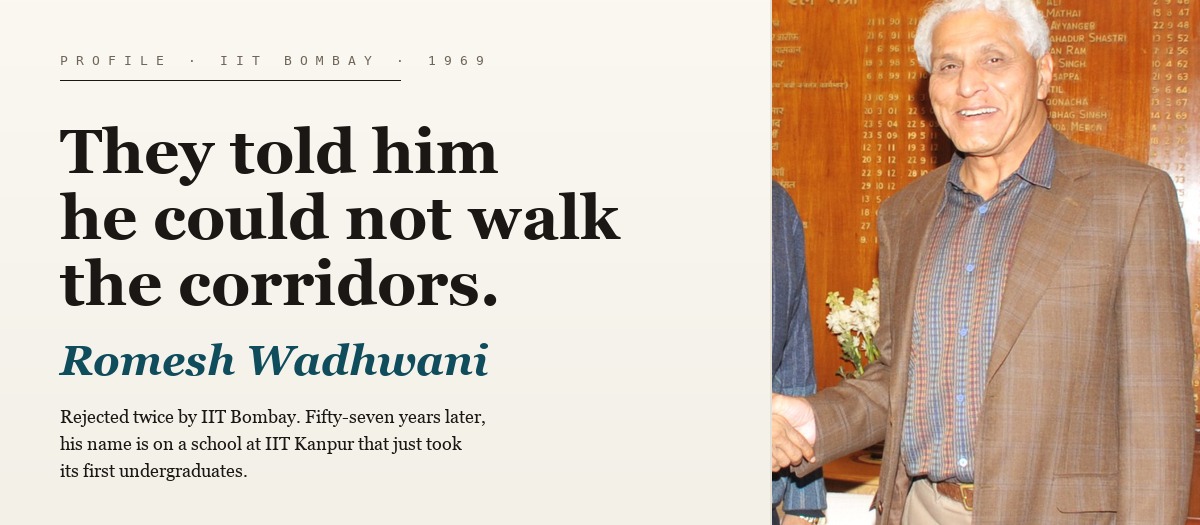
Romesh Wadhwani, New Delhi, February 2016. Photo: Ministry of Railways (India), GODL-India, via Wikimedia Commons.
The rejection, told smaller than the legend
The story has been retold enough times that it has grown in transit. The version that circulates now is that Indian engineering colleges refused him because of his disability. That is not what the record says, and the smaller version is better.
Romesh Wadhwani was born in Karachi in August 1947, ten days after Independence, and his family came to Delhi as Partition refugees. He contracted polio at the age of two and has had difficulty walking ever since. IIT Bombay turned him down twice. The first time was because he was underage. The second time was medical, and the account of it comes from a Fortune India feature: the authorities denied him admission "with the medical officer saying he would not be able to walk the long corridors of the buildings".
What he says he did next is the part people remember:
I had never allowed polio to interfere with my work or ambition. And I was not willing to take it lying down. I saw that the doctor was a little over weight and challenged him to race me to the college gate. Once he realized that I was dead serious about my admission, he gave in. The race never happened.
Two caveats belong with that quote, because it is load-bearing for everything after it. The only source is Wadhwani himself, telling it roughly fifty years after the fact, and the interview is hosted on his own foundation's website. There is no contemporaneous record of the exchange. It is a good story, told by the person it flatters, and it should be read that way.
He got in. IIT Bombay's electrical engineering department lists him as "a batch of 1969, EE department". His own account of his first venture is characteristically unromantic: his first startup, he says, was Compuguard in 1972, "unless you count the canteen I set up in Hostel No. 2 as my maiden venture".
Pittsburgh, with two dollars fifty
In late August 1969 he flew to Pittsburgh for a master's at Carnegie Mellon. Forbes reports he arrived "with less than $2.50 in his pocket". Worth noting that this figure is always reported in the third person; there is no interview in which he states it himself.
He was invited to stay for a doctorate. He is inconsistent about when he finished it. In 2016 he told Forbes he started his first company "immediately after graduating in 1972"; in the 2015 Fortune India piece he says he finished the master's in 1970 and the doctorate in 1971, adding, "That's the quickest ever. I believe the record still stands." Both accounts are his. Neither is obviously the correct one.
Compuguard sold energy-management and security software for commercial buildings. Raising money for it took, by his own description, calls on "over a 100 venture capitalists". Forbes India puts it more precisely: 125 firms approached, 124 rejections, and a yes from Urban National Corp in Boston. His second company was a robotics business he stayed with out of obligation rather than conviction, telling Fortune India he remained "for eight years as I thought it was my moral responsibility to pay back the $40 million that venture capitalists had invested".
His own verdict on twenty years of work is the least flattering sentence in any of his interviews:
My first two companies were mediocre. I made so many mistakes... and, of course, I learnt a lot from them. But I was really frustrated because even after 20 years as an entrepreneur, building two companies, 10 years each, I did not feel that inner joy and satisfaction.
Aspect Development, and what $9.3 billion in stock actually meant
He moved to Silicon Valley in 1990 and founded Aspect Development in 1991, building business-to-business software for component and supplier data. It went public in 1996. Then it nearly died. "We missed the public quarter, saw a drastic crash in the stock price from $60 to $6 per share," he told Forbes India. "There were many hiccups. Later, we revamped the company internally and came out with a whole bunch of new products."
The rebuilt company was acquired by i2 Technologies. Forbes states it plainly: Wadhwani "first became a billionaire in 2000 after i2 Technologies acquired Aspect Development, a software firm he founded, for $9.3 billion in stock."
Three details are usually left out, and together they change the shape of the story. The deal was announced on 13 March 2000. The Nasdaq had peaked on 10 March. It was paid in i2 shares rather than cash, and by the time the transaction completed in June the value had slipped, with the closing figure reported nearer $8.8 billion. Then, in 2001, i2 reported a "$7.75 billion write-down in goodwill" against sales that had fallen 12% to $986 million.
What Wadhwani personally realised depends entirely on when he sold i2 stock, and no public source states it. He keeps a framed Wall Street Journal article about the deal in his office, described at the time as the largest software deal ever. Both things are true: it was the biggest software acquisition of its moment, and most of the value on the acquirer's books evaporated within eighteen months.
Year
What happened
Source
1947
Born in Karachi, ten days after Independence; family arrives in Delhi as Partition refugees
He bought a laboratory for the department that nearly refused him
This is the beat that gets skipped, and it is the most interesting thing he has done.
On 12 February 2001, roughly a year after the i2 deal made him a billionaire, Romesh Wadhwani inaugurated the Wadhwani Electronics Laboratory in the electrical engineering department at IIT Bombay. The department's own page records that it "was set up in the Department of Electrical Engineering, IIT Bombay with the help of an endowment from Dr. Romesh Wadhwani, a batch of 1969, EE department, IIT Bombay, for teaching and project development in electronics."
The first substantial thing he did with the money was endow the institute whose medical officer had tried to keep him out, in the specific department he had graduated from. Nobody at IIT Bombay appears to have remarked on the symmetry publicly, and he has never made a point of it either.
The philanthropy that followed has a consistent shape, and he has explained the logic himself:
When we started the foundation, right from the beginning it was clear that we were not just going to give $10,000 here and $50,000 here and let 10,000 flowers bloom. We had the opportunity to grow companies at scale. It's not just important to apply money, but to apply effort and money, and we began by picking a few initiatives each of which could achieve significance of scale.
That is why he builds whole institutions rather than writing cheques. He signed the Giving Pledge in 2012, committing 80% of his wealth. On why Indian billionaires should do the same, he was blunt with Forbes India: "I'm giving away 80 percent of my wealth, I don't have to, no one's forcing me to. I'm doing it voluntarily."
One footnote on family, because it is the single most common error written about him. The Wadhwani School of Data Science and AI at IIT Madras is not his. That was endowed with ₹110 crore from his brother Sunil Wadhwani, an IIT Madras mechanical engineering graduate. Romesh is IIT Bombay and IIT Kanpur. Wadhwani AI in Mumbai, founded in 2018, was funded by both brothers together.
What the money at IIT Kanpur has and has not bought
WSAIS was established in May 2025, after an MoU signed on 30 April in the presence of the Prime Minister. Its own annual report says the school "currently comprises 20 faculty members representing multiple departments of IIT Kanpur", organised into a department and five centres covering robotics, AI policy, intelligent systems, and cybersecurity of critical infrastructure.
Here is a fact worth stating plainly: no donation figure for the school has ever been published. Not in IIT Kanpur's announcement, not in the Foundation's release, not in the school's annual report. The only rupee number attached to the wider deal is an umbrella figure, and it covers far more than Kanpur. The Foundation committed "over Rs 700 crore with matching funds from ANRF, IIT Kanpur and IIT Bombay to set up two superhubs, AICTE, and 10 Wadhwani Innovation Network (WIN) centres of excellence", as part of a Rs 1,400 crore package. Any article that presents that as the price of the Kanpur school is misreading it.
What did arrive is specific. Foundation CEO Ajay Kela said the investment would "support not only the school's physical infrastructure, but also long-term programs, scholarships and entrepreneurial pathways for students". The 2025 announcement promised that admissions "for the first batch of Department of Intelligent Systems students is slated to begin in 2026". That promise came due on 14 August, and it was kept.
There is a nice coincidence in who runs it. The dean is Prof. Nitin Saxena and the director of IIT Kanpur is Prof. Manindra Agrawal. They are the A and the S of the AKS primality test, the 2002 result that made Indian theoretical computer science internationally famous. Saxena on the new cohorts: "With our first undergraduate cohorts joining alongside students in our M.Tech., MS, and PhD programmes, we are building a strong foundation for the School's academic and research ecosystem."
Agrawal's own quote at the orientation is worth reading for what it leaves out. He talks about opportunity in AI and cybersecurity, and about making the most of IIT Kanpur's ecosystem. He does not mention Wadhwani, or the donation, at all.
The parts that do not flatter anyone
Three weeks before those students arrived, someone who had been rejected from the same programme broke into IIT Kanpur's website. As Business Today reported on 29 July, he "replaced part of it with a simple message: 'Site is Hacked, All I Need Is Just a Fair Chance.'" He hit IIT Madras too, the co-host of the same degree, and posted screenshots claiming he only wanted to show what he could do.
Agrawal's response was more generous than it had to be. "We did not want to jeopardise the future of the student, which is why we have decided to give him an opportunity and are considering him for an internship at C3iHub. He can aim for admission next year." He added: "We want to send a message to other students that such actions are not the right way to seek opportunities."
Read it against the man the school is named after and it becomes uncomfortable in a useful way. A screening process rejected an applicant who could demonstrably breach both host institutes, and he responded by forcing the issue rather than accepting the verdict. Wadhwani challenged a doctor to a footrace for the same reason.
Students had opinions, and they were not the ones the institute would have chosen. The thread on r/Btechtards ran to 459 upvotes. The highest-scoring reaction to Agrawal's decision was three words, “Game recognises game” (96 upvotes), which is a student body reading the outcome as skill beating an entrance rank.
The more interesting comment questions the entire premise of the degree. At 72 upvotes: “In cyber sec the only thing you need to do is enter the industry, so degree won't do much.” That is the argument a four-year Bachelor of Cybersecurity has to defeat, made by exactly the cohort it is recruiting from. Another, at 17 upvotes, is blunter about what counts as proof: “han bro that's the only way to prove your skills”.
Others were less romantic about the internship. “So he won't be part of undergraduate program? What will he do with only an intern” (45 upvotes), and one prediction worth revisiting next admissions cycle, at 81 upvotes: “it would be insane ragebait if they reject him again after he applies next year”. All from the same 29 July thread.
The programme itself carries constraints IIT Kanpur states openly on its own FAQ. B.Cyber students cannot change branch. They spend years three and four off campus on internship. On placements the answer is direct: "No. Placement support will be provided by calling relevant organisations." Some host organisations pay no stipend. For a 17-year-old choosing between this and a conventional CSE seat, those are real trade-offs and they deserve to be weighed, not glossed.
The Foundation's own numbers deserve the same scrutiny. It says Wadhwani "has contributed US $1B to date to the Foundation", and reports five-year totals of "5M+ JOBSEEKERS SKILLED" and "150K STUDENT ENTREPRENUERS INSPIRED". Those are the Foundation's claims about itself, unaudited, and they are not internally consistent: a different page on the same site says 6M+ learners upskilled. More tellingly, the Foundation's stated mission is job creation, and none of the published figures is a jobs-created number. They are reach and training counts. The most recent impact report on the site dates from 2021.
Wadhwani AI, the Mumbai nonprofit the brothers funded jointly in 2018, publishes the most checkable output of anything in the portfolio: 122,000+ patients screened through its Cough Against TB tool across 16 states, with data current to July 2025. The claimed "12-16% increase in TB case diagnoses" carries no linked study, so treat the screening count as solid and the efficacy figure as the Foundation's own.
And there is a gap between what he says and how he is scored. He has pledged 80% of his wealth. Forbes, on the same profile page that puts his net worth at $5.5 billion as of 17 August 2026, gives him a philanthropy score of 2 out of 5.
What an IITian can actually take from this
Not "never give up". The useful lessons here are narrower and more awkward.
The gatekeeper is often wrong and can sometimes be argued with. A medical officer made a judgement about what a body could do. He was wrong, and the correction required arguing in the room rather than appealing afterwards.
Twenty years of mediocre work is a normal input. He built two companies over two decades and calls both mediocre. Aspect was company three, started at 44.
Headline numbers are not what people receive. $9.3 billion in stock at the top of a bubble, followed by a $7.75 billion writedown, is a different outcome from $9.3 billion. Read acquisition news for the currency and the date.
Institutions outlive grants. His stated reason for building schools rather than giving cheques is scale, and a first undergraduate cohort commits four years of teaching that cannot be quietly unwound.
Check whose money it actually is. Two brothers, two IITs, two foundations, one shared surname. Most articles get this wrong.
The fifty-two students who started at Kanpur this month were not born when Aspect Development was sold. Most of them will never hear the story about the medical officer. They are on a degree that exists because a man who was told he could not walk the corridors decided that the answer was to buy the building.
Wadhwani graduated from IIT Bombay electrical engineering in 1969 and endowed a laboratory back into that same department in 2001. If you want the campus on a shirt, our IIT Bombay collection is here, and we stock all 23 IITs rather than the five that trend.
Every claim above links to the source it came from. Where his own accounts contradict each other, both versions are given.
Last updated: 17 August 2026.
About the author Arun Raghav S, Co-founder, IITian Vibes · B.Tech, IIT Jodhpur. Writes on IIT admissions, exam policy, and the aspirant journey at iitianvibes.com/blog.
Frequently asked questions
Which IIT did Romesh Wadhwani attend?
IIT Bombay, electrical engineering, batch of 1969, per the department's own records. The institute rejected him twice before admitting him, once because he was underage and once on medical grounds relating to polio.
Is the Wadhwani School at IIT Madras his?
No. That is the Wadhwani School of Data Science and AI, endowed with Rs 110 crore by his brother Sunil Wadhwani, an IIT Madras alumnus. Romesh funded the Wadhwani School of AI and Intelligent Systems at IIT Kanpur. Wadhwani AI in Mumbai was funded by both brothers.
How much did Romesh Wadhwani donate to IIT Kanpur?
No figure has ever been published, by IIT Kanpur, the Wadhwani Foundation or the school's annual report. The only public number is an umbrella Rs 1,400 crore package covering IIT Kanpur, IIT Bombay, AICTE and ten centres of excellence.
How much did he make from selling Aspect Development?
Unknown. i2 Technologies acquired Aspect for $9.3 billion in stock in 2000, announced three days after the Nasdaq peak. i2 wrote down $7.75 billion in goodwill the following year. What he personally realised depends on when he sold, and no source states it.
What is Romesh Wadhwani's net worth?
Forbes put it at $5.5 billion on 17 August 2026, ranking him 759th in the world. It is a real-time figure that moves daily. He has pledged 80% of his wealth to his foundation.