
IIT placements aren't won in your final year — they're won in your first. By the time Phase 1 opens on December 1, the round-1 CGPA filter has already decided which companies you can even apply to, and the students with offers in hand are usually the ones who converted a third-year summer internship into a pre-placement offer months earlier. Here's the honest, year-by-year roadmap: when the process actually runs, what companies test, how much DSA is really enough, and where to start — with the real numbers, not vibes. For the salary side of the story, see our per-IIT placement data.
When do IIT placements actually happen?
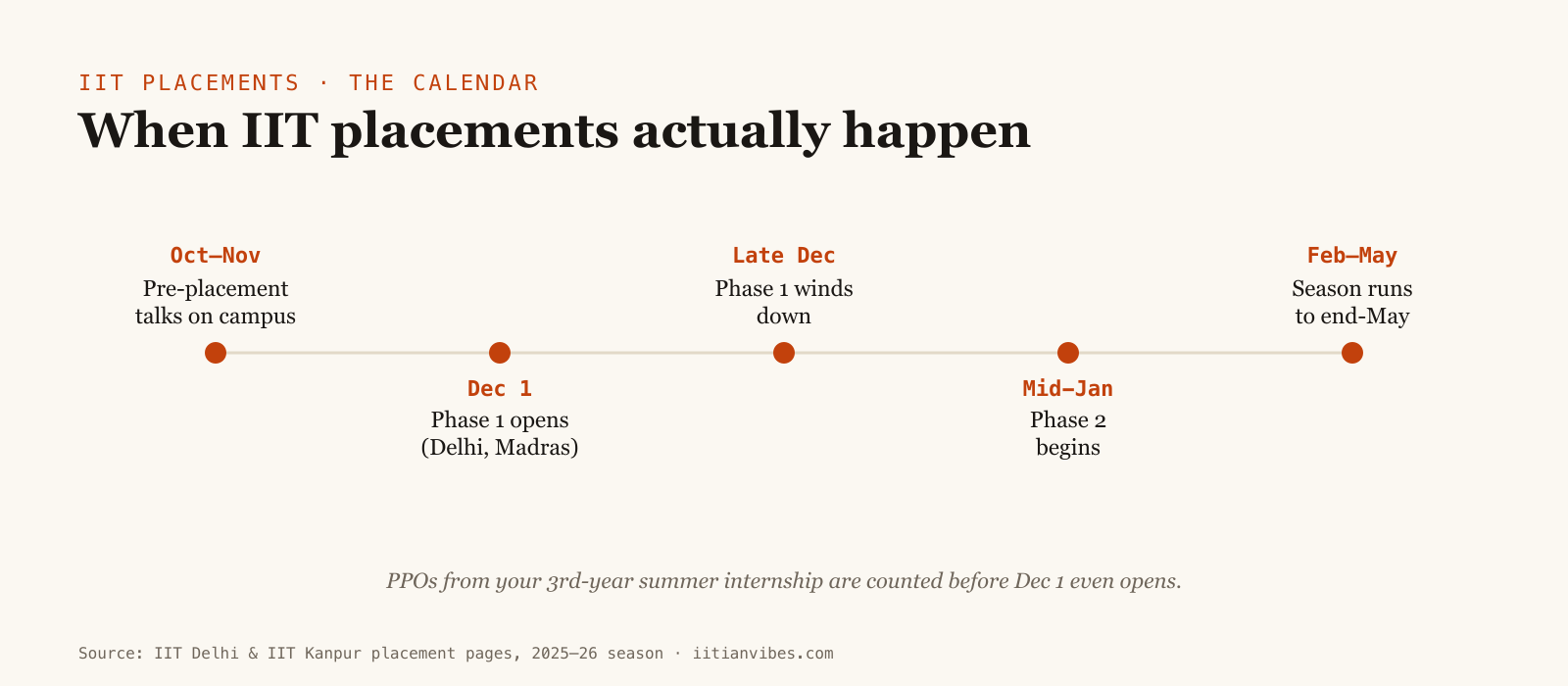
Two tracks run about a year apart: the summer-internship hunt for third-years and final placements for fourth-years. Final placements open in Phase 1 on December 1 at most IITs and run into Phase 2 from mid-January through May. Crucially, the pre-placement offers (PPOs) earned from your third-year internship are counted before Phase 1 even begins. Recent scale: IIT Delhi logged 1,275 offers and 1,140+ students placed by December 2025, and IIT Kanpur extended 1,202 offers by December 26 before Phase 2 opened in January (IIT Delhi, IIT Kanpur).
The summer internship is the real lever
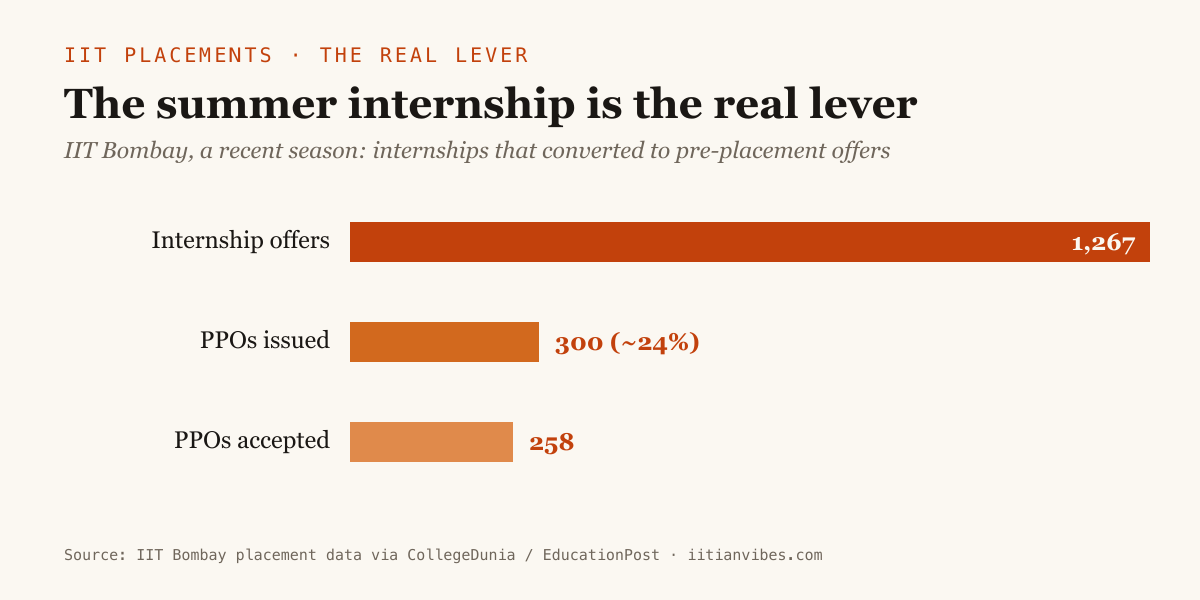
If you take one thing from this page: the third-year summer internship matters more than the final-placement scramble. Treat the internship as a six-month interview — at IIT Bombay, a recent season turned 1,267 internship offers into 300 PPOs (~24%), of which 258 were accepted (EducationPost / CollegeDunia). The students relaxing in December are usually the ones who nailed an internship the summer before.
Your year-by-year roadmap
Start early; the cheapest CGPA points you'll ever earn are in your first two semesters. These targets are widely-cited community/guide recommendations, not official IIT requirements.
| Year | Focus | Concrete targets |
|---|---|---|
| 1st | Pick a lane (software / quant / core). Master one language. Protect your CGPA from day one. | CGPA 8+; fluent in C++/Java/Python; basic DSA (arrays, strings, recursion) |
| 2nd | Consistent DSA (Easy → Medium). Build one solid project. A research/professor internship for the résumé. | Work a structured sheet (Striver A2Z); start Codeforces contests; 1 strong project |
| 3rd | The decisive year. Graphs/DP/trees + CS fundamentals. Land and convert the summer internship into a PPO. Résumé v1. | ≥150 LeetCode; Codeforces 1400+ by end of 5th sem; 1 quality internship |
| 4th | Execution, not learning. Mock interviews, résumé polish, CS-fundamentals + system-design revision, managing rejection. | 200–300 LeetCode total; 10+ mock interviews; every résumé line defensible |
What do companies actually test?
The first cut is almost always an automated CGPA filter — below the threshold, you're dropped before anyone reads your scores or projects. After that, it's role-specific:
| Role | What you'll face | Typical CGPA gate |
|---|---|---|
| Software (SDE) | Online DSA test → coding interviews → CS fundamentals (OS, DBMS, CN, OOP) → system design for senior roles | ~6.0 service IT, ~6.5 product |
| Core (Mech / Civil / EE / Chem) | Domain aptitude/technical written test → technical interviews on subject depth (GATE-style prep helps) | Varies by company |
| Quant / HFT / Finance | Speed-math aptitude (Optiver: 80 questions in 8 minutes) → probability & brainteasers → market-making games | 7.0+; an extremely tight funnel |
Keep your CGPA above 7 if you can — it clears almost every product and finance filter. Cutoffs vary by company and cycle (Google/TCS/Infosys often ~6.0; Flipkart ~6.5; Goldman Sachs 7.0).
How much DSA and CP is actually enough?
Less than the panic suggests — but done well. The recurring consensus across placement guides: around 300 well-chosen LeetCode problems beats grinding 1,000, because pattern recognition is what gets tested, not problem count ("800 solved, still unplaced" is a real failure mode). Work a structured sheet (Striver's A2Z / SDE or Blind 75), push Codeforces toward 1400+ by the end of your fifth semester, and — the highest-ROI trick — solve past online-assessment questions of your target companies to calibrate real difficulty (most campus OAs sit around Codeforces 1200–1700).
Two hours every day beats a ten-hour weekend grind. Placements reward consistency, not heroics.
What do IITians actually say?
The honest, unfiltered version lives in student communities. A heavily-upvoted "ask me anything" from a big-tech software engineer on r/Btechtards is full of practical prep specifics; and if you're feeling behind, the thread "failed JEE, almost had a year-back, still got the highest package" is the reminder that effort and the right prep beat your entry rank. The pattern in both: start early, optimise the internship, and treat DSA as a daily habit.
How this is sourced
- The calendar and offer counts (Dec 1 Phase 1, Phase 2 to May, IIT Delhi/Kanpur 2025–26 figures) are from institute placement pages.
- The intern→PPO funnel is IIT Bombay's recent-season data — illustrative of the path, not a system-wide average (no single all-IIT conversion rate is published).
- Year-by-year targets, CGPA cutoffs and DSA counts are widely-cited community and placement-guide recommendations, not official IIT policy — they shift by company and cycle, so treat them as direction, not law.
Last updated: June 2026. We refresh this each placement season. Made it through the grind? Wear it.
Real placement stories from current IIT students
Two recent AMAs from IIT students who landed top-tier offers in the 2025-26 cycle clarify what the roadmap above actually rewards.
The quant route. From "Joining Quant, AMA" (r/Btechtards, Dec 2025, 633 upvotes / 390 comments) — a 4th-year CSE IIT student with a quant firm PPO at ~₹1 crore first-year:
"I mostly did a lot of random reading out of interest, not because of placements. Not much CP. Like everyone else here, I have never studied for a college exam, for more than a couple of hours."
The pattern across quant-AMA threads on Reddit is consistent: top-tier quant offers go to students who genuinely enjoyed maths and reading deeply, not to the LeetCode-grind contingent. The stipend was ~₹5L/month for the internship that converted; the firm "usually hires from a few colleges only." If quant is the target, branch + IIT + raw mathematical taste matter more than CP rating — but the path is brutally narrow.
The "sit for placements" route. From "Finally Placed at DE Shaw – AMA" (r/Btechtards, Dec 2025, 294 upvotes / 223 comments) — a CSE student at an "old IIT" who rejected a 19 LPA PPO to sit for Phase 1:
"I didn't secure a good internship (mostly lack of preparation along with bad luck) and ended up doing intern in a company which pays 40k/month and they offered PPO of 19LPA which I rejected to sit for placements. Once we accept PPO we are not allowed to sit for placements [...] DE Shaw's process include a OA first followed by 2 rounds of interview which majorly focused on DSA, C++ fundamentals and a very little emphasis on projects." — OP, r/Btechtards
Two operational insights worth pulling out: (1) accepting a PPO at an IIT typically removes you from Phase 1 — so a mid-PPO is a real decision, not a fallback. (2) Quant + product interview funnels still skew heavily DSA + CS fundamentals; "projects" matter for resume shortlisting, not for technical rounds. The student's explicit admission that they "didn't secure a good internship" is also a reminder that Phase 1 is genuinely a second chance — the funnel earlier in this post (1,267 internships → 300 PPOs → 258 accepted) cuts both ways.
Frequently asked questions
When do IIT placements actually start?
Phase 1 opens on December 1 at most IITs and runs through mid-December. Phase 2 begins in mid-January and runs through April–May. Pre-placement offers (PPOs) from your third-year summer internship are accepted before Phase 1, so the offer count published on Day 1 already includes converted PPOs.
What is a PPO and should I accept one?
A pre-placement offer is a full-time job offer made directly off your summer internship, before Phase 1 placements open. The trade-off: at most IITs, accepting a PPO removes you from sitting for Phase 1 / Phase 2 placements. So a mid-PPO (e.g. 18–22 LPA) is a real career decision — secure but caps your upside. PPOs are increasing across all IITs (IIT Delhi: 300+, +33% YoY in 2025-26).
How much LeetCode is actually enough?
The most-cited targets across placement guides: ~200–300 well-chosen problems by your fourth year, with focus on patterns (graphs, DP, trees, sliding window) over raw volume. Codeforces 1400+ rating by end of fifth semester is the soft cutoff for the strongest CP-focused firms. Quant firms test less DSA and more probability + maths + speed; product firms (Microsoft, Google) test core DSA + CS fundamentals (OS, DBMS, CN, OOP).
Do non-circuital branch students get placed at IITs?
Yes, but the funnel is narrower for tech / finance roles. Per current student commentary on r/IITDelhi and r/IITK, biotech / civil / textile / chemical students who target tech or finance roles "work 2x" to clear the same filter as circuital students. Core engineering roles (Mech, Civil, Chem, EE) recruit primarily from their own branches and have separate CGPA cutoffs. Non-tech roles (consulting, BD, finance back-office) are realistic for any branch with strong fundamentals.
What CGPA do I need for IIT placements?
Widely-cited cutoffs: ~6.0 for service IT (TCS, Infosys, Wipro), ~6.5 for product (Flipkart-style), 7.0+ for finance, quant, and most US-tech roles. Below 7.0 the SDE filter drops most product companies; below 6.0 most placement opportunities close. These vary by company and cycle — keep your CGPA above 7 if you can.
Can I sit for placements if I have a backlog?
It depends on the IIT and the company. Most IITs allow registration with an active backlog but several blue-chip companies (most banks, quant firms, FAANG-tier) have a "no active backlog" filter on their CGPA-cutoff page. Cleared-backlog students are typically eligible everywhere. Check both your IIT's placement cell rules and the company-specific cutoff document each cycle.
Is it possible to switch to a software job from a core branch?
Yes, and the placement data confirms it — non-circuital students do land Microsoft, Amazon, Goldman, etc. offers every cycle. The trade-off is preparation intensity: you're competing with CSE students who've been writing C++ since first year. Plan to start DSA + one language in your first year regardless of branch if software is the target.