
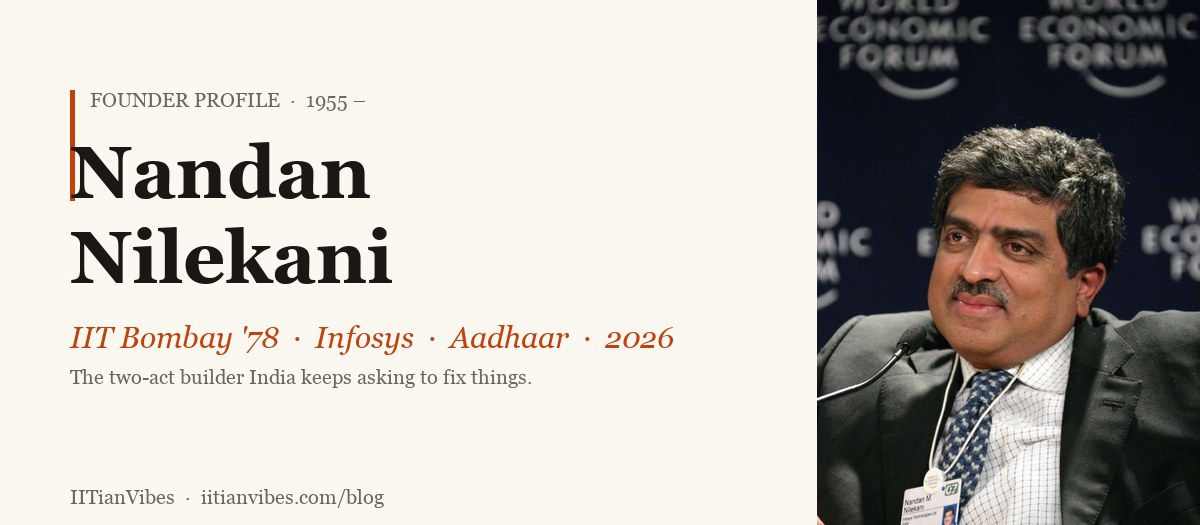
July 2026. The Government of India announced a high-powered task force to fix the country's exam system after another year of NEET and UGC-NET leaks. The person they picked to head it: Nandan Nilekani, 71. This is a man whose Forbes real-time net worth sits at $2.5 billion as of 1 August 2026, whose company (Infosys) he still chairs, whose face is on every UPI transaction India runs. And yet Delhi called him back into public service again — the third national-scale problem in fifteen years he has been asked to solve. This is a profile of the two-act builder, told through the specific years and specific numbers that mattered.
Dharwad, 1973: the telegram that made him
Nilekani was 18 when he had to decide which IIT to attend. His father, working out of Dharwad in northern Karnataka, had a clear preference and wired it in.
My father sent me a telegram when I had to go to Chennai for my interview, saying join IIT Chennai chemical engineering or something like that. So at the age of 18 you want to do the opposite of what your father tells you, so I said, "No, I'll join electrical engineering in IIT Bombay."
That is Nilekani himself, on tape, in his Computer History Museum oral history recorded 8 January 2019 in Bangalore. It is the origin story he tells in his own voice, and it is very Indian: a father with a plan, a son with a train ticket, a rebellion that quietly rewired the country's technology decade. He arrived at IIT Bombay in 1973 and moved into a hostel where, by his own admission, he did not have much self-confidence yet.
Two facts about 1970s IIT Bombay that shaped what came next. First, there was no Computer Science department. All undergraduates did Electrical Engineering, and if they wanted software they picked it up through electives. Nilekani took a lot of those electives. Second, the campus computer was an EC-1030, a Soviet ES EVM series clone of the IBM S/360, wired in via India's then-USSR partnership. You wrote your program on punch cards, dropped the stack in at night, and picked up the output in the morning. That is where Nandan Nilekani first touched code.
He names two professors from those years: J.R. Isaac, the legendary EE/CS pioneer, and Deepak (D.B.) Phatak, who is still active at IIT Bombay's CSE department five decades later. But the credential Nilekani cites most often is not academic. It is that he was the general secretary and organizer of Mood Indigo, the IIT Bombay cultural festival. He organized two editions. And he has said, on the record: "all I know about management and leadership I learned in Mood Indigo" (IIT Bombay Alumni Relations, 20 June 2023). The IITian who eventually built Infosys and Aadhaar credits a college fest for his management sensibility. That is not the story most placements coaches will tell you, but it is the story he tells himself.
He graduated in 1978 with a B.Tech in Electrical Engineering and took the train to Bombay's Fort area to start his first job at Patni Computer Systems. That is where he met a man named Narayana Murthy.
Patni Computer Systems, 1978: meeting Murthy
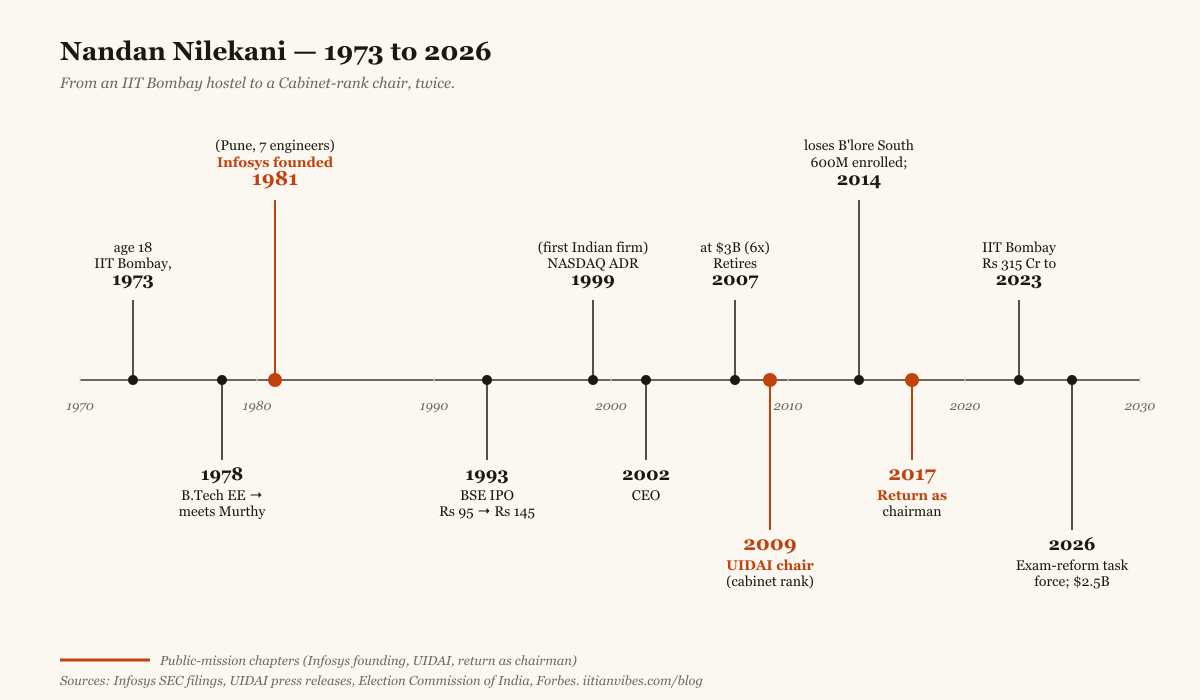
Patni was one of the earliest Indian software services firms, and it is where a small group of engineers began to form the network that would become Infosys. Murthy was Nilekani's interviewer. Over the next three years, that circle grew to seven. On 2 July 1981, they incorporated Infosys Consultants Private Limited in Pune. The seven founders: N.R. Narayana Murthy, Nandan Nilekani, Kris Gopalakrishnan, S.D. Shibulal, K. Dinesh, N.S. Raghavan, and Ashok Arora.
The seed-capital story you have heard is probably wrong. The internet has repeated for decades that Infosys was founded with $250 borrowed money. The primary source, in her own words, is Sudha Murty, in a Deccan Herald interview dated 15 March 2024, and she says the real number was Rs 10,000, given from her personal savings to Narayana Murthy.
I had Rs 10,250 in my savings. I saved Rs 250 for myself and gave him the rest because he failed in his earlier venture Softronics, so I took a risk.
She kept Rs 250 for herself because Murthy's previous venture had gone under. Not $250 for the company. Rs 250 for the wife. The English-language internet has been repeating a bad translation for forty years.
Inside the new company, the founders split by geography. Murthy stayed in Bangalore (Infosys moved from Pune in 1983) and ran delivery. Nilekani moved to the United States and ran everything customer-facing. According to the IIT Bombay Alumni Association's archived profile, he was "based in the US from 1981 to 1987, managing the marketing and development efforts". Two co-founders, two continents, one company. It is a structure most Indian startups would recognise today. In 1981 it was uncommon.
June 1993: the IPO that almost failed
By 1993, Infosys was twelve years old, was doing enough revenue to think about a listing, and filed for an IPO on the Bombay Stock Exchange. Offer price: Rs 95 per share, against a book value of only Rs 20. That is a 4.75x premium at a time when the Indian public did not really trust software companies. Retail investors did not bite.
The IPO was undersubscribed. On the day the issue looked like it would fail, Morgan Stanley stepped in, picked up 13% of the equity at the offer price, and stabilised the book. Then, in June 1993, the stock actually listed on the BSE. Opening price: Rs 145. A 52% listing gain on Day 1 for an issue that no one wanted a week earlier. That is the trade that made a lot of early Infoscions wealthy on paper, and it is the trade most versions of the Infosys origin story skip past.
Six years later, on 11 March 1999, Infosys did something no Indian-registered company had ever done. It listed on the NASDAQ in New York, issuing 1.8 million American Depositary Receipts at $34 each. Nilekani was president and chief operating officer at that point. Every Indian tech company that later filed for a US listing walked through a door Infosys pushed open that morning.
On 10 January 2002, per Infosys's own Form 20-F filed with the US SEC, the board re-designated Nilekani as Chief Executive Officer, President and Managing Director, effective 31 March 2002. He would run the company for the next five years. During his CEO tenure, Infosys revenue grew six-fold to $3 billion. Headcount crossed 72,000. On 21 June 2007, he retired as CEO to become Co-Chairman and handed the operating role to Kris Gopalakrishnan.
The Infosys years in numbers
| Year | Milestone | Nilekani's role | Source |
|---|---|---|---|
| 1981 | Infosys incorporated in Pune | Co-founder, US market | Company records |
| 1993 | BSE IPO, Rs 95 offer / Rs 145 listing (52% gain) | President | BSE listing records |
| 1999 | NASDAQ ADR listing, 1.8M ADRs @ $34 | President, COO | Benzinga historical |
| 2002 | Became CEO on 31 March, effective from 10 Jan board resolution | CEO, President, MD | SEC Form 20-F |
| 2007 | Revenue reaches $3B (6x since 2002); retires as CEO on 21 June | Co-Chairman | SEC Form 20-F FY2007 |
| 2009 | Leaves Infosys in July for UIDAI | Founding chairman, UIDAI | Public record |
| 2017 | Returns as non-executive chairman on 24 August after Sikka's exit | Non-executive chairman | Fortune, 18 Aug 2017 |
| 2026 | Reappointed at 45th AGM on 23 June | Non-executive chairman | Infosys 45th AGM proceedings |
The interlude: Imagining India, 2008
Between stepping down as CEO in 2007 and stepping into government in 2009, Nilekani wrote a book. Imagining India: The Idea of a Renewed Nation came out under Penguin's Allen Lane imprint in India in 2008, followed by a Penguin Press hardcover in the US in 2009. The paperback ran 528 pages with a foreword by Thomas Friedman. It was, in effect, his job application to be a public-infrastructure builder rather than a private-sector one. The book argues that India can leapfrog several stages of development if it treats identity, education, health and payments as software problems.
The reviews were kind. Forbes, in April 2011, called it "must reading for anyone wanting to gain a reasonably current understanding of the state of affairs in this rapidly growing economy". Delhi was reading too.
June 2009: the phone call from Manmohan Singh
The Unique Identification Authority of India was formally established on 28 January 2009. On 23 June 2009, Prime Minister Manmohan Singh appointed Nandan Nilekani as its first chairperson, with rank equivalent to a Cabinet minister. Nilekani took formal leave of Infosys in July 2009 to run it. He was 54. He was giving up an operating role at a NASDAQ-listed company to run a government agency that did not yet have a database.
The engineering choices Nilekani and his team made in that first year defined what Aadhaar became. A 12-digit unique identity number. Each number linked to a resident's demographic data plus a set of biometrics: a photograph, ten fingerprints, and two iris scans. The scale target was every resident of India. The rollout strategy was pace.
We felt speed was strategic. Doing and scaling things quickly was critical. If you move very quickly it doesn't give opposition the time to consolidate.
That is Nilekani, in Forbes India, 8 October 2013. It is a stunningly candid quote from a sitting government appointee. He is openly admitting he raced the project to enrol as many people as possible before the political system could organise a stop.
The political system did try. In December 2011, the Parliamentary Standing Committee on Finance, chaired by BJP's Yashwant Sinha, rejected the National Identification Authority of India Bill, 2010 — the statutory foundation the UPA government had proposed to formalise Aadhaar. The grounds were cost, national security, privacy, and overlap with the Home Ministry's National Population Register. Aadhaar continued anyway, on the strength of executive orders, while the legal architecture was disputed.
In November 2012, retired Karnataka High Court judge K.S. Puttaswamy filed a Public Interest Litigation in the Supreme Court challenging Aadhaar's constitutional validity. That case became the vehicle through which India would eventually recognise the right to privacy as a fundamental right, in a nine-judge bench verdict delivered on 24 August 2017, which held that "the right to privacy is protected as an intrinsic part of the right to life and personal liberty under Article 21". The Aadhaar Act itself was upheld by a five-judge bench (4:1) on 26 September 2018, with reading-down.
By the time Nilekani stepped down as UIDAI chairman in March 2014, roughly 600 million Indians had been enrolled. That is more than the population of the European Union. It is, still, the largest biometric identity project ever attempted anywhere.
May 2014: losing Bangalore South
Nilekani's next move was electoral. He joined the Indian National Congress and contested the Bangalore South Lok Sabha seat in the 2014 general election. His opponent was BJP's five-term incumbent Ananth Kumar. The Modi wave was building. Nilekani ran a professional, well-funded, data-driven campaign.
He lost by 228,575 votes. Election Commission data via IndiaVotes records the final margin: Ananth Kumar took 633,816 votes (57.29% vote share); Nilekani took 405,241 votes (36.63%). On counting day, 16 May 2014, he called the result himself, before the final numbers were declared. To PTI, he said:
I concede defeat and congratulate Ananth Kumar for his performance in this poll.
The man who ran Aadhaar could not win the seat next to Infosys's headquarters. The lesson he seems to have taken from 2014 is that direct electoral politics is not his instrument. Public infrastructure is.
August 2017: the return
Three years after the election loss, Infosys was in a boardroom crisis. CEO Vishal Sikka, brought in from SAP in 2014, had spent months in an open dispute with the founders, particularly Narayana Murthy, over corporate governance and executive pay. On 18 August 2017, Sikka resigned. Fortune's coverage that day was blunt: "Sikka had come under fire in recent months from some of the founders of the company on issues related to corporate governance and salary increases for its top executives."
Six days later, on 24 August 2017, the Infosys board named Nandan Nilekani non-executive chairman. Eight years on, he still holds that seat. The Infosys 45th AGM held on 23 June 2026 reappointed him as director. At the previous year's AGM in June 2025, Business Standard reported him telling shareholders that "Growth to continue despite macro tensions." The company is Rs 1.5 lakh crore of annual revenue territory. He is still on the letterhead.
The 2026 present: DPI, EkStep, and the exam-reform brief
Three things are worth tracking about Nilekani in 2026, because they show where his second act is heading.
The philanthropy. In June 2023, marking fifty years since he first walked into the IIT Bombay campus, Nilekani donated Rs 315 crore to IIT Bombay. In his own words: "IIT-Bombay has been a cornerstone in my life, shaping my formative years and laying the foundation for my journey." Separately, EkStep Foundation, which he co-founded with his wife Rohini Nilekani and Shankar Maruwada, was seeded with $10 million and now targets 200 million Indian children. Its open-source Sunbird stack is what powers the Government of India's DIKSHA education platform.
The DPI push. At Global Fintech Fest 2025 in Mumbai, Nilekani unveiled Finternet, the next-wave Digital Public Infrastructure architecture he is championing. Pilots are running across 20 ecosystems on four continents. At the India AI Summit in February 2026, he argued that pairing AI agents with open networks like UPI is the specific path the Global South should take rather than trying to out-scale OpenAI or Google on foundation models.
The task force. Which brings us back to July 2026. The Government of India constituted a high-powered task force, headed by Nilekani, to recommend how to make India's examination system leak-proof. It follows a year of NEET and UGC-NET paper leaks that gutted student trust in the exam machinery. The public record is clear on the appointment. What is not clear is what the fix looks like. That is what he has been asked to write.
What r/india actually says about him
The internet does not treat Nilekani gently. Reddit's r/india, r/StartupIndia and adjacent subs have been arguing about him for years, and the sentiment is not uniform. Here are four voices from real, verifiable threads.
Pro, on the IIT-B donation — from a June 2023 r/india thread: "Kudos to Nilekani. It is rare that a former alumni donates such huge amount to their alma mater. Hope more alumni do it. US institutes have huge alumni donations which are used for research and development."
Nuanced, on India's AI capability — after Nilekani said in October 2024 that Indian startups should leave LLMs to the big boys in the valley, a technical commenter on r/india agreed: "He is being fairly realistic. Unless top tier researchers (like the person who co-authored the Transformers paper) return to India, no one will be pouring billions into AI research in India. Indian startups should focus on integrating AI into marketable products."
Anti, on Aadhaar as ID — after the Calcutta High Court ruled in July 2026 that Aadhaar, PAN and Voter ID are not proof of citizenship, r/india's top comment read: "You're a citizen when convenient to the government / Only then."
Anti, on the exam-reform task force itself — days after the July 2026 appointment, this landed on a "One Man, Every Government, Every Digital ID Project?" thread: "Because he and the whole Infosys Crew are biggest scam-stars of Modi's India. Nilekani is single handedly reponsible for the decline of India as an IT-hub. Only thing he cares about is bribing Gov. officials for the big contracts, then putting cheapest labor on building the digital infrastructure and then taking 99% of the margins for himself."
You do not have to agree with the criticism to acknowledge that it exists. Any honest profile of Nilekani has to sit with it. He is a builder who chose to build public infrastructure at national scale, and public infrastructure at national scale generates public grievance at national scale. The Aadhaar rollout excluded people from PDS rations because their fingerprints did not read on cheap scanners. The Infosys-built income-tax portal in 2021 crashed for weeks. The July 2026 hostility on r/india is not random; it is a memory.
What current IITians can actually learn from Nilekani's career
Five specific takeaways. Not "follow your dreams." Actual moves you can copy.
- Pick your co-founder before you pick your idea. Nilekani did not decide to build a software company and then find Murthy. He worked next to Murthy at Patni for three years and then, when the moment came, joined a group that already trusted each other. Every successful IIT startup you know has a version of this story.
- Split the founding team by geography, not by function. Murthy in Bangalore doing delivery, Nilekani in the US doing sales, from year one. Most Indian startups only split like this at Series B. Infosys did it in 1981.
- The trade that made you may not have wanted you. The Infosys IPO was undersubscribed in 1993. Morgan Stanley bailed it out. It listed at a 52% premium the next week. Failed launches are often just cold launches. Ship anyway.
- You can leave money on the table and it will not kill you. Nilekani walked out of a NASDAQ-listed operating role at 54 to take a government appointment. He came back to the private sector as chairman ten years later. The Forbes number is now $2.5 billion. Leaving money on the table for public service is a trade a small number of Indian founders have actually made and lived to see the compound.
- Public infrastructure is a career path. Aadhaar, UPI, ONDC, DIKSHA, Finternet. India is one of maybe three countries in the world where a founder-engineer can build state-scale software as a second career. If you are the kind of IITian who wants to work on things that touch a billion users, you do not have to leave the country. You just have to get in the room.
If you are at IIT Bombay right now, you can literally walk past the buildings Nilekani helped fund. If you are anywhere else in the IIT system, you are working on a hostel network and a JEE credential that both, in different ways, sit on top of infrastructure he had a hand in. The reasonable ambition is not to be Nilekani. The reasonable ambition is to notice which trillion-user problem is currently unsolved on your campus and think seriously about who you would call at 54 if the government asked you to fix it.
Want to represent IIT Bombay on your chest while you are at it? Our IIT Bombay hoodies and IIT Bombay T-shirts are the closest we get to a Mood Indigo GS jacket forty-eight years later.
Frequently asked questions
Which IIT did Nandan Nilekani attend?
IIT Bombay, from 1973 to 1978, B.Tech in Electrical Engineering. In the 1970s, IIT Bombay had no separate Computer Science department, so Nilekani studied Computer Science through Electrical Engineering electives.
Was Nandan Nilekani a founder of Infosys?
Yes. Infosys was incorporated as Infosys Consultants Private Limited in Pune on 2 July 1981 by seven engineers: N.R. Narayana Murthy, Nandan Nilekani, Kris Gopalakrishnan, S.D. Shibulal, K. Dinesh, N.S. Raghavan and Ashok Arora. Nilekani ran the company's US market from 1981 to 1987.
When was Nandan Nilekani the CEO of Infosys?
Nilekani was CEO, President and Managing Director of Infosys from 31 March 2002 to 21 June 2007. During his tenure, Infosys revenue grew six-fold to $3 billion. He handed the CEO role to Kris Gopalakrishnan and became Co-Chairman.
What is Nandan Nilekani's net worth in 2026?
Forbes real-time net worth for Nilekani was $2.5 billion as of 1 August 2026, ranking him #1,669 in the world. He remains non-executive chairman of Infosys, was reappointed at the 45th AGM on 23 June 2026, and now heads a Government of India task force on exam reform.
Last updated: August 2026.