
Founder Stories · IIT Kharagpur · Published 28 September 2026
On 14 April 2021, Coinbase listed on Nasdaq, and an IIT Kharagpur computer science graduate became one of the biggest winners of the day. Bloomberg's numbers, as Mint carried them, put the chief product officer's stake at about $180.8 million, roughly ₹1,500 crore, fifteen months after he joined. Mint's line: he "joins Coinbase founders Brian Armstrong and Fred Ehrsam as major winners of the firm's Nasdaq Inc. debut."
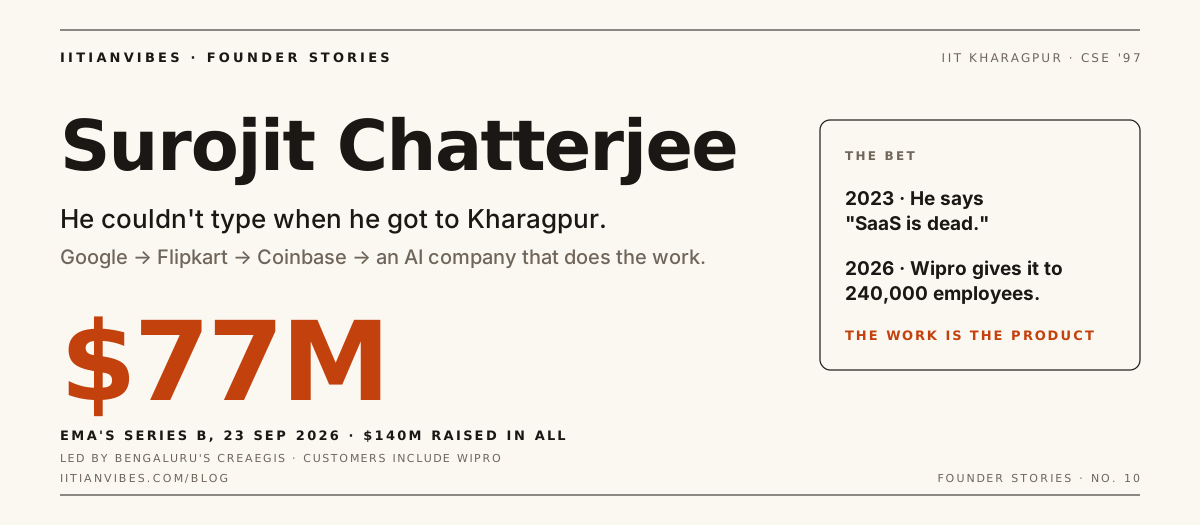
As a Kharagpur fresher in the 1990s, the same man could not type. When Surojit Chatterjee arrived at Kharagpur, the only computers he had seen were at railway reservation counters. He learned to type at night so he could finish his assignments.
Last Wednesday, 23 September 2026, the company he started after Coinbase, Ema, raised a $77 million Series B led by Bengaluru's Creaegis, taking it to $140 million raised. Ema sells what it calls AI employees: software that does the HR tickets, IT requests and finance paperwork that large companies pay people to do. One of its showcase customers is Wipro. That is the part of this story every IIT student headed for an IT-services offer letter should read twice. This is how a boy from a small town who couldn't type got here, and what his bet means for the rest of us.
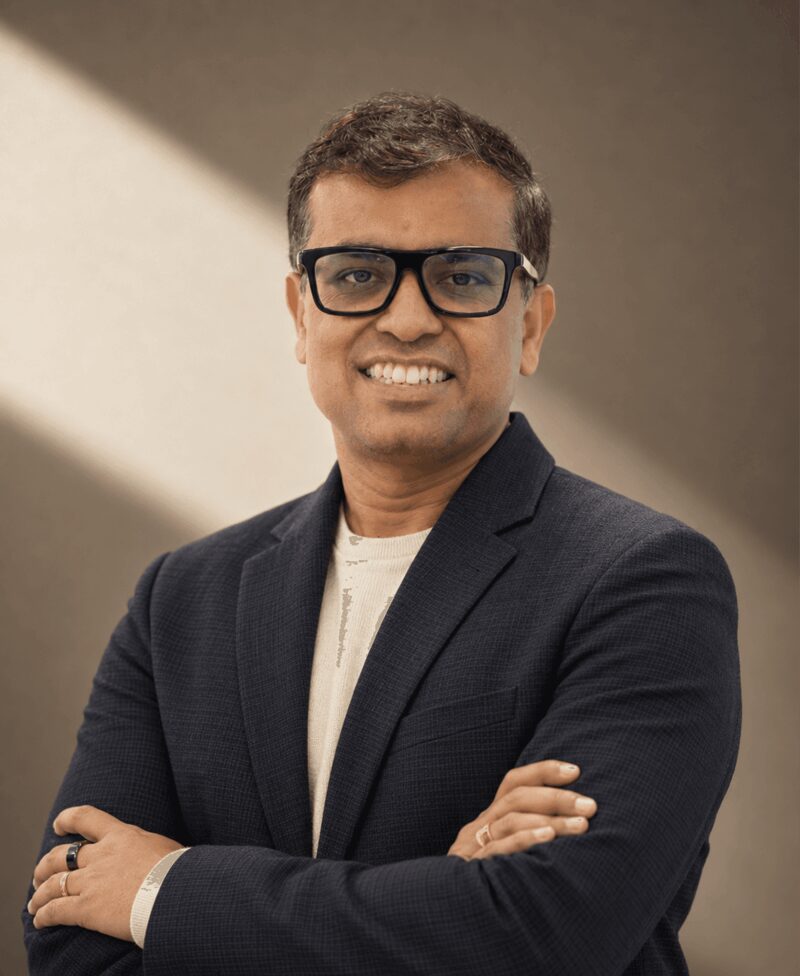
Kharagpur, class of 1997: the fresher who learned to type at night
Chatterjee has told his origin story consistently, if with small variations. In 2022 he described "a very poor, lower middle-class family from a small town"; in 2024, "a remote village in India". The town is never named. What is constant is that nobody at home knew what an engineer should study. "My entry into engineering happened because I was good at mathematics and loved the subject," he told YourStory. "I went to IIT, and a lot of people said 'oh, you should study computer science,' and so I did."
Anyone who has sat in a first-year programming lab behind a classmate who has had a laptop since class eight knows the next part.
"I had never touched a keyboard before. I would barely be able to type anything in the class, and by the time I would be able to do anything, the class would be over. I would learn to type during the nights and weekends and finish my assignments."
Surojit Chatterjee, to YourStory, April 2022
He caught up fast enough to do real research. As an undergraduate, he and a classmate built a neural network from scratch to recognise speech in a Kharagpur lab, Forbes India reported, long before Siri. His verdict on it: "It didn't work that well, but we learnt a ton." (Forbes India dates the lab work to "the early 2000s"; he graduated in 1997, so it was the 1990s.) In his third year he interned at DRDO's Centre for Artificial Intelligence and Robotics in Bengaluru: "I built neural networks to help robots navigate. It was very early work—what we now see in autonomous vehicles in San Francisco, I was working on early versions of that."
Two things are worth noticing for a current student. First, the specialisation came before the career. He "researched machine learning, focusing on areas like voice and handwriting recognition" in the 1990s, when those were unsolved academic problems, and came back to it 26 years later as a founder. Second, the internship was a government defence lab, not a brand-name company. His record from the 1990s is about doing hard work early, not about who was hiring on Day 1.
His degree, for the record, is a B.Tech: Ema's leadership page lists "an MBA from MIT, MS in Computer Science from SUNY at Buffalo, and B. Tech from IIT Kharagpur", plus 40 US patents. Mint's 2021 piece called it a BSc, which is an error.
1997–2022: building other people's businesses
After Kharagpur came a master's at SUNY Buffalo and research in the US on handwriting recognition funded by the US Postal Service, which needed machines to read addresses. Then Google, where TechCrunch says he spent "more than 11 years at Google over two stints, the first as a founding member of Google's mobile search Ads product."
The first stint taught him what it feels like to be early and doubted. When he pitched mobile advertising, a retail marketing chief told him, as he recounted it to YourStory: "I love your enthusiasm, I love your passion, but nobody will buy a dress on a mobile phone." Forbes India's figure for where that business ended up is a $50 billion revenue engine. That is the outlet's number, not an audited Google one, but the direction is not in dispute.
| Years | Role | What happened | Source |
|---|---|---|---|
| Until 1997 | B.Tech, Computer Science, IIT Kharagpur | Speech-recognition neural net in a lab; DRDO robotics internship | YourStory, Forbes India |
| Late 1990s–2015 | MS, SUNY Buffalo; US research; Google (first stint) | Founding member of Google mobile search ads | TechCrunch |
| 2015–17 | Head of product, Flipkart | Took over product; ran it through demonetisation | YourStory 2016, 2022 |
| 2017–20 | Google (second stint) | Led Google Shopping | Mint |
| Feb 2020 – Nov 2022 | Chief product officer, Coinbase | Through the April 2021 listing; left with about $105M in stock sales | DL News |
| 2023 – now | Co-founder and CEO, Ema | $140M raised; $77M Series B on 23 Sep 2026 | TechCrunch |
Flipkart, and the week cash stopped working
In 2015 he came home to run product at Flipkart, taking over the role from another Google hire, Punit Soni. Then, in November 2016, the government withdrew ₹500 and ₹1,000 notes, and cash on delivery, which YourStory says was "close to 70 percent of its business", went into shock. His memory of it is calm: "we quickly adapted and then we figured out it was okay. That's when I saw the value of sovereign currencies like Bitcoin, Ethereum and others. That's when I bought my first Bitcoin."
The Coinbase job, three years later, grew out of that week. When Coinbase announced his hire in January 2020, he gave TechCrunch the personal version: "Growing up in India in a poor middle-class household, I saw very closely what a lack of liquid cash does to a family's lifestyle." In between Flipkart and Coinbase came three more years at Google, leading its shopping platform.

November 2022: getting off the ride
The listing-day windfall made him a headline in India. The exit made him one in America, less kindly. In November 2022, in the middle of a crypto crash and a restructuring, Coinbase disclosed that he was stepping down by mutual agreement. His own post: "Three years of building, three years of growth, three years of the most exciting roller coaster I could imagine — but now it's time to get off the ride and catch my breath."
DL News later reported that he left with about $105 million from stock sales, three years into a five-year deal. The same piece quoted his reason, which is more personal than executive departures usually get: his father had been diagnosed with Alzheimer's and his mother had died unexpectedly that year. "If I'm honest with myself, I don't think I've allowed myself time to grieve either yet," he wrote.
On Hacker News the story drew 290 points and a fight. One commenter: "This guy fails and gets 100+M dollars - never has to work another day in his life, and somehow after all that his break is 'much needed'? Really?" Another pushed back: "Most comments here are completely missing the point, because they are looking at whether he deserves the money, and it seems 'unfair'." Both are fair readings of an executive-pay system. Neither is a reading of the man, who, within months, had started again from a laptop.
What Reddit remembers
Reddit never discussed the Kharagpur graduate or Ema. We could not find a single thread with comments on the company, including in Series B week. What it remembers is the Coinbase executive, and not warmly. In June 2022, as Coinbase's stock slid, a poster in r/CryptoCurrency summarised an anonymous employee petition that called for the removal of the COO, the chief people officer and "Chief Product Officer, Surojit Chatterjee" for "executing plans and ideas that have led to questionable results and negative value." The thread drew 175 comments.
When his exit was announced in November, the same subreddit went for the pay. One of the most-upvoted jokes was about Coinbase's fees: "I hope they charged him a 8% fee to swap his portfolio to stablecoins then another 8% fee to turn stablecoin into cash then yet another 8% fee to transfer to bank." The serious version sat just below it: "These salaries of CEO's are insane. I mean yeah they have an insane amount of pressure, but still almost billion dollars over the time when the company's stock crashed almost 90% of ATH is crazy."
The most useful voice is a year older and less angry. In November 2021 a Coinbase user wrote him an open letter in r/CoinBase about an unsupported token distribution: "Dear Mr. Chatterjee: Greetings! Thank you for helping make a great product experience with Coinbase... Coinbase remains silent. Your users are losing trust." That is what being chief product officer of a consumer app with millions of users looks like from the other side. Every backlog decision has someone waiting on it, and they know your name. Ema sells to enterprises, not to retail users on Reddit. So far, nobody there has an opinion on it.
2023: the bet that "SaaS is dead"
Ema started as "a solo project—Chatterjee tinkering on his laptop, reading research papers". The insight was one he had watched at every employer for 25 years: "even in the best companies in the world, 50 to 60 percent of people's time was spent just keeping the lights on—mundane, repetitive work. What if we could delegate that to AI?" The company, EMA for Enterprise Machine Assistant, was founded in 2023 (April, per Forbes India; Ema's own site says February) with Souvik Sen, a former Okta and Google engineering leader with 37 patents of his own.
It came out of stealth in March 2024 with $25 million from Accel, Section 32 and Prosus, with angels including Sheryl Sandberg and Jerry Yang, and a pitch that fit in one line: "Our goal is to build a universal AI employee." Moneycontrol reported an extension of another $36 million in July 2024, and that the seed round "was closed within three days." (Accounts of the earlier rounds do not add up exactly across outlets; the number everyone agrees on is $140 million in total.)
The public thesis was blunter than the product. Three years ago he said "SaaS is dead", a line he acknowledged was met with scepticism. His argument is that software companies sell tools that still need a person to operate them, and that the next generation sells the finished work. He told Forbes India that building it was "like a war zone", and that the unglamorous decisions came first: governance and security were designed before any product code, because "You can't do this retroactively." For a company selling into HR and finance departments, that is the sales pitch.
What the $77 million bought
The Series B, announced on 23 September, was led by Creaegis, with Accel, Section 32 and Prosus adding to their stakes. TechCrunch reports it more than quadrupled the 2024 valuation; Ema did not disclose the figure. The company has nearly 200 employees and offices in Bengaluru, London and Vancouver. Its own numbers, which are company claims and should be read as such:
- Revenue up 50-fold in two years, and bookings above $150 million. Chatterjee told TechCrunch the bookings figure counts multi-year contracts "rather than representing annual recurring revenue", and declined to give a run rate.
- More than 50 active enterprise deals and over a million active users, with customers including NTT DATA, Hitachi, ADP, PwC, KPMG, Wipro and Microsoft, per TechCrunch.
- At Wipro, Ema says it "powers an employee assistant supporting more than 240,000 associates across 65 countries" and handles about 2.9 million employee queries a year.
The lead investor's reasoning is the useful sentence for anyone judging AI startups right now: "Many agentic AI companies have compelling demos, but few have proven they can deliver in production at enterprise scale." Chatterjee's own version, from the Moneycontrol report: "Enterprises do not need more software. They need work to get done."
What his bet means for an IIT student in 2026
Here is the uncomfortable sentence from launch week. On IT services firms, Chatterjee told TechCrunch: "A lot of the services companies are working with us. They are also dramatically changing or disrupting their own business models because they understand the human-forward model may not be the best model going forward."
"Human-forward model" is a polite name for the way India's IT services industry has grown for thirty years: win a contract, staff it with graduates. If Wipro, one of India's largest IT services companies (and, through Wipro Ventures, an early Ema investor), is buying software that answers 2.9 million employee queries a year, the entry-level job is changing, and the people selling that software know it first. His answer on jobs, given to Forbes India in 2025, is the optimist's one: "When computers came in, everyone thought they will lose jobs. When, in fact, they created many more jobs." You don't have to believe it to plan for it.
Five things his route actually teaches, none of them "follow your passion":
- Starting behind is survivable if you do the boring catch-up. He could not type in first year. He fixed it at night and on weekends, not by switching branches.
- Pick the hard problem before it is fashionable. Speech and handwriting recognition in the 1990s, mobile ads when a retail CMO told him nobody would buy a dress on a phone, AI agents in 2023 when "SaaS is dead" drew scepticism. Each time the skill was ready when the market arrived.
- An operator career is a founder's apprenticeship. Twenty-five years inside Google, Flipkart and Coinbase is where he saw the "keeping the lights on" work that became Ema's product. The insight came from the job, not a pitch competition.
- Reinvent on purpose. His own advice, from 2022: "take some risks, try something new... You kind of go back to the ground level, become humble, learn from others, and then slowly build up. Every few years, do that."
- If you are going into IT services, learn what is being automated first. The HR, IT and finance tickets Ema handles are the work new hires used to be trained on. Be the person who deploys the agent, not the person the agent replaces.
If Kharagpur is yours, the IIT Kharagpur collection is where we keep the merch. Wear it for the campus that took in a fresher who had only seen computers at railway counters, and sent him out writing neural networks.
FAQ
Which IIT did Surojit Chatterjee study at?
IIT Kharagpur, where he earned a B.Tech in Computer Science, graduating in 1997. He later completed an MS in Computer Science at SUNY Buffalo and an MBA at MIT, and holds 40 US patents, according to Ema's leadership page.
What is Ema and how much has it raised?
Ema, founded in 2023 by Surojit Chatterjee and Souvik Sen, builds "AI employees" that automate enterprise HR, IT and finance work. On 23 September 2026 it raised a $77 million Series B led by Bengaluru's Creaegis, taking total funding to $140 million. Its valuation was not disclosed.
How much did Surojit Chatterjee make at Coinbase?
Bloomberg valued his stake at about $180.8 million (roughly ₹1,500 crore) after Coinbase's April 2021 listing. When he stepped down in November 2022, DL News reported he had made about $105 million from stock sales over three years.
Why did Surojit Chatterjee leave Coinbase?
Coinbase described the November 2022 departure as mutually agreed, during a restructuring. Chatterjee said he wanted a personal break after a hard year in which his father was diagnosed with Alzheimer's and his mother died. He founded Ema within months.
Last updated: September 2026. Corrections to hello@iitianvibes.com.