

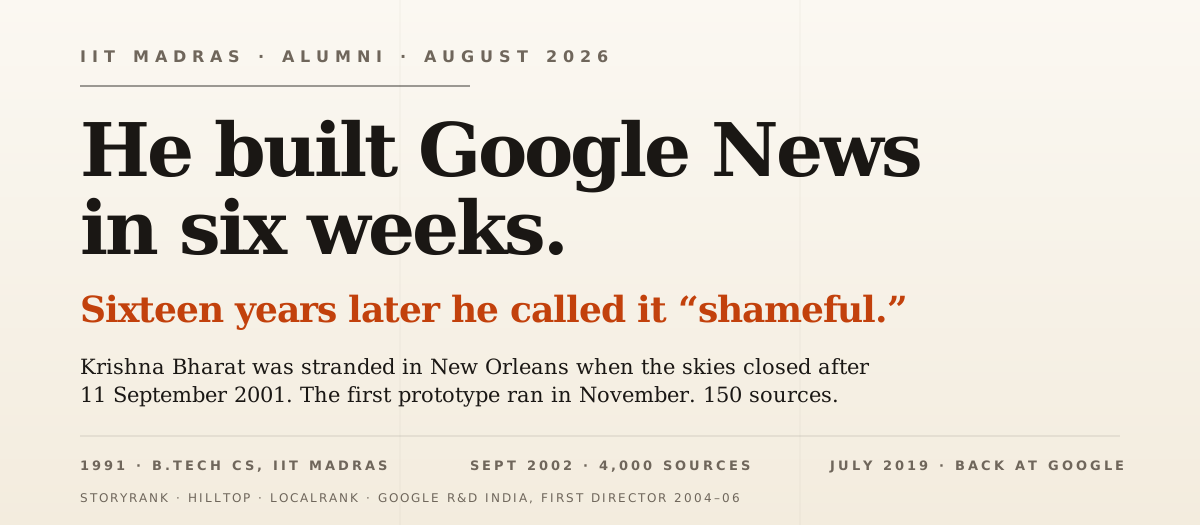
Profile · IIT Madras · August 2026 · The man who created Google News is an IIT Madras graduate almost nobody in India has profiled properly. This is an attempt to fix that, including the parts he would probably rather forget.
September 2001. Krishna Bharat was stuck in New Orleans. He had flown in for a text retrieval conference, the kind of gathering where a few hundred researchers argue about indexing, and then the towers came down and American airspace closed. He could not get home to California. So he did what a certain kind of engineer does when trapped in a hotel with a laptop and a catastrophe on every screen.
He got annoyed at the software.
"I was at a text retrieval conference and indexing conferencing in New Orleans along with lots of other researchers, and we were stuck there after 9/11 happened because the skies were closed," he told the Riptide oral history project at Harvard's Shorenstein Center in April 2013. "So I spent all my time trying to either find a flight back or follow the news and brainstorm about finding news with a lot of people. So I was stewing in it, in some sense."
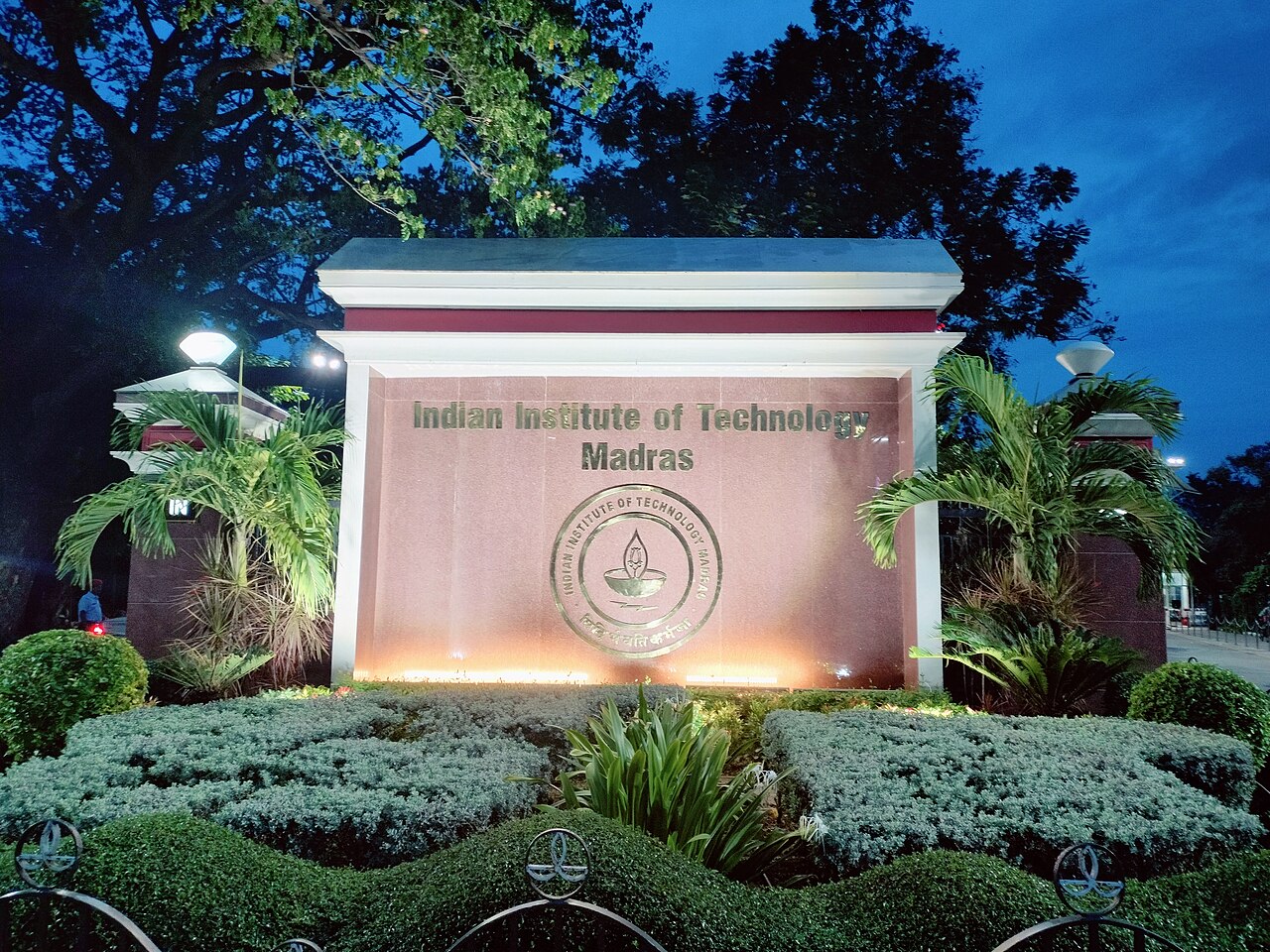
About six weeks later he had a working prototype. Eleven months after that, Google launched it publicly. Today Google News is one of the most consequential pieces of software ever built by an Indian engineer, and the man who built it graduated from IIT Madras in 1991 with a B.Tech in Computer Science.
The IIT Madras years, and the hole where they should be
Here is the honest problem with writing this section: almost nothing about it is documented.
IIT Madras' own Heritage Centre citation gives you one sentence. "Dr. Krishna Bharat graduated in 1991 from IIT Madras with a B.Tech. degree in Computer Science. In 1996, having obtained a Ph.D. in Computer Science from Georgia Tech, he joined the staff at DEC Systems Research Center in Palo Alto, California." The alumni office page is shorter still, listing him as "1991 - B.Tech - Computer Science" and describing him, rather wonderfully, as "Xoogler, News guy and investor."
That is the entire public record of four years. No hostel. No professor. No course. No anecdote. His longest recorded interview, the Riptide oral history, covers his Bangalore childhood and his Georgia Tech years in detail and does not mention IIT Madras once.
We are flagging that rather than inventing colour to fill it, because the gap is itself the story. Bharat left IIT Madras in 1991, which means a Computer Science degree taken entirely before India had commercial internet access, which VSNL opened to the public on 15 August 1995. Whatever he learned about information retrieval at Madras, he learned it on machines with no network to the outside world. Eight years after graduating he was at Google, working on how to rank the entire web.
IIT Madras gave him its Distinguished Alumnus Award in 2015, citing "his research contributions and renowned innovations in the field of interactive systems for information access." Note the phrasing. Not "search." Not "news." Interactive systems. The institute got the framing right, and almost every subsequent write-up got it wrong.
The newspaper he built in 1993
Because the thing people miss about Krishna Bharat is that he was never really a search person. He was an interface person.
His PhD at Georgia Tech was done in the Graphics, Visualization and Usability Center, under Scott Hudson. His own archived student page from around 1995 states it plainly: "Krishna is a PhD student in the Graphics, Visualization, and Usability Center of the College of Computing at the Georgia Institute of Technology. His research advisor is Scott Hudson." The thesis he described himself as writing was called "Supporting the Construction of Distributed, Interoperative, User Interface Applications." Human-computer interaction, in other words. Buttons and windows and how people actually use things.
And in the middle of that, he built a newspaper.
"But one of the projects I did when I was in grad school was on actually creating a personalized, interactive newspaper. So even though I was a technologist, my research said go off and build a newspaper. And this was 1993." Krishna Bharat, Riptide oral history, April 2013
The project was real and it was published. Kamba, Bharat and Albers, "The Krakatoa Chronicle: An Interactive, Personalized Newspaper on the Web," presented at the fourth international World Wide Web conference in 1995.
Hold that date against the rest of this piece. Google News is not an idea that arrived on 11 September 2001. It is an idea Krishna Bharat had in 1993, as a graduate student, eight years before anything happened that made the world need it urgently enough to fund it. What 9/11 supplied was not the concept. It was the justification.
Hilltop, and the idea that experts confer authority
After Georgia Tech he joined DEC's Systems Research Center in Palo Alto, which became Compaq's after the 1998 acquisition and Hewlett-Packard's after 2002. This detail matters later, so keep it.
His work there was not interface design. His publication record from those years is dense web-infrastructure research: finding mirrored hosts, term vector databases, mining linkage between sites. One of those papers was co-authored with Andrei Broder, Monika Henzinger and a young engineer named Jeffrey Dean.
Then, in 1999, Bharat and George Mihaila of the University of Toronto came up with Hilltop.
The idea is elegant. Instead of ranking a page by counting every link pointing at it, first identify a small set of "expert documents," pages that exist mainly to link out to good sources on a topic, and rank results by what those experts say. From the paper presented at WWW10 in Hong Kong in May 2001: "These are a subset of the pages on the WWW identified as directories of links to non-affiliated sources on specific topics. Results are ranked based on the match between the query and relevant descriptive text for hyperlinks on expert pages pointing to a given result page."
A widely repeated claim is that Google bought Hilltop. It did not. The patent, US 7,346,604, filed in October 1999 and granted only in 2008, is assigned to Hewlett-Packard, because Bharat invented it on DEC's payroll before he joined Google. Google never owned it.
What Google got was Bharat himself, in 1999, and then his own re-implementation of the same instinct in code Google could own: US 6,725,259, "Ranking search results by reranking the results based on local inter-connectivity," granted April 2004, sole inventor Krishna Bharat.
Remember the shape of the Hilltop idea, because he is about to use it again. Authority is not a property of a document. It is something conferred on you by sources that have no stake in you.
Six weeks
When the planes hit, Google had a problem it could not solve, and Bharat says so bluntly.
"A lot of online news sites had kind of melted down, so Google had to host some of that content. They built a resource page. It was abundantly clear that, although we were a premier information company, people came to us and said give us information about what just happened now, and we didn't have a good answer, right?"
The technical reason for that failure is the single most interesting thing in this entire story, and Bharat explained it himself in a post on Google's own blog in May 2011:
"At Google we realized that our ability to display links to the freshest and most relevant news was limited by a fundamental problem: fresh news lacked hyperlinks. Google's ranking depended on links from other authors on the web. Fresh news, by definition, was too fresh to accumulate such links. A new importance signal was needed. I realized that if Google could compute how many news sources were covering the underlying story at a given point in time, we could then estimate how important the story was. Thus, 'Storyrank' was invented."
PageRank counts who links to you. It cannot work on a story that is nine minutes old, because nothing has had time to link to it. So Bharat substituted a different proxy for importance, and it is the Hilltop instinct wearing new clothes. Instead of counting links from unaffiliated experts, count newsrooms. If two hundred independent editors all decided this morning that a thing mattered, it probably matters.
He put it more plainly in 2013: "Just like Page Rank was about how many pages linked to it, Story Rank was about how excited editors are about the story."
The build was fast. "September 11th happened, a month and a half later I had my first prototype. 150 sources. Either top international sources or top national sources crawled every 15 minutes or so and indexed, and presented in the form of pretty ugly UI." By January 2002 his crawler and clustering were already powering news results inside ordinary Google search.
The public beta arrived in September 2002. Google's own About page from October that year describes roughly 4,000 sources, and then makes the design claim that would generate a decade of litigation and argument:
"Google News is highly unusual in that it offers a news service compiled solely by computer algorithms without human intervention. Google employs no editors, managing editors, or executive editors."
Bharat took it out of beta himself on 23 January 2006, signing the post "Creator, Google News," by which point it ran 22 regional editions in 10 languages.
What "quality" actually meant, in his own patent
"No editors" is a slogan. The interesting question is what replaced them, and there is a precise answer, because Bharat co-invented it.
US 7,577,655, "Systems and methods for improving the ranking of news articles," was filed on 16 September 2003, almost exactly a year after launch, by Michael Curtiss, Krishna Bharat and Michael Schmitt. It enumerates what a machine should measure to decide whether a news source is any good. The list is worth reading slowly:
"number of articles produced by the news source during a first time period"; "breaking news score"; "amount of network traffic to the news source"; "human opinion of the news source"; "circulation statistics of the news source"; "size of a staff associated with the news source"; "number of original named entities in a group of articles"; "breadth of coverage"; "writing style used by the news source".
Size of a staff. Circulation. Original named entities, meaning: did you find this out yourself, or are you repeating someone who did.
Read that list and the "no human editors" line stops sounding like an abdication and starts sounding like a thesis. Google News did not remove editorial judgment. It tried to encode the conditions under which editorial judgment is trustworthy, then apply them at a scale no editor could. Whether it succeeded is the rest of this article.
Bangalore, 2004
The chapter that matters most to an Indian reader gets one sentence in most write-ups.
In 2004, Bharat set up Google's research and development operations in India and, per IIT Madras' own record, "served as its first Director until 2006." Larry Page and Sergey Brin flew to Bangalore that October. An Associated Press report from 13 October 2004 catches Bharat mid-hiring-spree:
"Krishna Bharat, who created Google's news service, is now busy hiring in Bangalore. 'We don't have a cap (on how many to hire). We will take in as many people as we can, if they meet our global standards,' he said."
Brin, in the same visit, conceded Google had been "too late" in tapping Indian engineers: "We would have preferred to do it sooner. But there are only so many things we can do at once."
Sit with the sequence. An IIT Madras graduate of 1991 leaves a country that had no commercial internet while he was a student, builds a flagship product in California, and thirteen years later comes back to open the lab that hires the people who were sitting the JEE while he wrote the prototype.
Two quotes, six years apart
In May 2011, at the peak of it, Bharat gave Nieman Lab an interview defending the algorithmic design in its strongest form. Bias in individual outlets was fine, he argued, so long as the machine in the middle stayed neutral:
"Over time, I realized that there is value in the fact that individual editors have a point of view. If everybody tried to be super-objective, then you'd get a watered-down, bland discussion. That is the opportunity that having an objective, algorithmic intermediary provides you. If you trust the algorithm to do a fair job and really share these viewpoints, then you can allow these viewpoints to be quite biased if they want to be."
The same month, on Google's blog, he reported the scale that argument was operating at: "over 70 editions in over 30 languages," "over 1 billion clicks a month to news publishers worldwide," and one in six Google web searches returning news results computed with StoryRank.
Now October 2017. A gunman had opened fire in Las Vegas. Google's Top Stories surfaced 4chan threads misidentifying the shooter. Bharat, who had left the company two years earlier, wrote a public post that CNBC reproduced in full:
"Google friends -- this is shameful and irresponsible. Time to go back to the tried and tested practice of showing vetted sources for fresh queries at the top of web search. This would not have happened on my watch. Google News per se doesn't feature 4chan for a reason. [User generated content] is unreliable, and anything of value there will ultimately be screened by and surface in mainstream sources. Why not wait to be sure? You have a responsibility to get it right. This section is called 'Top Stories' not 'Rumors'."
Same man. Same product. Six years.
The 2011 position was that you can trust the intermediary if it is objective. The 2017 position is that objectivity without vetting is a liability, and that the fix is to go back to "vetted sources," which is to say back to the staff-size and circulation signals in his own 2003 patent. He was not contradicting himself so much as watching a specific safeguard get dropped and naming it. "This would not have happened on my watch" is a remarkable sentence for a founder to write in public about his own creation.
He was self-critical earlier, too. In the 2013 Riptide interview: "Our situation is where the ranking needs to get better. I completely agree. Over the years, we've come up with many solutions to fix that. But none of them is perfect."
What readers say it became
Nobody on Reddit is arguing about Krishna Bharat. We swept ten subreddits and could not find a single comment that mentions him by name, which tells you how thoroughly the creator has been detached from the creation in public memory.
They argue about the product constantly. In January 2026, r/technology discussed Google replacing publisher headlines with AI-generated ones:
"The scary part isn't AI writing headlines, it's Google confidently misstating facts while borrowing a publisher's credibility. That's not summarization, that's misinformation with a logo." u/amitash1, 81 upvotes, 23 January 2026
"Borrowing a publisher's credibility" is precisely the mechanism Bharat's patent tried to measure and preserve. The complaint is not that the machine ranks badly. It is that the machine now writes.
In the same thread, a reader describes their fix, and it is a straight reversal of the problem Bharat set out to solve in that New Orleans hotel room:
"Turning off 'Discover' and bookmarking your favourite news sources in your browser = Better life" u/JDGumby, 18 upvotes, 23 January 2026
Going back to a handful of trusted outlets, checked by hand, is exactly the behaviour he found "too exhausting" in 2001. Twenty-five years later some readers have decided the exhausting version was better.
On an April 2026 thread about Polymarket betting lines appearing inside Google News, which Google called an error, one comment lands closer to the truth than it probably intended:
"I bet a decade from now these tools are going to be a rat's nest of exceptions, special cases and hand crafted filters that take more human work to maintain than the old DMOZ directory." u/TheVenetianMask, 5 upvotes, 11 April 2026
That is the "no human editors" promise being audited twenty-four years on. DMOZ was the hand-curated web directory that algorithmic ranking replaced. The suggestion that the algorithm now takes more human maintenance than the directory did is the sharpest available critique of the entire project, and it came from a comment with five upvotes.
None of this is Bharat's doing. He has not run Google News since 2015. But it is the world his design decisions helped create, and the criticism now aimed at Google is, almost word for word, the criticism he aimed at Google in 2017.
The return nobody reported
Here is the fact that Indian coverage of Krishna Bharat almost universally gets wrong.
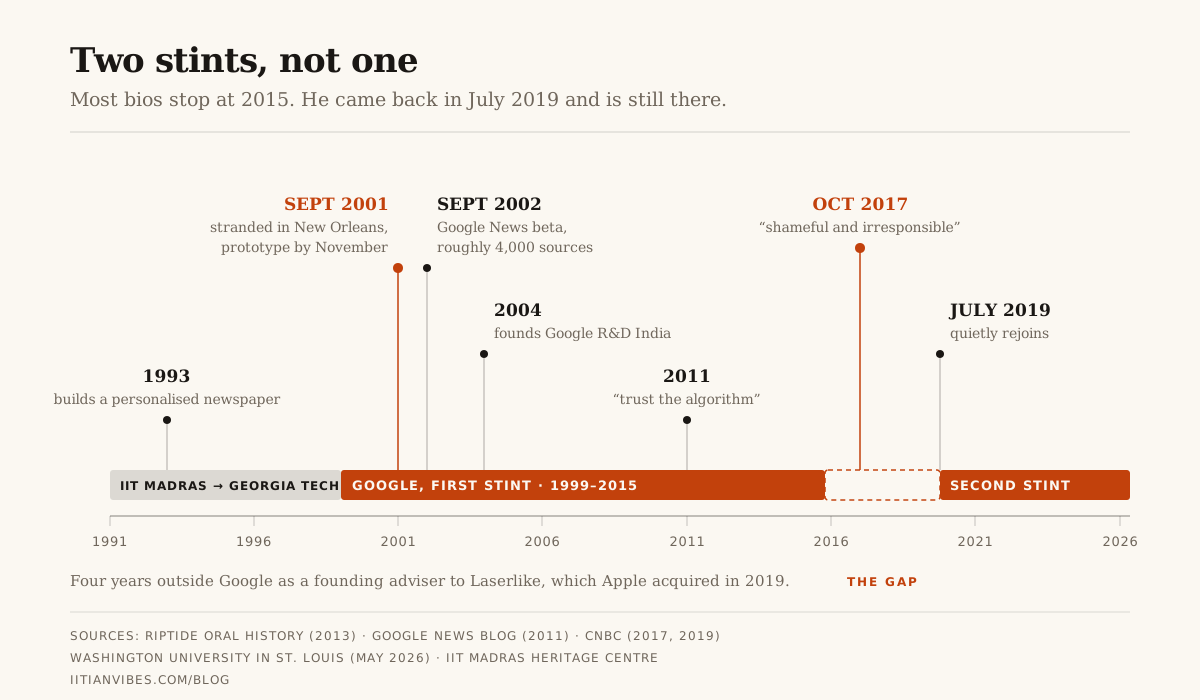
He left Google in 2015, after roughly fifteen years, and became a founding adviser to a machine learning company called Laserlike. Not a founder. Apple acquired Laserlike in 2019.
And then he went back. CNBC reported on 22 August 2019: "Krishna Bharat, the inventor of Google News, has returned to the company after four years to work on Search and News, Google has confirmed. Bharat started his second stint at Google in July as a distinguished research scientist, again."
Twenty-one months after calling Google's news handling shameful and irresponsible, he rejoined to work on Search and News.
He is, as far as the record shows, still there. In May 2026, Washington University in St. Louis installed the inaugural Kavita and Krishna Bharat Professor in its Sam Fox School of Design and Visual Arts, endowed by a gift from him and his wife. The university describes him, in present tense, as "a distinguished research scientist at Google." That makes the second stint about seven years long, already longer than the four-year gap that most biographies treat as his exit.
His own Medium bio, meanwhile, still says "Ex-Googler." It appears to have been written during the gap and never updated. We are reporting both, because that contradiction is funnier and more human than either version alone.
One caveat worth stating: we found no verifiable public commentary from him on large language models or generative AI. His most substantive remarks on AI and journalism date from May 2019, before GPT-3 existed, when he wrote that "journalists will find that AI gives them superpowers, in discovery, analysis, reporting and editing." Do not read that as his view of what Google is shipping now. Since rejoining, he has been publicly quiet, which is what employed research scientists usually are.
The career, with sources
| Year | What happened | Source |
|---|---|---|
| 1991 | B.Tech, Computer Science, IIT Madras | IITM Heritage Centre |
| 1993 | Builds a personalised interactive newspaper as a graduate project | Riptide, 2013 |
| 1996 | PhD, Georgia Tech, HCI research under Scott Hudson; joins DEC SRC | GVU page |
| 1999 | Files the Hilltop patent; joins Google | US 7,346,604 |
| Nov 2001 | First Google News prototype, 150 sources, crawled every 15 minutes | Riptide, 2013 |
| Sept 2002 | Public beta, roughly 4,000 sources, no human editors | Google, Oct 2002 |
| 2003 | Co-files the news source quality patent, including "size of a staff" | US 7,577,655 |
| 2004 | Founds Google's India R&D operation, first Director to 2006 | IITM alumni office |
| Jan 2006 | Takes Google News out of beta; 22 editions, 10 languages | Google Blog |
| May 2011 | Over 70 editions, 1 billion clicks a month to publishers | Google News Blog |
| 2015 | Leaves Google; founding adviser to Laserlike | CNBC |
| Oct 2017 | Calls Google's Las Vegas coverage "shameful and irresponsible" | CNBC |
| July 2019 | Rejoins Google as a distinguished research scientist | CNBC |
| May 2026 | Endows a professorship at WashU; still described as a Google scientist | WashU |
A footnote the industry has not forgotten
Aggregating other people's journalism was never going to be free. In March 2005 Agence France-Presse sued Google, demanding removal of its content and $17.5 million in damages; it settled on undisclosed terms in 2007. Belgium went worse, where Copiepresse won and saw it upheld on appeal in May 2011, with Google facing "a fine of roughly €25,000 for every day it fails to comply."
Twenty years on the same fight runs with different weapons, over AI summaries rather than headline snippets. The question has not changed since 2002: if a machine reorganises your journalism and keeps the audience, what do you get.
What an IIT student can actually take from this
Not "follow your passion." Five specific things:
- Build the thing you want to exist, then wait. Bharat built a personalised newspaper in 1993. It went nowhere. Eight years later the same idea, unchanged in concept, became one of Google's flagship products, because the world finally had a reason to need it. The idea was never the bottleneck. Timing was.
- Solve your own irritation, not a market gap you read about. Google News exists because one man could not follow a story he personally cared about across a dozen websites. He was the user. That is why the design was right.
- Steal the shape of your own old ideas. Hilltop said authority is conferred by unaffiliated experts. StoryRank said importance is conferred by unaffiliated newsrooms. It is one idea applied twice, and the second application was worth far more than the first.
- Your best work may be owned by someone else. The Hilltop patent belongs to Hewlett-Packard, because he invented it on DEC's payroll. He had to rebuild the idea from scratch at Google as LocalRank. Read your employment agreement.
- You are allowed to criticise what you built. "This would not have happened on my watch" cost him nothing and clarified a great deal. He went back to the company two years later anyway.
If you are at IIT Madras now and want the campus on your chest rather than just on your degree certificate, our IIT Madras T-shirts are here.
FAQ
Who created Google News?
Krishna Bharat, an IIT Madras B.Tech Computer Science graduate from 1991. He built the first prototype about six weeks after the September 2001 attacks and launched the public beta in September 2002.
Did Krishna Bharat go to IIT?
Yes. He graduated from IIT Madras in 1991 with a B.Tech in Computer Science, then took a PhD at Georgia Tech in 1996. IIT Madras gave him its Distinguished Alumnus Award in 2015.
Does Krishna Bharat still work at Google?
He appears to. He left in 2015, then rejoined in July 2019 as a distinguished research scientist. A Washington University source from May 2026 still describes him in present tense as a Google scientist.
What is StoryRank?
The ranking signal Bharat invented for Google News. Because fresh news has no inbound links yet, PageRank cannot score it, so StoryRank estimates importance by counting how many independent news sources are covering the same story.
Method note: Every quotation here is linked to the source it came from, so you can check it against the original yourself. Two claims commonly repeated about Bharat are wrong and are corrected above: the Hilltop patent is assigned to Hewlett-Packard rather than Google, and he did not leave Google permanently in 2015. Patent US 6,529,903, frequently attributed to him online, is not his. We found no first-person account of his IIT Madras years in any reachable source and have said so rather than filling the gap. Corrections to hello@iitianvibes.com.