

Founder Stories · IIT Kharagpur · Published 5 October 2026
At 12.05 pm on Saturday, 18 July 2026, a white and blue rocket called Vikram-1 lifted off from Sriharikota, 35 minutes late, and put its payloads into a 450 km orbit on the first attempt. It was the first Indian rocket built by a private company to reach orbit. The Times of India reported that it made India "the third country to achieve orbital launch capability through private enterprise." The man who runs the company that built it, Pawan Kumar Chandana, told reporters: "In the first attempt, reaching orbit, I never thought it was possible. The Skyroot team made it possible."
His first phone call afterwards was to his father. He wrote about it on X a few days later: "When I called him after the launch, he just cried. And cried. He couldn't speak a single word. But I understood every word he couldn't say." The same post admitted that until Class 8 he had been a bad student, once scoring 51 in maths.
On 30 September, TIME named him to its 2026 TIME100 Next list. He is an IIT Kharagpur dual-degree graduate of 2012 who spent six years at ISRO on a government salary before co-founding Skyroot Aerospace in Hyderabad. This is how a self-described weak student ended up running India's first private orbital launch company, and what an IIT student in 2026 can actually take from the route he chose.
Kharagpur, 2007–2012: the boy who scored 51 in maths
The school years are the part of the story he tells against himself. "Until my 8th standard, I was a bad student," he wrote in the post about his father. Hindustan Times reported that "he once scored 51 marks in Maths and even failed another subject." He added that back then he "could never have imagined" making it to an IIT.
Where he grew up depends on which outlet you read. Mint says he was born in Hyderabad in 1991 and schooled there. ThePrint, writing from its own interview with him, says he "grew up in a middle class family in Visakhapatnam." Both can be true, and neither changes the next step: his father pushed him into JEE coaching. According to the Times of India, "The experience gradually transformed his approach to mathematics, helping him qualify for IIT Kharagpur on his first attempt." No outlet has published his JEE rank, and we have not guessed one.
He joined Kharagpur in 2007 and left in 2012 with a five-year dual degree. IIT Kharagpur's own post on his TIME listing, reproduced by Jagran Josh, describes him as its "Distinguished Alumnus, Mr. Pawan Kumar Chandana (Dual Degree, Mechanical Engineering, 2012)." The M.Tech half was in thermal science and engineering, per a 2022 IANS profile.
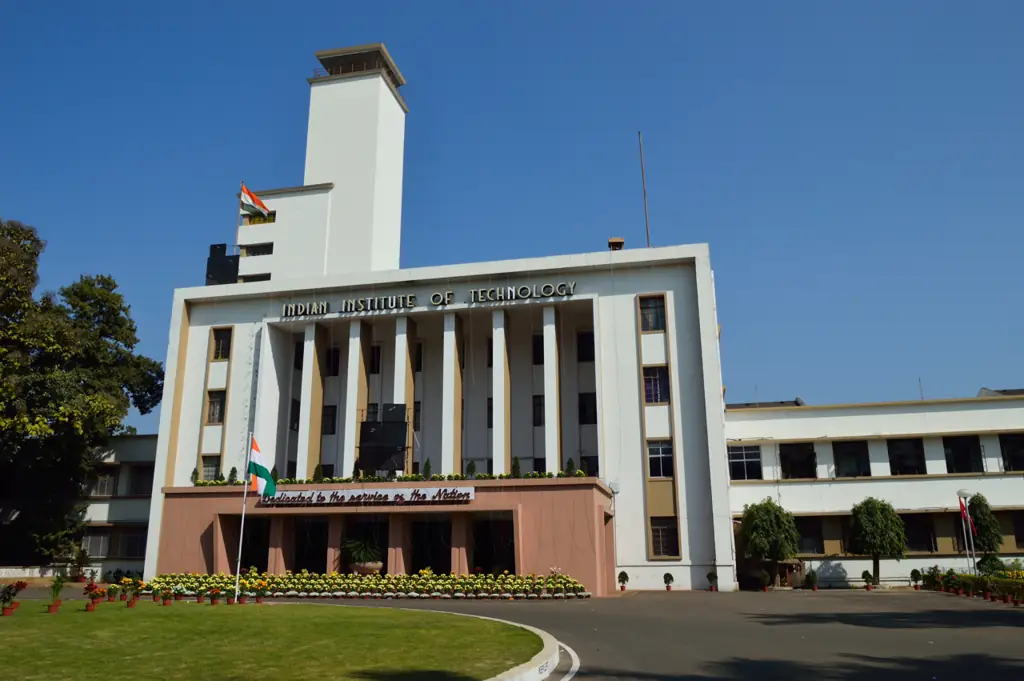

Two things from those five years matter for the rest of the story. First, the advice he was given about space. Speaking to ThePrint, as Hindustan Times reported, he recalled being told, as a fresher, not to join aerospace engineering because there was not much opportunity in it. He studied mechanical engineering. (He comes back to that advice below.)
Second, the itch to build a company started on campus, before he had any idea what it would be. "From my college days itself, I wanted to be an entrepreneur," he told Rediff in December 2022. ThePrint adds that while he was at IIT, a wave of student startups had convinced him "that a business could just start with an idea." That combination, an engineering degree plus a founder's restlessness, sounds like a lot of Kharagpur graduates. What he did next does not.
ISRO, 2012–2018: six years on real rockets
In 2012 he sat an interview for the Indian Space Research Organisation more or less on impulse. "Without any thought, I attended the interview and luckily got selected," he told India Today in December 2021. He said he got in "despite a comparatively low academic performance", and that the three others chosen were among the batch toppers.
The pay was a government scientist's. He has given two figures for it. On CNBC-TV18 he said, per Hindustan Times, "I think my first salary was something like ₹40,000 a month." To ThePrint he said ₹35,000, adding: "We should never, never think about what the pay is." Either way, he knew how the choice looked: "From IIT to joining a government job is very unconventional. I took that leap, I took that risk."
What he got for it was six years inside "ISRO's rocket making centre", the Vikram Sarabhai Space Centre in Thiruvananthapuram. Mint lists the work: he "joined ISRO in September 2012 and worked there until June 2018. His experience included the GSLV Mk-III, the S200 solid stage, the GSLV Mk-II booster and the SSLV programme." Mint also says he became deputy project manager on SSLV, ISRO's small satellite launcher, and won two innovation awards. In 2020 Forbes called him a "systems engineer".
He is clear about what those years did. "I would say, it made me a real engineer even though one studied engineering in college and has a couple of degrees," he told Rediff. ISRO also gave him his co-founder. Naga Bharath Daka, an IIT Madras graduate, worked in the avionics flight computers group at VSSC from 2012 to 2015 before moving to Xilinx. NDTV reports that "while at ISRO, they shared accommodation, became close friends and often dreamt of building a private space company." A rocket company, in other words, that started as flatmates' talk at ISRO.
2017–2018: a draft bill, a question and one cheque
The idea needed a legal opening, and in 2017 one appeared. Moneycontrol tells it this way: the two founders "were working at ISRO when they read a draft of India's Space Activities Bill and saw a clear sign that private companies might soon be allowed to build and launch their own rockets." The bill was not law. No private Indian company had ever launched anything. But the direction was visible to two people who knew exactly how a launch vehicle is built.
The question he kept asking, as he later put it to ThePrint, was simple: "Why can't we build a private rocket company?" His answer to himself was that it "felt like the marriage of two passions: entrepreneurship and rockets." He quit ISRO in June 2018. Skyroot Aerospace was founded in Hyderabad the same month, per IANS, with Chandana as CEO.
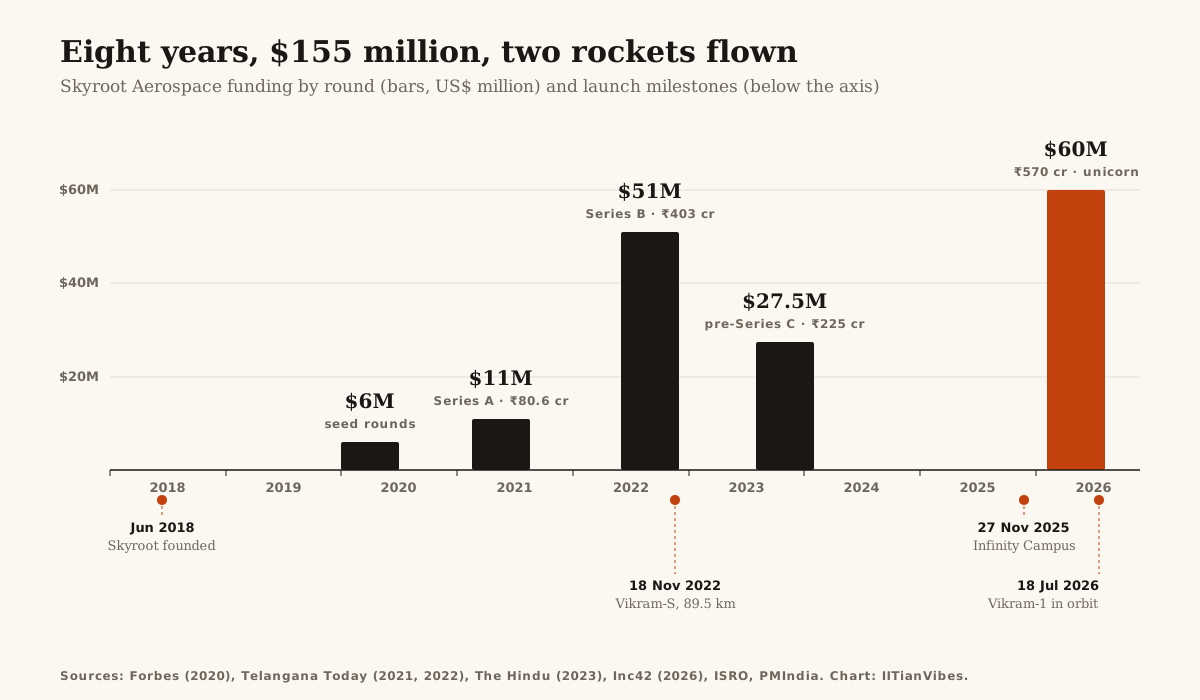
The money was harder than the engineering. "Building a rocket is rocket science, but raising capital was an even bigger rocket science," he told Forbes India in December 2025. Moneycontrol's account is that "The only person who wrote the first cheque was Mukesh Bansal", the founder of Myntra and Cultfit, in 2018. By March 2020, when Forbes put Chandana on its 30 Under 30 Asia list, the company had raised $6 million, "including from Myntra founder Mukesh Bansal, and defense equipment manufacturer, Solar Industries." (Some 2026 coverage names Flipkart's Binny Bansal as the first investor instead. The contemporaneous Forbes profile names Mukesh, and so do we.)
The first institutional round, $11 million (about ₹80.6 crore) in May 2021, was led by Greenko Group founders Anil Chalamalasetty and Mahesh Kolli, with Mukesh Bansal coming back in. Moneycontrol's July 2026 headline says a Bansal investment of ₹12 crore turned into ₹700 crore. That is Moneycontrol's arithmetic, not a disclosed figure, but it tells you what being the first cheque into a company like this can be worth.
Building Skyroot in three scenes, 2020–2025
Scene one: printing engines
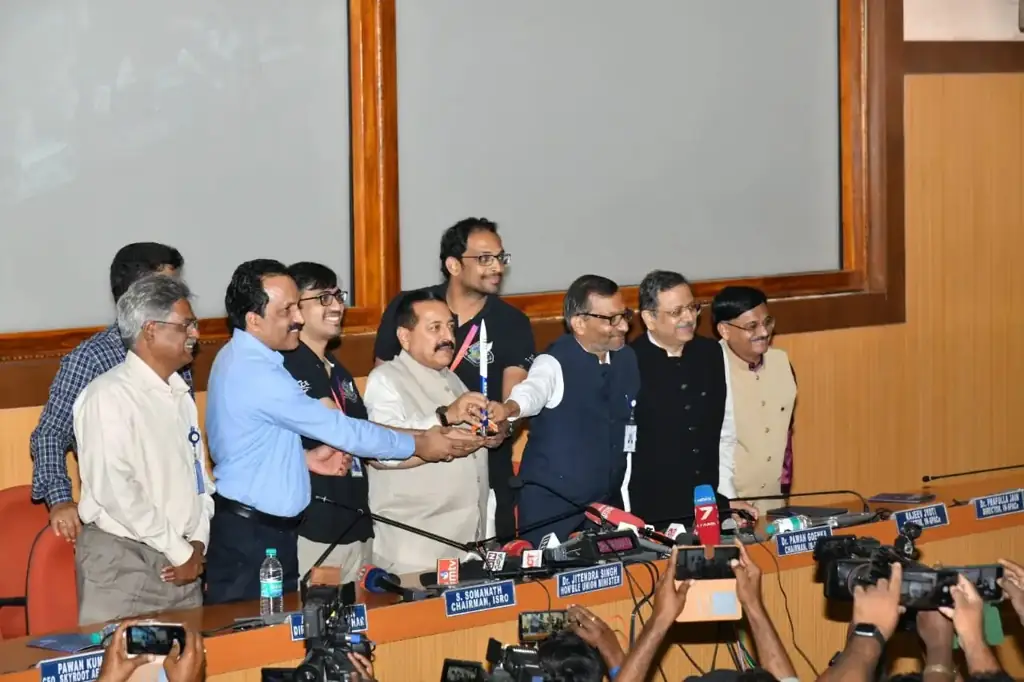
Skyroot's first public proof was an engine, not a rocket. The company test-fired its Raman engine in 2020 and, The Hindu notes, said its fully 3D-printed injector "halved the mass and cut components and lead time by 80%". In November 2021 it fired Dhawan-1, described as India's first privately developed fully cryogenic engine. Chandana's line at the time: it was "developed using 3D printing with a superalloy, reducing manufacturing time by more than 95 percent." Two months earlier, on 11 September 2021, Skyroot had signed a framework MoU with the Department of Space for access to ISRO facilities. Chandana signed it for the company.
Scene two: 89.5 km, 18 November 2022
The first rocket was a test shot. Vikram-S, a sounding rocket, lifted off from Sriharikota at 11.30 am on 18 November 2022 in a mission called Prarambh (beginning). ISRO's own record: it "reached an altitude of about 89.5 km in 155 seconds, as planned" with three payloads on board, and "marks the first launch of a launch vehicle built by a private company in India." It did not go to orbit and was never meant to. It proved that a private company could get IN-SPACe authorisation, fly from ISRO's range and hit its planned altitude.

Scene three: a rocket factory, 27 November 2025
Three years later, the Prime Minister opened Skyroot's Infinity Campus in Hyderabad by video link and unveiled Vikram-I, the orbital rocket. The PMIndia release describes "around 200,000 square feet workspace for designing, developing, integrating and testing multiple launch vehicles, with a capacity to build one orbital rocket every month." For a company that had flown one sounding rocket, that was a bet on volume before the first orbital launch.
The part founders' profiles usually leave out
The dates slipped, repeatedly. In May 2021 Daka said Skyroot had "started bookings for launches starting from mid next year", meaning 2022. In September 2022, Skyroot raised a $51 million Series B led by Singapore's GIC. Daka said the money would get it to "full-fledged commercial satellite launch scale within a year from now." In October 2023, raising $27.5 million led by Temasek, Chandana said the company was preparing for "the launch of our second mission early next year." The orbital launch happened in July 2026. Rockets are late everywhere; it is worth knowing that a founder's timeline is a hope, not a schedule.
| When | What happened | Number | Source |
|---|---|---|---|
| 2007–2012 | Dual degree, Mechanical Engineering, IIT Kharagpur | 5 years | IIT KGP via Jagran Josh |
| Sep 2012 – Jun 2018 | ISRO, VSSC: GSLV Mk-III S200, GSLV Mk-II, SSLV | About 6 years | Mint |
| Jun 2018 | Skyroot Aerospace founded in Hyderabad with Naga Bharath Daka | 2 founders | IANS |
| May 2021 | Series A led by Greenko founders | $11M (₹80.6 cr) | Telangana Today |
| 11 Sep 2021 | Framework MoU with the Department of Space | Access to ISRO facilities | ISRO |
| Sep 2022 | Series B led by GIC | $51M (₹403 cr) | Telangana Today |
| 18 Nov 2022 | Vikram-S, India's first private launch | 89.5 km in 155 s | ISRO |
| Oct 2023 | Pre-Series C led by Temasek | $27.5M (₹225 cr); $95M total | The Hindu |
| 27 Nov 2025 | Infinity Campus opened, Vikram-I unveiled | 200,000 sq ft | PMIndia |
| May 2026 | Round co-led by Sherpalo Ventures and GIC; first space-tech unicorn | $60M; $1.1B pre-money; $155M total | Inc42 |
| 18 Jul 2026 | Vikram-1 reaches orbit on its first flight (Mission Aagaman) | 450 km, 60° | Times of India |
| 30 Sep 2026 | Chandana named to TIME100 Next 2026 | 1,000+ employees | TIME |
18 July 2026: orbit on the first try, and the sceptics' case
The launch window opened on 12 July. The New Indian Express had reported a window from 12 July to 4 August at ISRO's Satish Dhawan Space Centre. The rocket went on 18 July. India Today reported that it "not only aced the launch but also satellite deployment, with all four stages performing nominally on first attempt." The Times of India counted six payloads placed into the targeted orbit at an inclination of 60 degrees; TIME's summary is that Vikram-1 carried two customer satellites. IEEE Spectrum named them: satellites from Skyroot and Indian startup Grahaa Space, a demonstration payload from German startup Dcubed, and a robotic arm for debris removal from Indian startup Cosmoserve.
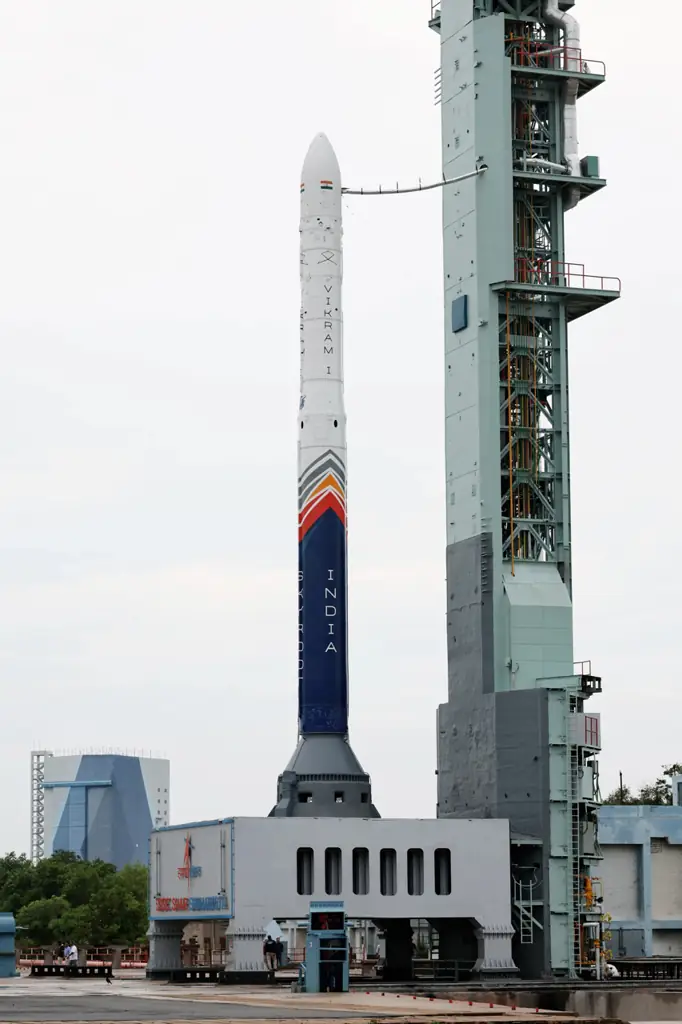

IEEE Spectrum also reported that Skyroot "became the first company to reach orbit on its first attempt." That is the line that turns a startup into a launch company, and this one had promised a launch four years earlier. For Chandana, the meaning was personal before it was commercial. In his ThePrint interview, quoted by Hindustan Times, he connected it to the advice he got as a fresher:
"When I joined IIT itself...the same talk, don't join aerospace engineering because there's not much opportunity there. The space sector today has created employment for 5,000 people in the last three to four years. I think that's just the beginning."
Pawan Kumar Chandana, to ThePrint, as reported by Hindustan Times, July 2026
The sceptics' case is worth reading in full, because it is the right one. Torsten Kriening, CEO of SpaceWatch.Global, wrote, as IEEE Spectrum quoted him: "The graveyard of small launchers is full of companies that flew once and stumbled on flights two, three, and four." And: "That is where failures statistically live." Skyroot is also not alone. The same report lists "Chennai-based Agnikul Cosmos, and Bengaluru-based Astrobase Space Technologies and EtherealX" as Indian launch startups close behind, and adds that whether there is enough demand for several of them "remains to be seen."
What Reddit made of it
The most useful reactions sit in r/ISRO, where the people who follow every Indian launch hang out. On the launch-day thread, "Skyroot Vikram-1 LiftOff!", the top-voted congratulation was simple: "Oh my god. Just magnificent! Many many congratulations, you guys did what only a few would do. Brilliant and inspiring for us all.." (u/arjobmukherjee, 41 upvotes, 18 July 2026). Over in r/IndiaSpeaks, someone watching the post-launch briefing noticed the CEO before anything else: "Yeah I'm hearing the head of the company now, who's so young which is good to see." (u/Odd-Indication-5301, 7 upvotes, 18 July).
The next day, a thread titled "As Vikram-1 reaches orbit, Skyroot faces a steep climb to business success" made the demand argument in plain words. One commenter wrote: "Indian govt and private sector needs to create enough demand for small satellites that can be manufactured and launched by private companies. When ISRO's own rockets hardly launch 5-6 times a year to launch a handful satellites, where's the opportunity for private launch providers to grow?" (u/vineethgk, 9 upvotes, 19 July). The most-upvoted comment in the thread saw an opening instead: "With both airtel, jio at minimum getting into constellation sat business it means there's a window of opportunity for SSLV vendors like Skyroot, Agnikul." (u/reyn_ero, 25 upvotes, 19 July).
By August, when Skyroot said the first stage of its second Vikram-1 was already headed to Sriharikota, the mood in the r/ISRO thread was about speed: "They just opened their new campus last year. Look how fast they can scale. I know it's just an SSLV class rocket but still." (u/Key-Mechanic2565, 28 upvotes, 23 August). That exchange is the whole question in miniature. Building rockets fast is the part Skyroot has now shown. Selling enough launches to keep a factory busy is the part it has not.
Where he is now, and five things an IIT student can take from it
As of early October 2026, the numbers look like this. TIME's citation, written by editor at large Jeffrey Kluger, says Skyroot "currently employs more than 1,000 people and has a valuation of $1.1 billion". That valuation dates from May 2026, when a $60 million round made Skyroot, in Inc42's words, "the first spacetech unicorn of the country", with $155 million raised to date.
Since the launch, investors have been circling at much higher prices. Inc42 reported in August that Skyroot had sought bids at a $2 billion valuation. CNBC-TV18 reported on 24 September, citing Moneycontrol, that Skyroot was in talks to raise $280–300 million from Fidelity, General Catalyst and Benchmark at around $2.8–3 billion. Those are talks, not a closed round. His personal net worth has not been reliably reported anywhere, so we do not estimate it.
The order book is starting to fill. HEX20, which builds spacecraft, has booked three dedicated launches starting in the last quarter of 2027. The first stage of the second Vikram-1 was on its way to Sriharikota by National Space Day in August. Daka told ETV Bharat on 28 September: "Our next mission is planned before the end of this year." Vikram-2, the company's next rocket, is aimed at a debut "hopefully towards the end of next year." The next flight is the one Kriening's warning is about.
Five things his route teaches, none of them about following your passion:
- Your Class 8 marks are not your ceiling. He scored 51 in maths, then cleared JEE on his first attempt after coaching his father pushed for. The gap closed with work, not with talent being discovered.
- The unglamorous first job can be the apprenticeship. He took about ₹35,000–40,000 a month at ISRO and called the move "very unconventional" for an IIT graduate. Six years on the S200 booster and SSLV are why investors believed two ex-ISRO engineers could build an orbital rocket.
- Find your co-founder by working next to them. Chandana and Daka were ISRO colleagues and flatmates before they were founders. You learn how someone handles a failed test in a lab, not at a hackathon.
- Read the policy, not just the news. The trigger for Skyroot was a draft bill the founders read in 2017, a year before they quit ISRO. Founders who read regulation early get a head start that money cannot buy.
- Discount every timeline, including your own. Skyroot promised launches for 2022, then 2024, and flew to orbit in 2026. IEEE Spectrum still called it the first company to reach orbit on a first attempt. Plan for the delay; do not let it stop you.
If Kharagpur is your campus, the IIT Kharagpur hoodies are where we keep the merch. Wear it for the place that took a boy who once scored 51 in maths and sent him to build rockets. For more from the same campus, read our profiles of Sundar Pichai and Surojit Chatterjee, the IIT Kharagpur placements breakdown, and last week's IIT roundup, which covered his TIME listing.
FAQ
What is Pawan Kumar Chandana's educational qualification?
He holds a five-year dual degree from IIT Kharagpur (2007–2012): a B.Tech in Mechanical Engineering and an M.Tech in Thermal Science and Engineering. IIT Kharagpur lists him as a Distinguished Alumnus, "Dual Degree, Mechanical Engineering, 2012". He then spent about six years at ISRO's Vikram Sarabhai Space Centre.
How old is Pawan Kumar Chandana?
Mint and the Times of India report that he was born in 1991, which makes him 34 or 35 in 2026. Mint says he was born in Hyderabad; ThePrint says he grew up in Visakhapatnam. He was on Forbes' 30 Under 30 Asia list in 2020.
Who founded Skyroot Aerospace?
Pawan Kumar Chandana (CEO, IIT Kharagpur) and Naga Bharath Daka (COO, IIT Madras), both former ISRO engineers, founded Skyroot in Hyderabad in June 2018. They had been colleagues at ISRO, where they also shared accommodation.
What is Skyroot Aerospace's valuation in 2026?
Skyroot became India's first space-tech unicorn in May 2026 at a $1.1 billion pre-money valuation, after a $60 million round; it has raised about $155 million in total. In September 2026 it was reported to be in talks to raise $280–300 million at about $2.8–3 billion. That round had not closed.
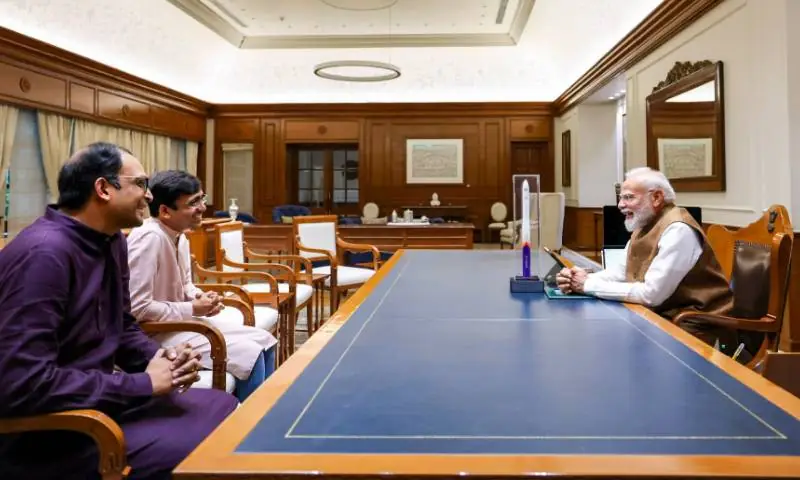
Hero photo: Pawan Kumar Chandana and Naga Bharath Daka, 27 July 2026, PMIndia (pmindia.gov.in). Card design: IITianVibes.
By Arun Raghav S · Co-founder, IITian Vibes · B.Tech, IIT Jodhpur. Last updated: 5 October 2026. Corrections to hello@iitianvibes.com.