

The interview that almost didn't happen
April 1, 2004. Sundar Pichai was sitting in his last Google interview when somebody asked him what he thought of Gmail. Gmail had launched that morning. Pichai had not used it. He was not even sure it was real.
"I had my final interview there in 2004, it was April Fool's Day and the day Gmail launched," he told Stanford's graduating class in 2026. "So when my interviewers asked me about it, I wasn't sure if it was a joke or a real product." Twenty-one years later, the company that almost lost him to a calendar coincidence would pay him a three-year package worth up to $692 million, and he would be running it.
Most current IITians are sold a single story about what success looks like. You crack JEE. You graduate from an IIT. You start a company. You get rich. That is the founder myth. Pichai is the proof that there is a second path, and it might be the higher-leverage one. He never started a company. He has spent his entire career as somebody else's employee. He is also the most powerful IITian alive.
This is the honest profile. The verified parts, the unverified parts, the parts his own alma mater is openly skeptical about. There is no rags-to-riches arc here, because the rags-to-riches story is not true.
The IIT Kharagpur years (1989 to 1993)
The standard Pichai story is that he grew up poor in a two-room flat in Chennai. The first half is true. The "poor" framing is not.
Pichai was born in Madurai on 10 June 1972. His father, Regunatha Pichai, was an electrical engineer at GEC, the British conglomerate. His mother worked too. They lived in a two-room apartment in Ashok Nagar, Chennai. That is genuinely modest by 1980s middle-class American standards. By 1980s Indian standards it is a household with two earning professionals, one of them in a senior engineering role at a multinational. The framing matters because his career story is constantly retold as "rose from poverty". It is more accurately read as "an engineer's son who worked hard and went far".
He went to Jawahar Vidyalaya school, then Vana Vani, the on-campus school at IIT Madras, for Class XII. Vana Vani is a real edge in JEE prep. He cleared the entrance exam and joined IIT Kharagpur in 1989. His exact JEE rank is not publicly verified. Aggregator sites have estimated 1300-1700 but admit "there are no reliable sources." This profile will not invent one.
At IIT Kharagpur he studied Metallurgical Engineering and lived in Nehru Hall of Residence, room B-308. FactorDaily covered his January 2017 return to the campus, when he walked back into Nehru Hall and his old hostel room. The B-308 detail matters because it is one of the few places his story has a real physical address.
The professors who taught him remember a specific thing about his work. Professor Sanat Kumar Roy, who taught Metallurgy at IIT Kharagpur for 44 years and supervised Pichai's BTech thesis along with Professor Indranil Manna, described what he saw in the thesis.
"He was doing work in the field of electronics at a time when no separate course on electronics existed in our curriculum. His thesis dealt with implanting molecules of other elements in silicon wafers to alter its properties. It was very clear from the beginning that he was enthused about electronics and materials."
Prof. Sanat Kumar Roy, IIT Kharagpur Metallurgy department
This is the early tell. Pichai picked Metallurgy. He spent his thesis trying to bend Metallurgy into electronics. He was already pivoting before he had a career to pivot from.
Roy also noted, after Pichai's 2017 IIT Kharagpur visit, that "normally, toppers are expected to join academics because IIT toppers are academic-minded. But Sundar chose a different path and he excelled to the pinnacle of success." That line is the closest reliable corroboration of the widely-circulated "Institute Silver Medal" claim, which I could not verify directly through any iitkgp.ac.in page. The honest version: he was an academically strong student who broke the topper-to-academic norm.
He also met Anjali Haryani at IIT Kharagpur. She was studying Chemical Engineering in the same batch. They became close in college and later married. Two of their kids are now in their twenties.
Stanford, Wharton, McKinsey, and a year of his father's salary
The single most-quoted moment from Pichai's own commencement speeches is what happened when he got into Stanford. He told the 2026 Stanford graduating class directly:
"When the call from Stanford came, my father spent the equivalent of a year's salary to buy my ticket. It was my first time on a plane. When I landed in California, it wasn't exactly as I had imagined."
That is the real stakes line. Not a $1,000 backpack story (a common aggregator embellishment with no primary source). A father spending a year's salary on a plane ticket so his 21-year-old son could try America. Pichai joined Stanford's MS programme in Materials Science and Engineering in 1993.
He was supposed to do a PhD. He did not. As he put it himself in 2026, "I came here fully intending to get my PhD, and to move into academics. Life had other plans, and I needed to get a job sooner. So I left my doctorate program. Stanford was generous to offer me the chance to fulfill the requirements for a master's." He finished the MS in 1995.
From there the chronology is contested across sources, but the dominant reading (Britannica plus Wharton's own alumni magazine) is: he joined Applied Materials in 1995, worked there roughly five years as an engineer and product manager, left in 2000 for Wharton, finished the MBA in 2002 as a Palmer Scholar, which is awarded to the top 5% of the graduating class, then joined McKinsey for roughly two years.
By 2004 he was at McKinsey doing the kind of consulting work that gets you partner by 35 if you stay. He did not stay. He took an interview at Google.
He went through five rounds. By the fourth, when someone asked if he had seen Gmail (invite-only at the time), he said no. The interviewer showed it to him. He came back to the fifth round and critiqued it. That answer got him hired.
His first role at Google was Product Manager for Google Toolbar. Toolbar was the product that pushed Google default search through every browser that mattered, feeding the AdWords targeting engine. It was not a glamour role. It was a strategic one. He was 32.
Building Chrome, then Android, then both at once
Scene 1: The six-year fight against Eric Schmidt
The first thing Pichai did at Google that mattered was decide Google needed its own browser. Eric Schmidt, then CEO, did not agree. For six years he blocked the project.
Schmidt's stated reason, preserved in Wikipedia's Chrome article citing contemporaneous Google leadership accounts, was that "at the time, Google was a small company, and he did not want to go through bruising browser wars." Microsoft's Internet Explorer was 90+ percent of the market. Firefox was the credible alternative. Schmidt thought Google would lose. Pichai disagreed.
Pichai's argument, made repeatedly through 2006 and 2007, was that the browser would soon be more important than the operating system, because most of what people did with computers happened inside it. Page and Brin eventually had Pichai's team build an internal Chrome demo and showed it to Schmidt themselves. Schmidt's later quote, when asked why he reversed: "It was so good that it essentially forced me to change my mind."
Scene 2: Chrome ships, 2 September 2008
The browser launched as a public beta on 2 September 2008, for Windows XP and newer, in 43 languages. Google had prepared a 38-page Scott McCloud comic to explain it to bloggers. The comic leaked a day early when European review copies shipped early to a German blogger. Google moved the launch up to match. Pichai had spent the previous two years running point on the engineering and design teams.
Chrome reached 1% market share by December 2008, 10% by mid-2010, and the global number-one slot by mid-2012. By 2024 it was 65%+ of desktop and a similar share of mobile through Android. It is the single most consequential product Pichai built and the last product he built that meaningfully shifted user behaviour. Hold that thought.
Scene 3: The Twitter offer and the $50 million counter
By January 2011 Pichai ran Chrome and Chrome OS. Twitter was at a stage where it badly needed product leadership. AllThingsD broke the story on 8 January 2011: "Sundar Pichai, the man in charge of Chrome and Chrome OS at Google, is being aggressively courted by Twitter to be its next head of product, according to sources with knowledge of the situation."
Google responded by retaining him. TechCrunch reported in April 2011 the counter package was "Google offered Pichai $50 million and Mohan $100 million, respectively, to stay... Google grants restricted stock to the employee that vests over time (two years in the case of Sundar and 3 or 4 years with Neal, says one source)." That figure tells you what 2011 Google's leadership thought he was worth. It also tells you he had outside leverage and used it.
Two years later, on 13 March 2013, Larry Page wrote a Google blog post handing him Android. Andy Rubin, who had built Android, was leaving. Page wrote: "Going forward, Sundar Pichai will lead Android, in addition to his existing work with Chrome and Apps... Sundar has a talent for creating products that are technically excellent yet easy to use—and he loves a big bet." Pichai was now running Chrome, Android, and the Google apps stack simultaneously. He was 41.
The CEO years: absorbing blows that would have ended a founder
On 10 August 2015 Larry Page wrote one of the most quoted CEO succession memos of the decade. It was titled "G is for Google." Buried inside the announcement that Page would step aside to run a new holding company called Alphabet was this passage:
"Sundar has been saying the things I would have said (and sometimes better!) for quite some time now, and I've been tremendously enjoying our work together. He has really stepped up since October of last year, when he took on product and engineering responsibility for our Internet businesses. Sergey and I have been super excited about his progress and dedication to the company. And it is clear to us and our board that it is time for Sundar to be CEO of Google." In 2019 Page would step down from Alphabet too, and Pichai would become CEO of both.
Look at what followed and ask whether a founder would have survived it.
August 2017: A Google engineer named James Damore wrote a 10-page memo arguing that women were biologically less suited to engineering. Pichai fired him with a public memo: "portions of the memo violate our Code of Conduct and cross the line by advancing harmful gender stereotypes in our workplace." The political right called it cancel culture. The left said it was the bare minimum. Pichai held the position.
2018, Project Maven: Roughly 4,000 Google employees signed a petition demanding Google cancel its Pentagon AI contract. About a dozen engineers resigned. Pichai issued Google's AI Principles in June 2018, declaring that the company would not pursue technologies "likely to cause overall harm" or those whose principal purpose was to "cause or directly facilitate injury to people." The Maven contract was allowed to expire. Google walked away from one of the biggest federal contracts on offer.
December 2018, Project Dragonfly: Pichai testified to the House Judiciary Committee about Google's plan to build a censored search engine for China. The project had over 100 employees at peak. Under questioning he committed: "Right now, there are no plans for us to launch a search product in China." The project was quietly killed.
20 January 2023: Pichai wrote the largest layoff memo in Google's history. He cut 12,000 jobs.
"I have some difficult news to share. We've decided to reduce our workforce by approximately 12,000 roles," he opened. Then the line that most CEOs do not write: "The fact that these changes will impact the lives of Googlers weighs heavily on me, and I take full responsibility for the decisions that led us here. Over the past two years we've seen periods of dramatic growth. To match and fuel that growth, we hired for a different economic reality than the one we face today."
8 February 2023: Three weeks after the layoffs, Google demoed Bard, its ChatGPT competitor. In the demo, Bard wrongly claimed the James Webb Space Telescope had captured the first image of an exoplanet (it was actually the European Southern Observatory's Very Large Telescope, in 2004). Alphabet shares fell 7.7% on the day, wiping $100 billion off the market value.
27 February 2024: Gemini, the renamed and rebuilt successor to Bard, started generating historically inaccurate images (Black Founding Fathers, female popes, dark-skinned Nazi-era soldiers). Pichai sent an all-hands internal memo: "I know that some of its responses have offended our users and shown bias — to be clear, that's completely unacceptable and we got it wrong."
5 August 2024: US District Judge Amit Mehta ruled in United States v. Google that "Google is a monopolist, and it has acted as one to maintain its monopoly." The judgement is the most significant antitrust ruling against a US tech company since Microsoft in 2000. Google has appealed. The case is currently at the DC Circuit. A potential Chrome divestiture remains on the table.
Now read that list of seven crises and ask: how many of them would a founder-CEO have survived? Travis Kalanick lost Uber over less. Adam Neumann lost WeWork over less. Elon Musk has consumed Tesla shareholder value over far less. Pichai absorbed every one of these blows and stayed. That is not a coincidence. That is the operator skill set. Founders are by nature defensive of their creation. Operators are by nature defensive of the system. The system survives. The founder ego does not.
Where he is now, and what current IITians should learn
In March 2026 the Alphabet board approved Pichai's new three-year package. Fortune reported the headline value at up to $692 million, including $2 million annual salary, no bonus, and equity awards tied to Alphabet stock plus Waymo and Wing performance. That is approximately ₹5,765 crore at current exchange rates.
Alphabet's Q1 2026 revenue came in at $109.9 billion, growing 20% year-on-year, with net income of $62.57 billion (up 81%) and Google Cloud revenue of $20.02 billion (up 63%). Google is, by any conventional measure, dominating. Pichai's package is set up to pay him for stewarding it.
He is also publicly admitting it is not enough. On 1 June 2026, in a Hard Fork podcast appearance, he conceded the competitive ground that had been the unmentionable thing inside Google all year. "When it comes to agentic coding with tool use, and instruction following, long-horizon tasks, I think we are a bit behind at this moment." The most powerful IITian alive saying out loud that Anthropic's Claude is doing the hardest part of AI better than Google's Gemini. He was not asked to say this. He volunteered it.
Now here is the part nobody else publishing a Pichai profile is going to print.
What KGPians actually say about him
His own alma mater is openly skeptical of his legacy. On r/iitkgp, in a thread half-jokingly suggesting Pichai should give every KGPian free Gemini Pro for life, one of the top-rated replies (20 upvotes, March 2026) said the thing nobody else says:
"Bro he is not giving to Stanford and you think he will give it to KGP??? literally i dont understand the CEO hype this all CEOs CTOs all are studied in US top University even an low level pvt college student get selected in US top university and Become the Anthropic CTO Pytorch Cofounder MSFT CEO. even I dont think Pichai give any giving back donation to [KGP]"
u/EnvironmentalSuit811, r/iitkgp (March 2026, 20 upvotes)
That is a current KGPian, on his alma mater's own subreddit, saying he does not really understand the hype and pointing out, correctly, that Pichai does not appear to have endowed a chair or a fellowship at IIT Kharagpur. Stanford has not received one either, beyond his commencement appearance.
The discipline of an honest profile is to leave that quote in. Pichai is the most successful IIT alumnus by net worth, by power, by reach. He is also, by his own community's reckoning, an opaque benefactor at best.
The career milestones, the verifiable timeline
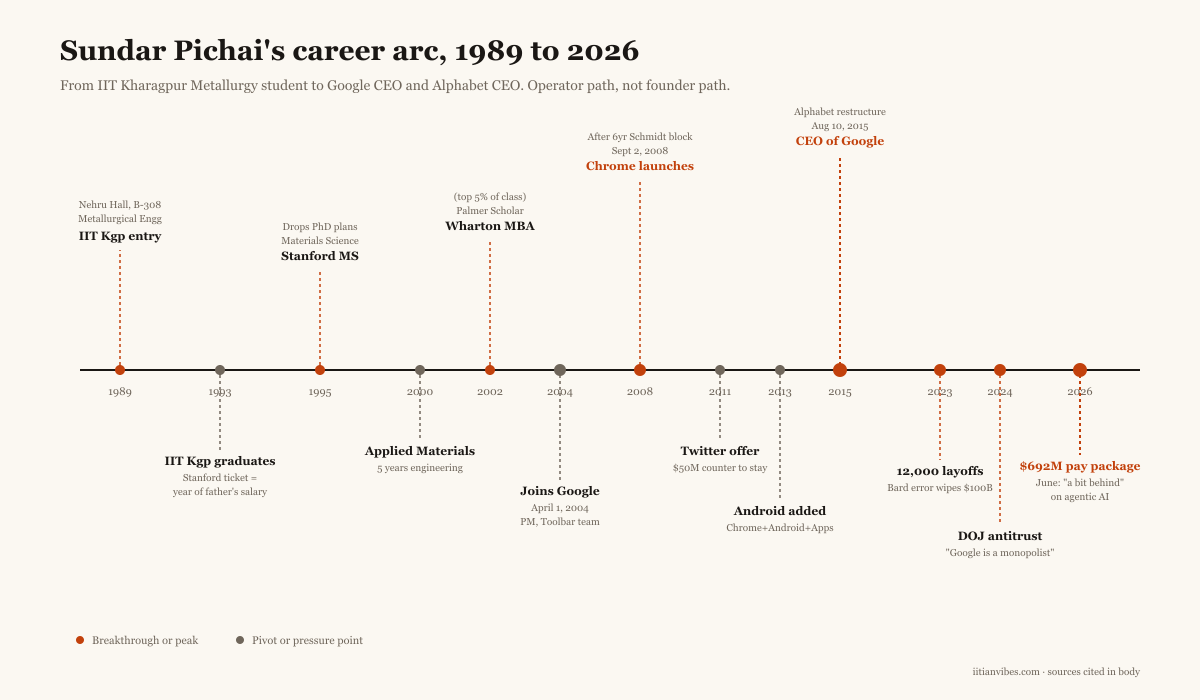
| Year | Milestone | Source |
|---|---|---|
| 1989 | Enters IIT Kharagpur, Metallurgical Engineering, Nehru Hall B-308 | FactorDaily on-site, 2017 |
| 1993 | Graduates IIT Kharagpur; admitted to Stanford | Wikipedia / TOI primary chain |
| 1995 | Completes Stanford MS, Materials Science (PhD dropped) | Pichai, 2026 Stanford Commencement |
| 2002 | Wharton MBA, Palmer Scholar (top 5%) | Wharton Magazine |
| 2004 | Joins Google as PM, Toolbar team | ProductPlan |
| 2008 | Google Chrome ships (2 September) | Wikipedia, contemporaneous sources |
| 2011 | Twitter offer; Google $50M counter to retain | TechCrunch, April 2011 |
| 2013 | Takes over Android (13 March) | Larry Page memo, blog.google |
| 2015 | CEO of Google (10 August), Alphabet restructure | Larry Page, "G is for Google" |
| 2023 | 12,000 layoffs (Jan); Bard demo wipes $100B (Feb) | Pichai memo; CNN |
| 2024 | DOJ antitrust ruling: "Google is a monopolist" | White & Case summary |
| 2026 | $692M pay package; admits Google "a bit behind" on agentic AI | Fortune; CNBC |
What current IITians can actually take from this
Five honest takeaways. None of them are "follow your dreams."
1. Operator is a path. Most IITians are sold the founder myth. The standard IIT narrative says the high-status outcome is starting a company. Pichai's entire career argues against that. He has been somebody else's employee for 30+ years, and he is the most powerful IITian alive. If your skill set is judgement plus diplomacy plus product taste, the founder path may actively underprice you. The operator path has fewer celebrities and substantially more leverage.
2. The IIT advantage compounds when you keep pivoting. Pichai studied Metallurgy. He wrote his thesis on electronics in silicon wafers. He did Materials Science at Stanford, then management at Wharton, then consulting at McKinsey, then product at Google, then management of products, then CEO. Every transition added a layer rather than discarding one. If you are an IITian locked into "I am a CSE / Mech / Met person", that framing is the cap on your career.
3. Stay the diplomatic builder. Pichai's actual superpower is absorbing pressure that breaks founders. Walk the seven CEO-era crises again. Maven, Damore, Dragonfly, layoffs, Bard, Gemini, DOJ. Founders detonate under that pressure because their ego is wedded to the product. Operators survive it because their ego is wedded to the system surviving them. Pick whichever, but pick consciously.
4. The uncomfortable critique is also true. Pichai has not built a product that mattered since Chrome in 2008. A 2024 r/developersIndia thread on his net worth (203 upvotes, 66 comments) captured this with surgical accuracy: one of the top-rated comments (75 upvotes) noted "after Chrome (which he worked on), there isn't something valuable which came out of Google recently. And whatever value comes out, it get killed easily." Killedbygoogle.com exists for a reason. Operating is not the same as creating. It is a real distinction. Decide which one you want to be.
5. Whatever path you pick, do not forget where you came from. Pichai is the most successful IITian alive. KGPians on his own subreddit are visibly cynical about how much he has actually given back. Whether they are right or wrong, the perception itself is the lesson. The IIT brand built you. At some point in the next 30 years, decide what you owe back to it and pay that bill openly. The community remembers.
If you are an IIT Kharagpur student reading this, we make merch for your campus. If you are at a different IIT, we probably make merch for yours too. Pichai's career is the long bet. Wearing your institute on your chest is the short one. Both are valid.
Last updated: June 2026. This profile is updated as Pichai's CEO arc continues. If you spot a factual error or a missing primary source, please reply to this post and we will verify and correct.