Founder Stories · IIT Delhi · 1971–1976
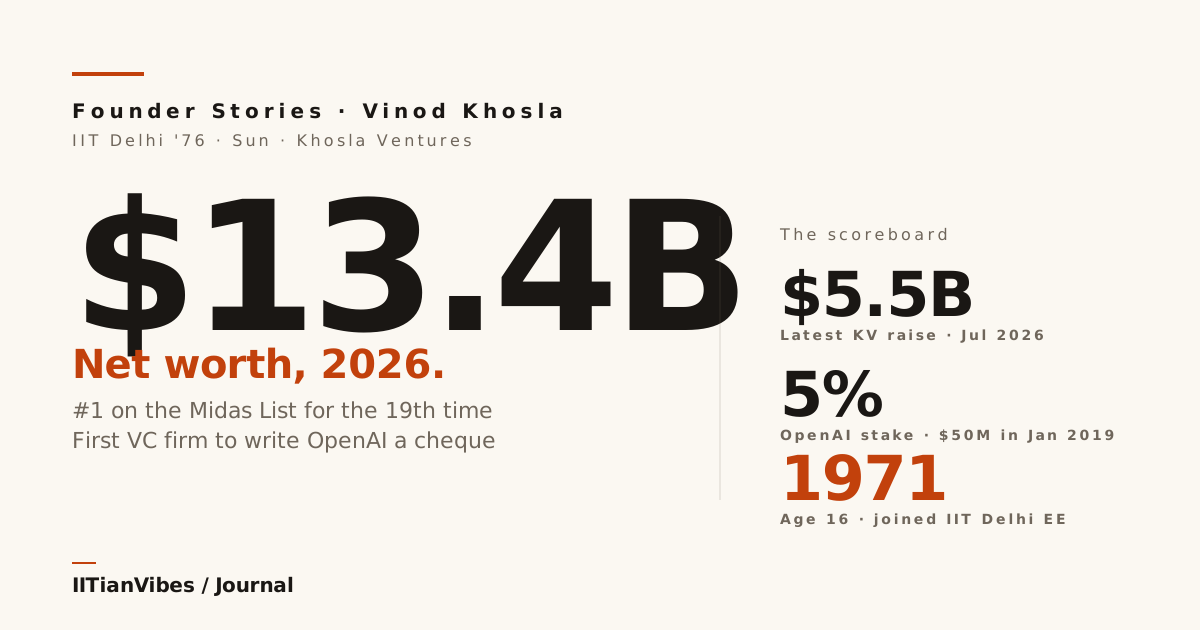
Vinod Khosla is the ur-IITian of Silicon Valley — the first IIT graduate to co-found a decacorn (Sun Microsystems, 1982), the first venture firm partner to write OpenAI a cheque (₹417 crore / $50M in January 2019, for what became a 5% stake), and in 2026 the loudest Indian-American voice on AI-driven job displacement. As of 2 August 2026, Forbes puts him at $13.4 billion, ranked #227 in the world and #1 on the Midas List for the nineteenth time (Forbes profile). Last month, Khosla Ventures started raising up to $5.5 billion across three funds — the largest raise in its two-decade history (Bloomberg, 23 Jul 2026).
But the relationship between Khosla and the IIT system he came from is thinner and more provocative than the community narrative suggests. Search r/IITDelhi and you'll find exactly one post about him in the last two years — one upvote, zero comments. Khosla's own advice to Indian students, delivered on stage in Bengaluru: "Not getting into IIT is just one small failure. Keep pursuing your dream." (Global Indian, May 2025). This is what he says in 2026, and how the batch of 1976 became the man now telling IITians the exam that got them in is overrated.
The IIT Delhi years: age 16, first computer club, "formative"
Khosla joined IIT Delhi in 1971 at the age of 16 and graduated with a B.Tech in Electrical Engineering in 1976 (Wikipedia; also from his own account at the IIT Delhi Alumni Interaction Series fireside chat, 24 October 2019: "I was 16 when I joined here."). Born 28 January 1955 to a Punjabi family in Pune, Khosla's father was an officer in the Indian Army posted to New Delhi, and wanted his son to also join the army (Wikipedia). Vinod chose electrical engineering instead. In the same fireside chat, he summarised what those five years actually gave him:
"IIT Delhi was just a beautiful experience for me, very formative. […] What I learned at IIT Delhi was to think a certain way." — Vinod Khosla, IIT Delhi Alumni Interaction Series, 24 Oct 2019
The most consequential story from his IIT years, told in his own words in an August 2025 podcast transcript, is about a hobby club: "When I started at IIT Delhi, there wasn't a single computer programming class at any IIT anywhere in India. We started a computer programming club and started the first real class in programming at any IIT as a hobby club in IIT Delhi." This is Khosla's own account — we've not independently verified it against IIT Delhi's archival records — but the shape of the story tracks with a return-visit talk on 9 August 2019, where he named his best IIT memory as an IT-staff strike that gave his computer club unrestricted access to the campus computer centre. He declined, on record, to discuss his "crazy 3 AM things" from Nilgiri hostel.
The 1971 cohort at IIT Delhi is the batch that shipped Khosla, and one line from his 2025 transcript captures why the timing mattered: "I joined IIT in 1971, so that was interesting." In 1971, computer programming as a curriculum did not exist at any Indian technical institute. Khosla left in 1976 with a way of thinking about problems that would outlast the specific subjects. That's the accurate summary of what IIT gave him, in his own framing.
1976–1982: Carnegie Mellon, Stanford, and the road to Sun
Khosla left India for a master's at Carnegie Mellon (biomedical engineering) and then an MBA at Stanford Graduate School of Business, graduating in 1980. His first venture attempt — a soy-milk company for the Indian market — failed. His second — Daisy Systems, an early computer-aided design startup, co-founded in 1980 — worked. But it was the co-founding of Sun Microsystems in February 1982 that put him in the Silicon Valley canon.
Sun had four co-founders: Khosla, Andy Bechtolsheim (whose Stanford SUN hardware became the founding product), Scott McNealy (from Onyx Systems), and Bill Joy (of Berkeley Unix). Khosla was Sun's founding chairman and CEO from 1982 to 1984, then left the company for venture capital (Wikipedia: "He served as the first chairman and CEO from 1982 to 1984, when he left the company to become a venture capitalist."). What Sun eventually became: peak revenue of $13.8 billion in FY2007-08, acquired by Oracle on 27 January 2010 for $7.4B (Wikipedia). The SPARC processor architecture that made Sun's workstations a category-defining product launched in 1987 — two years after Khosla had already moved on.
Khosla joined Kleiner Perkins as a general partner in 1986, alongside Sun's board member John Doerr. He spent the next 18 years at KPCB, then spun out to found Khosla Ventures in 2004. Read that carefully: he was CEO of one of the most consequential Silicon Valley firms of the 1980s for two years, then flipped to venture capital, and has now been in venture for four decades. The Sun chapter, huge as it is in the narrative, is a smaller share of his working life than KV alone.
Khosla Ventures 2004–2026: $5.5B raise, 67 unicorns, and the OpenAI first-cheque
Khosla Ventures' stated thesis, published on the firm's own site, is bigger than most VC pitches allow themselves to sound: "the proposition that the resource-rich lifestyle currently enjoyed by roughly 800 million people can, with the right technology platforms, be extended to all eight billion." That's the framing that lets KV back climate tech, precision agriculture, alternative meat (Impossible Foods), health diagnostics, and — most consequentially — the earliest institutional stake in OpenAI.
Per KV's own biography of Khosla: "In January 2019, he led KV's $50 million investment in OpenAI, making KV the first venture firm to invest in the company." TechCrunch reported in February 2025 that this initial $50 million cheque yielded a 5% stake in OpenAI — a position that, at OpenAI's implied valuations in 2025-26, is worth many multiples of KV's entire prior fund performance. This one deal alone is the reason Khosla is #1 on the 2026 Midas List for the nineteenth time.
KV in 2026 — the scale
| Metric (as of July 2026) | Number | Source |
|---|---|---|
| Companies invested in (all-time) | 804 | Tracxn |
| Unicorns in portfolio | 67 | Tracxn |
| Investments made in 2025 | 112 | Tracxn |
| Investments YTD 2026 | 57 | Tracxn |
| New investments in last 12 months | 64 | Tracxn |
| Latest fund raise (three funds, in progress) | Up to $5.5B | Bloomberg, 23 Jul 2026 |
| Midas List position 2026 | #1 (19th appearance) | Forbes |
| Personal net worth | $13.4B | Forbes, 15 Jul 2026 |
The $5.5B raise breakdown, per Bloomberg: roughly $1 billion for seed-stage, $2 billion for early-stage, and $2.5 billion for the opportunity fund. It follows a $3.5B raise in February 2025 (TechCrunch) — meaning KV has raised, or is raising, close to $9 billion in fresh capital in eighteen months. This is not a firm winding down.
What Khosla is saying in 2026 — the loudest single voice on AI job displacement
In a March 2026 Fortune interview with editor-in-chief Alyson Shontell, Khosla laid out the frame that has since anchored most of his 2026 public commentary:
"The single biggest issue I believe in the 2028 presidential election will be fear of AI. I think the single biggest danger to AI is not AI capability or lack thereof. The single biggest danger to AI adoption is politics." — Vinod Khosla, Fortune, 24 Mar 2026
His prediction on jobs, from the same interview: "There will be massive job dislocation. Will there be new kinds of jobs? Maybe, maybe not. I don't know. There's very few things AI won't be able to do today in next few years." His proposed policy response: "AI will favor capital over labor in the historical capital versus labor battle. If we equalize those two, we can be tax neutral and eliminate 125 million people off the tax roll."
In a follow-up Fortune piece on 27 July 2026, Khosla amended Elon Musk's post-money-abundance prediction with a political qualifier: "only if the politics permits this great abundance." He warned of a two-tier AI dystopia: "AI could create a world where a small elite thrives while the rest face economic instability, especially in a democracy that drifts without [active policy intervention]."
The line that lit up Indian tech Twitter this year came from India AI Impact Summit 2026, held at Bharat Mandapam on 19 February 2026 — a summit inaugurated by Prime Minister Narendra Modi. In a fireside moderated by Peak XV Managing Director Mohit Bhatnagar, Khosla said:
"If somebody has worked at Cisco for 15–20 years, I consider them unemployable in the real economy." — Vinod Khosla, India AI Impact Summit 2026, 20 Feb 2026 (source thread)
Same event, second-order prediction: "India's traditional IT and BPO services sectors will almost completely disappear by 2031 due to AI disruption." Read that against the fact that India's IT services industry employs roughly 5 million people directly and drives ~7.5% of GDP. Khosla is telling one of India's most valuable economic sectors, at a summit inaugurated by the Prime Minister, that it has five years to become something else.
The India + IIT contradiction: speech vs cheques
Here is the honest tension the community rarely names. Khosla speaks at IIT Delhi (2019 fireside, October). Khosla speaks at India AI Impact Summit (February 2026). Khosla speaks to Indian aspirants on Global Indian's cover in May 2025. He does not, at anywhere near the same rate, invest in Indian founder-led companies.
Khosla Ventures' most recent named India-connected deal is a $25 million check into Broccoli AI in July 2026, per exchange4media. Broccoli AI's co-founders — AJ Jain and Aditya Ketkar — are BITS Pilani Goa alumni. Not IIT. The one recent COVID gesture recorded on record was an April 2021 offer to fund oxygen imports for Indian hospitals during the second wave (Wikipedia). Khosla and his wife Neeru have been Giving Pledge signatories since 2011, but the concentrated Khosla philanthropy in India is not a public story.
The community read is thin. From r/india, 1 February 2016 (46 upvotes), user u/givehaircuttoramdev unpacked a Khosla talk in Bengaluru:
"A few years ago Vinod Khosla was in Bangalore, speaking to a crowd of engineers. He said he was surprised about people going from India to study English major at Stanford. He also joked about them and the crowd laughed and cheered him […] A society that has only engineers would be severely imbalanced and not be able to to deal with the issues facing it." — u/givehaircuttoramdev, r/india, Feb 2016
The subreddit that should have the most to say about him — r/IITDelhi — has exactly one Khosla post in the last two years. 1 upvote. 0 comments. That is the actual community engagement level with the man widely called the most successful IIT Delhi alum in Silicon Valley history. He is more visible in US venture press than in the daily conversation of the campus he came from.
What Khosla actually tells IITians in 2026
His signature career-strategy quote, delivered in the Global Indian cover story (paraphrasing George Bernard Shaw):
"The reasonable man adapts to the world; the unreasonable one tries to change it. All progress depends on the unreasonable man." — Vinod Khosla, Global Indian, May 2025
His view on standard VC math, from the same interview: "I haven't used IRR in 20 years." That is the entire venture-capital industry's core return metric. Khosla says he doesn't use it. What he uses instead is a hit-rate framework — a small number of extreme outcomes that pay for everything else. The OpenAI cheque is the pattern: $50M in, 5% stake, and the payoff exceeds every disappointing bet KV has ever made.
His view on failure, from the 2019 IIT Delhi fireside: "Failures is where you learn the most. As long as failure doesn't kill you, failure doesn't hurt." And on luck: "At least 80% of my life is about luck." That is a striking admission from the ur-IITian success story — a public rejection of the deterministic "IIT → Sun → billionaire" fable that Indian aspirational culture wants to build around him.
The three concrete pieces of advice a JEE 2026 aspirant should take from a Khosla profile:
- Not getting into IIT is one failure, not the failure. He said this on the record in May 2025. Read it against the JEE 2026 anxiety spike and treat it as the corrective.
- Twenty years at a stable large tech firm may be the wrong bet in an AI-eating market. He called Cisco 15-20-year veterans "unemployable in the real economy" in Feb 2026 at Bharat Mandapam. Whether or not you agree, the framing is: optionality > tenure.
- The path from IIT to consequence is a way of thinking, not a subject. His own summary of what IIT gave him: "IIT Delhi taught me to think a certain way." Not calculus, not thermodynamics — a mode of attack on problems. Optimise for that mode, not for the coursework.
The bottom line — 50 years after IIT Delhi
Vinod Khosla left IIT Delhi in 1976 as a 21-year-old electrical engineer with a hobby-club programming background and moved to Pittsburgh for graduate school. Fifty years later, he is #1 on the Midas List for the nineteenth time, has just started raising $5.5 billion, holds the earliest institutional stake in OpenAI, and is the most-quoted Indian-American voice on where AI is taking the labour market. He is not, however, the concentrated India-tech investor the community narrative sometimes wants him to be. His engagement with India is real but skewed to speech — big speeches at big summits — over cheques.
Read that as the honest arc, not a criticism. The value of a Khosla profile for an IITianVibes reader is precisely in resisting the "he's ours" flattening and reading the actual record: what he built, what he backed, what he said, what he warned. That record is more useful than the tribute.
Frequently asked questions
Which IIT did Vinod Khosla attend and when?
Khosla attended IIT Delhi from 1971 to 1976 for a B.Tech in Electrical Engineering. He was 16 when he joined and 21 when he graduated. Sources: his own account at the IIT Delhi Alumni Interaction Series fireside chat (24 October 2019), Wikipedia, and IIT Delhi's Distinguished Alumnus listing.
What is Vinod Khosla's net worth in 2026?
$13.4 billion as of 15 July 2026, per Forbes — ranked #227 in the world. He is #1 on the 2026 Midas List of top venture capitalists, for the 19th time. Wikipedia lists $15.6B (May 2026) — the delta is a market-cap correction across snapshots, not a data error.
Was Vinod Khosla really OpenAI's first investor?
Khosla Ventures was the first venture firm to invest in OpenAI, leading a $50 million check in January 2019 that yielded a 5% stake (per TechCrunch's Feb 2025 reporting). This was a firm-first, not an individual-first — OpenAI's founding donors in 2015 included Elon Musk, Reid Hoffman, Peter Thiel, Amazon, and Infosys. But the first *venture firm* was KV.
What did Vinod Khosla say about IIT in 2025-26?
His most-quoted line to Indian aspirants, from a May 2025 Global Indian cover story: "Not getting into IIT is just one small failure. Keep pursuing your dream." His most-quoted line to Indian IT workers, from India AI Impact Summit 2026: "If somebody has worked at Cisco for 15-20 years, I consider them unemployable in the real economy." He also predicted India's traditional IT and BPO services sectors will "almost completely disappear by 2031."
Does Khosla Ventures invest heavily in Indian founders?
Not proportionally to its size or Khosla's rhetorical India engagement. Khosla Ventures' most recent named India-connected deal is a $25 million check into Broccoli AI (July 2026) — co-founded by BITS Pilani Goa alumni, not IIT. Khosla speaks in India at high-profile events (India AI Impact Summit at Bharat Mandapam, Feb 2026) more often than he writes cheques into India-headquartered startups.
Sources: Wikipedia (Vinod Khosla, Sun Microsystems), Khosla Ventures own site (team bio, IIT Delhi 2019 fireside), Forbes profile (updated 15 July 2026), Bloomberg ($5.5B raise, 23 Jul 2026), TechCrunch (Feb 2025), Tracxn portfolio scale, Fortune March 2026, Fortune July 2026, Global Indian May 2025, Singju Post Aug 2025 transcript, BSP-IIT Delhi campus visit (Aug 2019), Exchange4Media (Broccoli AI deal, Jul 2026), Reddit atoms verified via arctic-shift API. Last updated: 3 August 2026.
Repping IIT Delhi? Shop official IIT Delhi merchandise — hoodies, tees, oversize tees, varsity jackets and caps. Free shipping across India.
By Arun Raghav S · Co-founder, IITian Vibes · B.Tech, IIT Jodhpur · Published 3 August 2026. Corrections to hello@iitianvibes.com.