
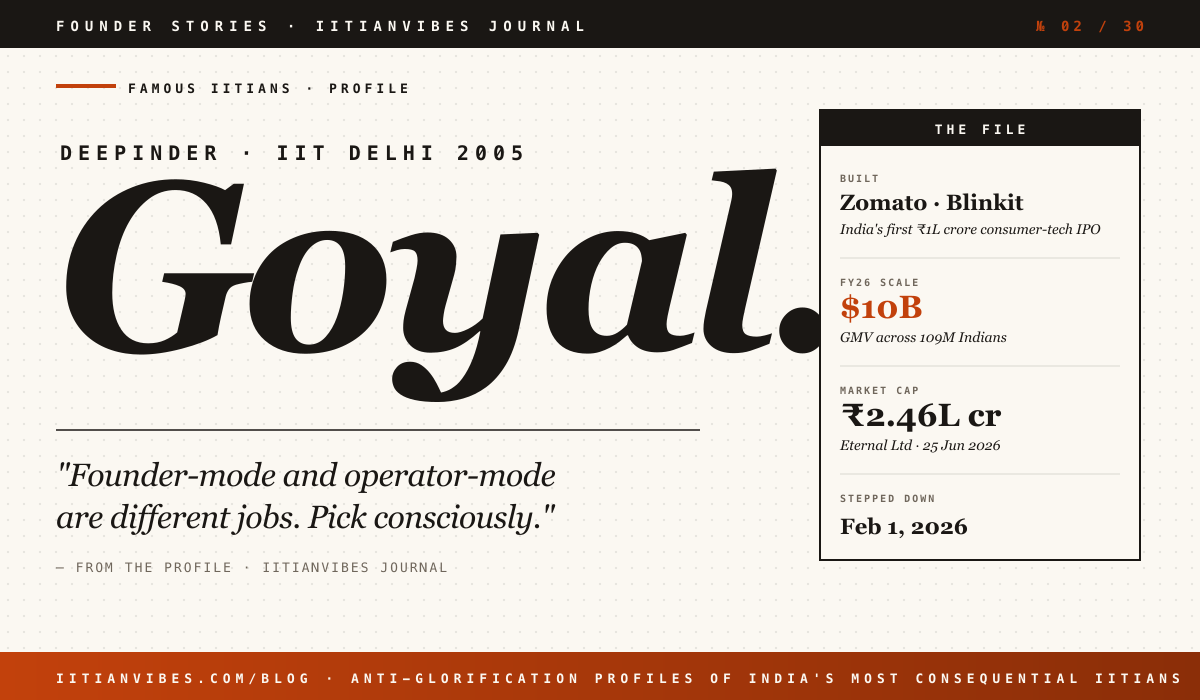
January 21, 2026. Deepinder Goyal sent the email at 4:08 PM IST. He was stepping down as CEO of Eternal, the Rs 2.46 lakh crore listed parent of Zomato, Blinkit, Hyperpure and District. Albinder Dhindsa, the Blinkit founder who had run quick commerce since the 2022 acquisition, would take the Group CEO chair from February 1. Goyal would stay on as Vice Chairman and director, but the operating job was over.
"This is a change in title, not in commitment toward outcomes," he wrote in the letter to shareholders. "Eternal remains my life's work."
It was a strange line for a company worth more than HUL's free float and almost three times Swiggy's market cap to absorb. The man who had taken Zomato from a scanned-menu PDF on a Bain & Co intranet to India's first ₹1 lakh crore consumer-tech IPO in July 2021 was leaving the corner office to chase a brain-health wearable, a neural-research lab, and an aviation startup. The Sundar Pichai story, covered in this Journal, was the IITian who proved operator-mode beats founder-mode. Goyal is the inverse. He built the category, then walked away while the Reddit community he employed turned on him. This is the honest profile.
The IIT Delhi years (2000 to 2005)
Goyal entered IIT Delhi around 2000 and graduated in 2005 with an Integrated M.Tech in Mathematics and Computing. This is the only IIT credential the institute itself confirms. The official IIT Delhi Distinguished Alumni Award record lists him as #388, Award Year 2020, Degree Year 2005. The DAA citation states he "received an Integrated M.Tech. in Mathematics and Computing from IIT Delhi in 2005," verbatim from the institute.
Notice what is not in that record. No JEE rank. No hostel allocation. No professor anecdotes. The "I failed twice at IIT" line that circulates on LinkedIn and Quora has no primary source. Every verifiable "I used to fail" quote from Goyal is about school, not IIT. In a 2021 interview surfaced via Inshorts, he said: "I was a terrible student during school. I used to be at the bottom of the class. I used to fail." The school context. Class 11, 39% marks. Not Math and Computing at IIT Delhi.
What Goyal himself says about IIT, in the interview the institute published with his DAA, is more useful. Asked what he took away from his time on the Hauz Khas campus, he answered: "The environment at IIT Delhi fosters an entrepreneurial mindset. It was at this institute that I realized that your life is entirely of your own making. You alone have the power to design your life as you want it to be." His parting line for current students, in the same interview: "Never give up. Play to stay in the game. That is the only way to win the game, because most people give up while playing the game."
One detail almost everyone misses. The food delivery idea did not start at Bain. Goyal told the same IIT Delhi convocation interview: "I started a food delivery company right out of IIT, in 2005. It was too early to do it then. In 2009, after a very enriching stint at Bain and Co., I restarted the business with scanned menus and reviews instead of digital ordering solutions which we finally introduced within Zomato in 2015." The first attempt, often called Foodlet, died quietly. The 2008 Foodiebay launch was the second try. Most Zomato profiles skip the failed first one.
Pankaj Chaddah, who would later co-found Foodiebay with him, was an IIT Delhi 2007 graduate. They met at Bain & Co, not on campus. Goyal was two batches ahead. The IIT Delhi network produced both the founder and the co-founder, but the partnership formed in a Gurgaon consulting office, not in a Kumaon hostel.
Bain, canteen menus, and the wedge
In January 2006, Goyal joined Bain & Company in Gurgaon as an Associate Consultant. He spent three years there. The verbatim story of how Foodiebay was born has been told by Goyal in three places that match each other closely: a Wharton/Knowledge@Wharton interview, a MENA Entrepreneur long-read, and the IIT Delhi DAA citation.
The Bain office had a rule. In Goyal's own words: "The rule was that you cannot take these menu cards to your desks, because if you would actually lose them, then nobody would be able to order." The HR team would print thick paper menus from the restaurants nearby and pile them on a shared desk. You walked over, you flipped through them, you wrote down what you wanted, you walked back. It worked, kind of.
Goyal and Chaddah saw the friction. "So, we just solved a very simple problem of people ordering food," Goyal told MENA Entrepreneur, "we just scanned those menu cards, and put them up on the Bain intranet portal." Within a week, the internal version was getting steady traffic. That was the signal. "We started getting traffic from within Bain, and we thought if a 100 people will visit the site so many times, a lot of other people will find it useful, too," he told Knowledge@Wharton.
The next step was Delhi at large. "I think we'd spent a week of traveling around Delhi, and we picked up pretty much all the menu cards that we could find from different restaurants. And we just scanned these menu cards and put them online on a website." The website, Foodiebay.com, launched on July 10, 2008.
One product decision from that period is worth pausing on, because it explains the whole bet. Asked at Wharton why Foodiebay used scanned image menus instead of standardised text menus like the American site MenuPages, Goyal said: "Indians are a lazy bunch. So we wanted to create something very close to their physical world. While menupages.com has menus in [a] standardized format, we scanned the actual menu cards and then put them up." The "physical world" line is the founder reading the user, not the textbook. By the December 2008 YourStory profile, Foodiebay had 1,400 NCR restaurants listed.
The Bain years ended in November 2009, when Goyal and Chaddah quit to go full-time. On January 18, 2010, they incorporated DC Foodiebay Online Services Private Limited, the legal parent. In November 2010, the website itself was renamed Zomato, because, as Goyal blogged at the time, the older name "wasn't going to be the best option since it might restrict our perception as just a food website." The trope that "Zomato launched in January 2010" mixes the incorporation date with the brand date. Both are in the Companies Act filing; only the rebrand is the company today.
Building the category: three scenes
The next eleven years are usually told as a single straight line from 2010 to the 2021 IPO. The line was not straight. Three scenes do the work.
Scene one. 2010. The Sanjeev Bikhchandani cheque. Info Edge, the parent of Naukri and 99acres, was the first institutional backer. Bikhchandani's initial cheque was around Rs 4.7 crore, for an 18.5% stake. Asked later why he backed it, Bikhchandani listed three things: the founder, the team, and the company's potential to create a category. Notice the order. The founder first, then the team, then the category. Bikhchandani is also IIT Delhi (1989, Engineering). The first institutional cheque was an IIT Delhi alumnus writing to an IIT Delhi alumnus. The compounding inside the Hauz Khas alumni network is the part nobody quantifies. By 2026, that Rs 4.7 crore stake is the foundation of a market cap that has touched Rs 2.46 lakh crore. A 52,000x return on the original cheque, in 16 years.
Scene two. 2014 to 2022. The international round-trip that nobody puts on the chart. Between 2012 and 2015, Zomato expanded into the UAE, Sri Lanka, Qatar, the UK, the Philippines, South Africa, New Zealand, Turkey, Brazil, Indonesia, Chile, Portugal, Canada, Lebanon and Ireland. The largest single move was the January 2015 Urbanspoon acquisition, which TechCrunch reported was between $50 million and $60 million in cash, paid to IAC. With Urbanspoon, Zomato entered the US and Australia in one stroke. Goyal said the integration would redirect Urbanspoon traffic to Zomato "by the end of March."
By November 2021, Zomato had closed its operations in the UK, US, Singapore and Lebanon. The UAE food delivery business was shut down on November 24, 2022. The international empire that took seven years to build was wound down in 13 months. Most profiles of Goyal do not mention the exits at all. The honest read is that India plus a defensible quick commerce bet was the real franchise. Everything else was capital donated to learning. If you are an IIT student reading this and thinking the first move after raising a Series A should be Dubai or London, the Zomato precedent suggests otherwise.
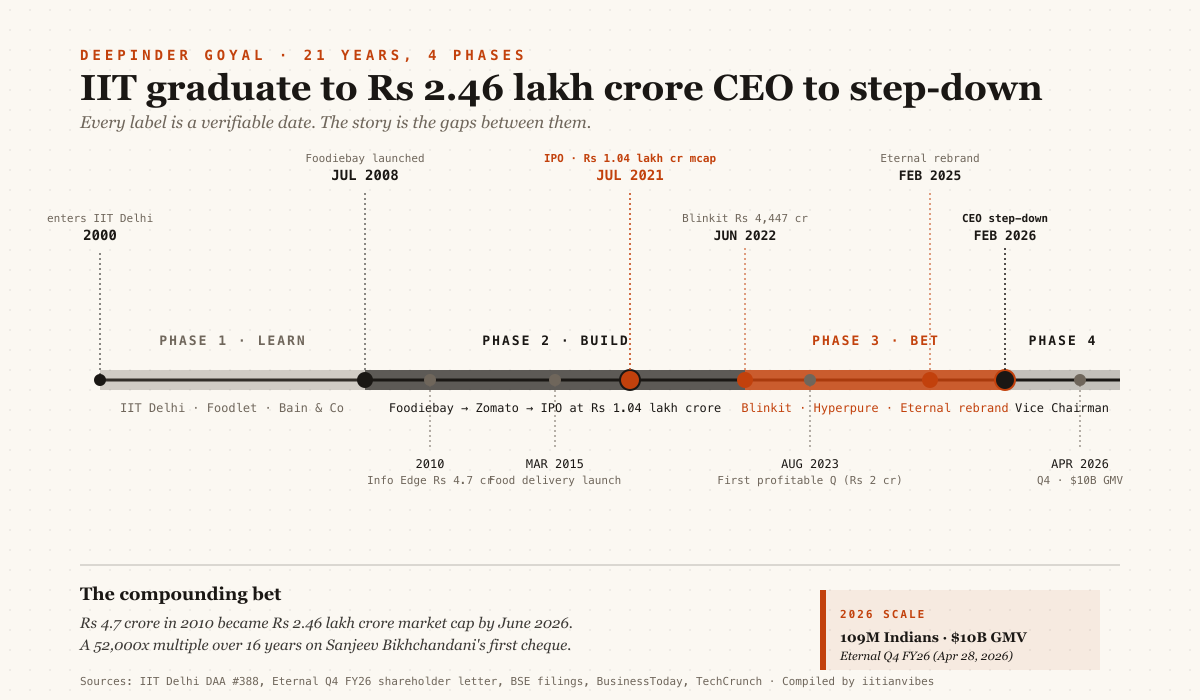
Scene three. July 2021. The IPO that Goyal refused to call historic. The Zomato IPO opened on July 14, 2021, at a price band of Rs 76. It closed on July 16 oversubscribed 35 times, a Rs 9,375 crore issue split between Rs 9,000 crore fresh and Rs 375 crore offer for sale from Info Edge. The subscription numbers came in within hours. Listing day was July 23. The share opened at Rs 116, a 52.6% premium, hit an intraday high of Rs 138.70 and closed at Rs 125.85 on BSE. Market cap stood at Rs 1.02 lakh crore on the NSE close.
The note Goyal sent his employees that day did not read like a victory lap. "A lot of people are calling this a 'historical moment'. It is not. History is always made in hindsight. Never in the present. Back to work," he wrote, in a letter widely reproduced by BusinessToday. The Red Herring Prospectus filed with SEBI a week before listing made the same point in numbers. Accumulated losses on the balance sheet were Rs 5,600.3 crore at the end of FY21. FY21 loss had dropped 66% from FY20's Rs 2,385.6 crore to Rs 816.4 crore. The company that had just been valued at over a lakh crore had never made a profit. Goyal told retail investors that, in plain language, on listing day. The credibility he banked then would matter two years later.
Blinkit, Eternal, and the step-down
The post-IPO years were not a coast. They were a different bet. On June 24, 2022, the Zomato board approved the acquisition of Blink Commerce Private Limited, the parent of Blinkit, in an all-stock deal. The total purchase consideration was Rs 4,447.48 crore, or about $568 million. Goyal's letter to shareholders the same day said: "Quick commerce has been our stated strategic priority since the last one year. We have seen this industry grow rapidly both in India and globally, as customers have found great value in quick delivery of groceries and other essentials. This business is also synergistic with our core food business, giving Zomato the right to win in the long term."
Five months later, in a November 2022 shareholder letter, Goyal was "nervously excited" about Blinkit and was reframing the bet around defence: a well-entrenched quick commerce player would, over time, threaten the food delivery business itself, so owning quick commerce was about protecting food delivery as much as building a second category. "Right to win" was the marketing line. Defending the core food franchise was the operational reason.
The bet paid off in two reports. On August 3, 2023, Zomato reported its first ever profitable quarter: profit after tax of Rs 2 crore for Q1 FY24, on revenue of Rs 2,416 crore, up 71% year-on-year. The profit was thin and partly tax-driven, but the milestone was real and a quarter ahead of guidance. Then in April 2024, Goldman Sachs published a note valuing Blinkit at Rs 119 per share against food delivery's Rs 98. Quick commerce had overtaken the core. A later Goldman note put Blinkit at $18.1 billion, 56% of the parent's target valuation.
That was the setup for the Eternal rebrand. On February 6, 2025, the Zomato board approved changing the listed parent's name to Eternal. The shareholder vote followed in March. Goyal's letter to shareholders opened with a sentence that almost no public-company CEO would write: "Zomato is an accidental company. It was born out of a simple desire to serve, and over time, it became a business." On the new name itself, he added: "Eternal is a powerful name, and to be honest, it scares me to my core. It is a tall order to live up to." The Zomato app would keep its name. The holding company that owned Zomato, Blinkit, Hyperpure and the District going-out platform became Eternal. The ticker on BSE and NSE changed from ZOMATO to ETERNAL.

The first months of 2026 were not quiet. On January 1, the Indian Federation of App-Based Transport Workers organised a log-off protest on New Year's Eve. Goyal posted on X the next morning: "Zomato and Blinkit delivered at a record pace yesterday, unaffected by calls for strikes." He followed up by arguing that "if a system were fundamentally unfair, it would not consistently attract and retain so many people who choose to work within it," and warned readers against being swept up by narratives driven by vested interests.
The reception was harsh. A thread on r/india with 243 upvotes and 63 comments collected the counter-arguments. The top comment, with 195 upvotes, drew a direct historical analogy: "Slavery wasn't exploitation just way of life. Slaves were given shelter and food. Can't believe they ask for everything." Another comment, with 52 upvotes, framed the model: "The only thing being optimized here is how fast risk can be dumped on the poorest person involved. This model works by design: one person relaxes, another one gambles their life in traffic." Three weeks later, Al Jazeera published a feature documenting an 18-year-old gig worker named Ankush killed at a Noida traffic signal on his first day. The piece quoted IFAT general secretary Shaik Salauddin: "Our collective voice reached the CEOs and the government; it is a win for those unionising." The Union Labour Ministry held talks with Blinkit, Zepto, Swiggy and Zomato. The platforms agreed to drop "10-minute" branding. Karnataka had already passed a 1 to 1.5% welfare levy on every payout under its Gig Workers' Welfare Board.
Goyal sent the resignation letter on January 21, 2026, a week before the Al Jazeera piece ran. The official reasoning was not the gig-worker pressure. It was that he had been doing something else for a while. He had been "drawn to a set of new ideas" that involved "significantly higher-risk exploration and experimentation" outside a listed company's remit, he told shareholders. Continue Research, Temple (a brain-health wearable), LAT Aerospace. Albinder Dhindsa, the Blinkit founder Eternal had bought in 2022, became Group CEO on February 1, 2026.
Where he is now, and what current IITians should learn
The numbers in June 2026 are not small. Eternal closed at Rs 255.25 on June 25, 2026, with a market cap of Rs 2.46 lakh crore, inside a 52-week range of Rs 212.60 to Rs 368.45. Goyal's personal stake is around 3.83% of the company. Forbes pegged his net worth at approximately Rs 14,000 crore, or USD 1.7 billion, around the time of his resignation. The Q4 FY26 shareholders' letter, published April 28, 2026, reported that "109 million Indians completed transactions worth over $10 billion through Blinkit, District, and Zomato" in the financial year. Consolidated revenue grew 186% year on year to Rs 17,680 crore. Adjusted EBITDA grew 160% to Rs 429 crore. The company that Goyal stepped back from is, on every metric the BSE tracks, the most consequential consumer-tech bet in Indian markets.
But the honest read on his last year as CEO did not come from BusinessToday or Mint. It came from a 712-upvote thread on r/indianstartups in November 2025, two months before the formal resignation.
"Him resigning as CEO of Eternal was coming. He has come to the office less than half a dozen times in the last 6 months, that too mostly during board meetings. All businesses of eternal (zomato, blinkit, hyperpure, district) have their individual CEOs who run the day to day. Deepinder has been mostly involved in his personal projects (temple, lat etc) for quite some time."
u/Aggravating-Spread95 on r/indianstartups, 128 upvotes, November 23 2025. From a thread titled "Tea on the Deepinder Goyal Zomato resignation saga" with 712 upvotes and 88 comments.
That is the open question this profile cannot close. Eternal is, by April 2026 numbers, the strongest consumer-tech business in India. It also spent the second half of 2025 with a founder-CEO who, by the description of people watching from inside the startup ecosystem, was mostly somewhere else. The next eight quarters will tell us whether the company was already running on the operating leverage Goyal built between 2010 and 2023, or whether the founder-shaped hole shows up in the financials.
Five things current IIT students can take from the story, in order of how often the takeaway is wrong elsewhere:
- Founder-mode and operator-mode are different jobs. Goyal stayed in founder-mode after the IPO. Shark Tank, podcasts, Temple, LAT, Continue Research. The board, or his own restlessness, eventually said that was incompatible with running a Rs 2.5 lakh crore public company. Our Sundar Pichai profile argued the reverse case, that long-term operating discipline can beat founding new things. Both are real paths. Pick consciously, not by default.
- Build the smallest version of the wedge first. Bikhchandani did not write the Rs 4.7 crore cheque for a pitch deck. He wrote it for a founder who had already proven on a Bain intranet, with 100 users, that the wedge existed. The IIT-Delhi-to-IIT-Delhi network mattered, but the Bain proof of demand mattered more. Almost nothing in your campus pitch deck is as convincing as 100 internal users.
- Public markets reward honesty over hype. The "we are not yet profitable" line in the Red Herring Prospectus and the "history is made in hindsight" message on listing day cost Goyal short-term valuation. They bought long-term credibility. When Q1 FY24 became the first profitable quarter in August 2023, the market believed the number partly because the founder had not over-promised for two years. The same dynamic applies to your founding letter, your hiring page, and your investor updates.
- You will be wrong about international. Zomato spent capital across at least 14 countries between 2012 and 2015 and shut down most of those operations between 2021 and 2022. The real franchise was India plus a defensible quick commerce bet. If your founding pitch is "global from day one," study the Zomato exits before you sign a Delaware C-corp. The pattern is consistent across Indian consumer tech: international optionality is mostly capital donated to learning.
- Build something people argue about. The r/india slavery analogy and the r/StartUpIndia "personality cult" thread with 213 upvotes are not fan mail. The same community that praised Goyal for the Ambience Mall lift incident in October 2024 was calling him "reckless" by July 2025. The Reddit cycle on Indian founders is not symmetric. But Eternal exists. Swiggy lost the food delivery war. Zepto came late to quick commerce. If you build a category in India, you will be hated by some of the people you employ, including the 4.5 lakh delivery partners Goyal tweeted about on January 1, 2026. The hatred is not optional. The category is.
Career timeline (verified)
| Year | Event | Source |
|---|---|---|
| 2000 | Joins IIT Delhi, Integrated M.Tech Mathematics and Computing | IIT Delhi DAA #388 |
| 2005 | Graduates IIT Delhi. Starts first food venture (Foodlet), which fails | IIT Delhi DAA interview |
| Jan 2006 | Joins Bain & Company, Gurgaon, as Associate Consultant | Wikipedia, multiple secondary |
| 10 Jul 2008 | Launches Foodiebay with Pankaj Chaddah | Wikipedia |
| 2010 | Info Edge invests Rs 4.7 crore at 18.5% stake. Brand renamed Zomato in November | Inc42 |
| Jan 2015 | Acquires Urbanspoon from IAC for $50M to $60M; enters US and Australia | TechCrunch |
| Mar 2015 | Launches food delivery service in India with Rs 360 crore commitment | TechCrunch |
| Jan 2020 | Acquires Uber Eats India in all-stock deal ($206M fair value) | Uber Investor Relations |
| Nov 2021 | Shuts down UK, US, Singapore and Lebanon operations | Business Insider |
| 23 Jul 2021 | IPO lists at Rs 116 on BSE, market cap Rs 1.02 lakh crore | Republic World |
| 24 Jun 2022 | Acquires Blinkit for Rs 4,447 crore (all-stock, $568M) | Entrackr |
| 3 Aug 2023 | Reports first ever profitable quarter, PAT Rs 2 crore | BusinessToday |
| 6 Feb 2025 | Board approves rebrand to Eternal; ticker changes from ZOMATO | Storyboard18 |
| 21 Jan 2026 | Announces resignation as Eternal CEO; Albinder Dhindsa succeeds | TechCrunch |
| 1 Feb 2026 | Goyal steps down. Becomes Vice Chairman and Director | Outlook Business |
| 28 Apr 2026 | Eternal Q4 FY26: $10B GMV, 109 million Indians, Rs 17,680 cr revenue | Eternal blog |
| 25 Jun 2026 | Eternal market cap Rs 2.46 lakh crore | Business Standard |
Wear the campus that wrote the playbook. Goyal, Chaddah, Bikhchandani: three of India's most consequential founder-investor stories ran through IIT Delhi. If you went there, we make merch for your batch. If you didn't, we probably make merch for your campus too.
By Arun Raghav S, Co-founder, IITian Vibes · B.Tech, IIT Jodhpur. Last updated: June 2026. Profile №02 in the Famous IITians series. The Sundar Pichai profile is here.