
The IIT Week · 26 October to 1 November 2026 · Week 44 · A line for all 23 IITs
IIT Kharagpur signed for a ₹35 crore School of Physical AI on Monday, ₹22.5 crore of it from two alumni, and called it India's first. IIT (BHU) Varanasi set up a school with almost the same name in July (Indian Express, IIT BHU notice). If you are searching for physical AI courses in India, both schools are below, with what each has actually announced.
The thread through the week is the IITs redrawing what a degree from them certifies. Kharagpur wants engineers who understand the physics under the model. IIT Ropar will now give a PhD for a product that sells, without a thesis. IIT Madras published a paper arguing that AI threatens the entry-level rung of a career more than whole jobs, and new Tracxn data says fewer IIT alumni started tech companies this year.
Students had a strong week. Three IITs took the whole podium at a national space-tech prize: Kharagpur first, Gandhinagar second, Roorkee third. An IIT Madras BS student won $10,000 at a Google hackathon, and three IIT Patna students won Flipkart GRiD. In Mumbai, Sahil Wakode's parents took their son's case to the Bombay High Court. A final-year student died at IIT (ISM) Dhanbad on Saturday. Below: the deep dive, the wins, AI and jobs, Ropar's PhD, IIT Bombay, the research, Careers Watch, exams, the trend, what students are saying, a line for every IIT and what is coming next. If your campus had a good week, wear it.
The deep dive: physical AI courses in India, and the ₹35 crore school at IIT Kharagpur
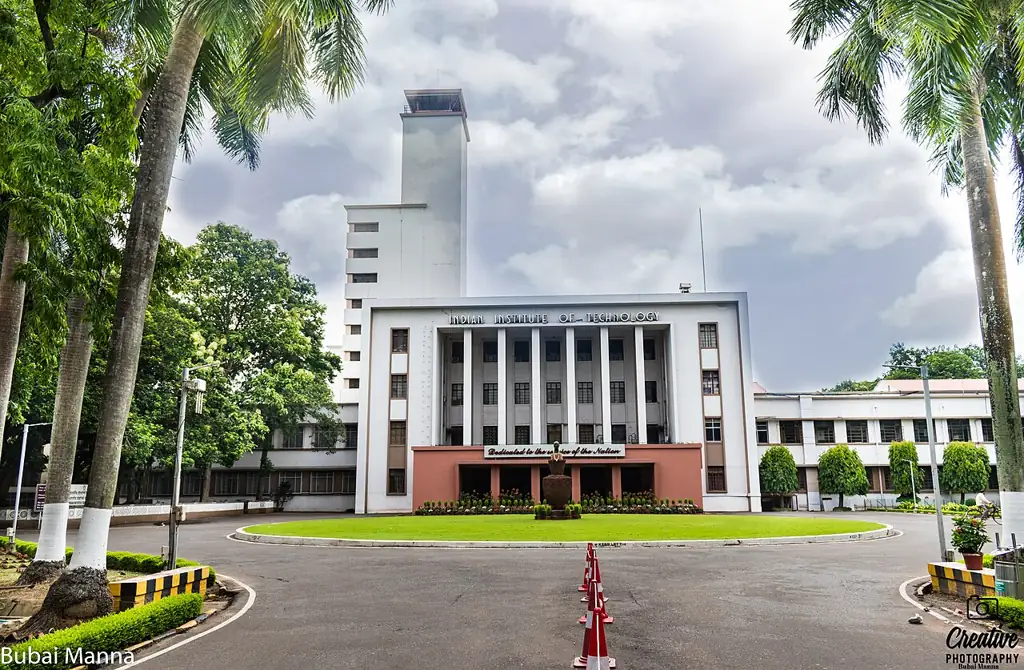
TL;DR: IIT Kharagpur signed a three-way MoU on 26 October with alumnus Vinod Gupta and the IITKGP Foundation USA for the Benjamin Gupta School of Physical AI: ₹12.5 crore from the Gupta family, ₹10 crore from an anonymous alumnus, the rest from the institute. A hybrid master's is planned, with no intake, fees or start date published. IIT (BHU) created its own School of Physical AI and Autonomous Systems in July, so "India's first" depends on what you count.
The money first. Indian Express reports: "The project will receive a contribution of Rs 12.5 crore from the Vinod Gupta family and Rs 10 crore from an anonymous alumnus, while IIT Kharagpur will provide the remaining funds." That leaves about ₹12.5 crore for the institute. One Telegraph report says the IIT Foundation pays that balance instead (The Telegraph); the other outlets say the institute does. The deal was signed with Gupta and the IITKGP Foundation USA, and the school is named after his son Benjamin, who died at 28 (NDTV, The Telegraph).
Gupta has done this before. "Gupta graduated in agricultural engineering from IIT Kharagpur in 1967. His $2-million grant helped the institute establish a management school in 1993." (The Telegraph).

What "physical AI" means here
Physical AI is AI that has to obey the real world: robots, sensors, digital twins of machines, models that know a beam can only bend so far. Kharagpur's list of research areas is specific. "The school will focus on areas including physics-informed machine learning, scientific AI, digital twins, intelligent robotics, autonomous systems, advanced sensing and AI-enabled experimentation." (ET Enterprise AI). Director Suman Chakraborty framed it as a correction to how AI is taught: "Our vision is to move beyond treating AI as a black-box solution. An engineer must understand the physics behind an intelligent machine" (NDTV).
What you can apply for is less clear. "Academic programmes are expected to commence from the upcoming academic session, with proposed offerings including hybrid-mode master's programmes, executive education, professional certification and specialised interdisciplinary learning modules." (The Telegraph). A second Telegraph report gives a looser timeline: "IIT Kharagpur plans to launch a master’s programme in Physical AI in the next academic year. The school is likely to be established next year, or by 2028, Chakraborty said." (The Telegraph). There is no BTech in the announcement, and no seat count, fee or eligibility rule has been published.
Who got there first
Most outlets ran Kharagpur's line that this is India's first Physical AI school (Indian Express, News18). IIT (BHU) Varanasi got there on paper three months earlier. Its notice dated 16 July sets up a coordination committee for the School of Physical AI & Autonomous Systems and cites an establishment notice dated 14 July (IIT BHU notice). Its department page says "The School focuses on developing intelligent machines, autonomous systems, robotics, and AI-enabled technologies capable of perceiving, reasoning, learning, and interacting with real-world environments." (IIT BHU). On 20 October, six days before Kharagpur's signing, Education Times headlined BHU as launching India's first such school and wrote: "The institute officially announced the school on July 15, 2026."
| IIT Kharagpur | IIT (BHU) Varanasi | |
|---|---|---|
| Name | Benjamin Gupta School of Physical AI | School of Physical AI & Autonomous Systems (PAIS) |
| Announced | MoU signed 26 Oct 2026 | Establishment notice 14 Jul 2026; committee 16 Jul |
| Money | ₹35 crore: ₹12.5 cr Gupta family, ₹10 cr anonymous alumnus, balance institute | None announced |
| Programmes | Hybrid master's, executive education, certificates (proposed) | Four-year BTech via JEE Advanced (press reports only) |
| Start | "Upcoming academic session", school "by 2028" | BTech "in 2027" (reported) |
| Intake and fees | Not published | Not published |
Sources: Indian Express, The Telegraph, The Telegraph, IIT BHU notice, EdexLive, Education Times. Retrieved 1 November 2026.
The BHU BTech is still a press report. EdexLive wrote that "The proposed four-year BTech programme will focus on robotics, intelligent machines and hands-on learning, with admissions expected through JEE Advanced", while hedging with "according to reports"; BHU's own pages list no programme yet. The fair reading: BHU created the first school by notice, and Kharagpur is the first to attach a named gift, a building and a programme plan to one.
What it means if you are choosing
If you are in Class 12 now, the only physical AI degree with a JEE route anywhere in the reports is BHU's reported BTech, and nothing official confirms it for JoSAA 2027. Watch BHU's seat matrix when it comes out. If you already have a BTech, Kharagpur's hybrid master's is the one to watch, and the word "hybrid" suggests it may be built for working engineers. Either way, nobody has published a syllabus, so a course anywhere selling itself as "IIT physical AI" before these schools publish one is selling something else. More on the campus in our IIT Kharagpur campus guide.
From IIT Kharagpur? Wear it: IIT Kharagpur hoodies, tees and varsity jackets, shipped across India.
The wins: three IITs on one space podium, a Google prize and Flipkart GRiD
TL;DR: IIT Kharagpur, IIT Gandhinagar and IIT Roorkee students took first, second and third at the Viasat Space for Good India Challenge 2026. An IIT Madras BS student won $10,000 at a Google hackathon. Three IIT Patna students won Flipkart GRiD 2.0, and an IIT Hyderabad startup demonstrated its 5G and pre-6G work to the Prime Minister.
| Who | IIT | What | Where | Prize |
|---|---|---|---|---|
| Adeetya Uppal, 4th-year aerospace dual degree | Kharagpur | 1st: DRISHTI, an AI that spots space debris and plans avoidance manoeuvres | Viasat: Space for Good India Challenge 2026, with IN-SPACe | ₹5 lakh |
| Shashank Kumar Singh, PhD, biological sciences | Gandhinagar | 2nd place | Same | Cash prize |
| Aryan Gupta, pre-final year mechanical | Roorkee | 3rd place | Same | Cash prize |
| AK Deepankar, BS Data Science | Madras | ShipGuard, an AI system that fixes iOS bugs | Google All Things Agentic Hackathon | $10,000 |
| Kashish Rai, Bhumi Garg, Pragya Mahajan, 3rd-year integrated BTech-MTech | Patna | 1st: Gridlock Oracle, predicts which traffic incidents will need road closures | Flipkart GRiD 2.0, with Bengaluru Traffic Police data | Not stated |
| WiSig Networks (incubated startup) | Hyderabad | Koala Tag and the OTFDM pre-6G waveform, shown to PM Modi | ESTIC 2026, Bharat Mandapam, 28 Oct | Demonstration |
Sources: Bisinfotech, India Today, India Today, Times of India, Patna Press, New Indian Express.
The space prize is the one to read twice. "Adeetya Uppal of IIT Kharagpur has been named the winner of the Viasat: Space for Good India Challenge 2026", run by Viasat with the national space regulator IN-SPACe, and "The winning concept stood out among six finalist projects" (Bisinfotech). Uppal's DRISHTI watches for debris near a satellite and computes a way around it; the organisers say it cuts response time from hours to seconds. "He will receive Rs 5 lakh to further develop the idea." (India Today). Gandhinagar's Shashank Kumar Singh, a PhD researcher in biology, came second, and Roorkee's Aryan Gupta third. The other three finalists were not named.

At IIT Madras, "IIT Madras student AK Deepankar has won USD 10,000 (approximately Rs 9.5 lakh) at Google's All Things Agentic Hackathon for building ShipGuard, an AI-powered iOS bug-fixing system." (India Today). He is in the IIT Madras BS in Data Science and Applications, and it is his second hackathon prize this year after $20,000 at RevenueCat Shipyard.
IIT Patna's three third-years won with a model trained on 8,057 real incidents from the Bengaluru Traffic Police (Patna Press). The Times of India summary: "IIT-Patna trio wins Flipkart GRiD 2.0 with AI tool “Gridlock Oracle” to predict traffic incident severity, cutting unnecessary deployments by 86%." (Times of India). The 86% is the team's own figure. And IIT Hyderabad's WiSig Networks "showcased indigenous 5G and emerging 6G technologies to Prime Minister Narendra Modi at the Emerging Science, Technology and Innovation Conclave (ESTIC) 2026 in New Delhi on Wednesday" (New Indian Express, Telangana Today). The demo was run by Sakshama Ghoslya, a principal engineer and IIT Hyderabad MTech alumnus (New Indian Express).

IIT Madras on AI and jobs: the risk is to the first rung, not the whole ladder
TL;DR: A white paper from IIT Madras's Centre for Responsible AI, released on 26 October, argues that AI's effect on work in India should be measured task by task. It names entry-level roles as the most exposed, gives no job-loss percentage, and calls its own classification a hypothesis.
The paper is How AI Is Reconfiguring Work in India: A Task-Based Framework for Understanding Augmentation, Displacement, New Roles and the Changing Structure of Jobs, presented on 22 October and put on the IIT Madras website on 26 October (Hindustan Times, India Today). Its central line: "The entry-level career pipeline is especially at risk" (The Hindu). The reason is how careers are built. "The paper identifies entry-level workers as particularly exposed because many junior roles consist of repetitive tasks that also serve as training grounds for more experienced professionals." (Indian Express).
Prof Balaraman Ravindran, who heads the centre and the Wadhwani School of Data Science and AI, put it in one breath: "Most jobs are made of tasks and only some can be done by AI. The effect depends on the tasks, the industry, the rules and what AI costs to use. So which tasks go, and why?" (Indian Express). He was blunter on one sector: "The BPO industry is something that will be severely challenged by adoption of AI and has been identified as such in the paper" (Indian Express).

Read the limits before you share the headline. The authors say their pathways should be treated as "a structured hypothesis for future empirical testing, not a settled finding" (Hindustan Times), and The Hindu notes the framework is "largely silent" on job quality because Indian data is thin. "Breaking the ladder" is Indian Express's headline, not the paper's phrase. Its three asks are cheap, narrow AI for small firms, India-specific labour research, and transition pathways and liability rules before adoption speeds up (Indian Express).
What it means for a student: the jobs that used to teach you the trade in your first two years are the ones being automated first. The skills that survive are the ones that rung was supposed to teach, built some other way: internships with real responsibility, projects that ship, and enough domain knowledge to check a model's work.
IIT Ropar's PhD without a thesis: sell the product instead
TL;DR: IIT Ropar has a Product/Startup-Driven PhD pathway in which the degree is awarded for research that ends in a product, a technology transfer or a startup. No thesis is required. Shortlisted applicants may face a written test and interview; no intake date or seat count is published.
"The institute has introduced a Product/Startup-Driven PhD pathway, under which doctoral research can lead to a product, technology translation, or startup." (India Today). The institute's programme document, India Today reports, says the PhD will be awarded on research outcomes tied to creating, developing and scaling products or startups. The rule of thumb an IIT Ropar official gave was blunt: "You have freedom. You have only one target. You sell the product, earn 10 lakh rupees, show it to me. You get PhD." India Today attributes that line to director Rajeev Ahuja and Deccan Herald to associate dean Sarang Gumfekar, and the ₹10 lakh is an illustration, not a published rule (India Today, Deccan Herald).

The terms matter. Incubation typically runs two years, and "The institute may take about 2% to 4% equity in startups it supports." (India Today). Selection is conventional: "The institute’s official website says shortlisted candidates may be required to take a written test and interview." (Deccan Herald). Gumfekar told India Today no other IIT offers the same route; BITS Pilani has something comparable.
Who it suits: a researcher who already has a prototype and a buyer in mind, and who is comfortable giving a small slice of the company to the institute. Who it does not suit: anyone aiming for an academic job, where hiring committees still read theses and papers. Ask the department for the written regulations before you apply; the press coverage is all there is in public so far.
IIT Bombay, six weeks on: the parents go to the High Court, the institute forms panels
TL;DR: Sahil Wakode's parents have petitioned the Bombay High Court for a CBI or SIT investigation supervised by a retired judge; their lawyer said it would be mentioned for urgent hearing on Monday 2 November. IIT Bombay has formed a committee to review its SC-ST cell and another on hostel life, according to an official who was not named.
"Ravindra C. Wakode and Sonali Wakode have filed a petition in the Bombay High Court seeking transfer of the investigation into the death of their son, Sahil Wakode, to the Central Bureau of Investigation (CBI) or a Special Investigation Team (SIT). The petition seeks supervision of the investigation by a judge who has retired from the High Court." (The Hindu).
The police case was registered on 19 September under the Bharatiya Nyaya Sanhita and the SC/ST (Prevention of Atrocities) Act. "Their counsel, advocate Hitendra Gandhi, said the petition would be mentioned on Monday for urgent hearing." (Hindustan Times). A separate plea in the Atrocities Act special court asks for a status report on the father's six representations to the police and for evidence to be preserved (Indian Express).
The petition makes allegations against the professor who invigilated the exam, including a caste remark; those are the family's claims, and the institute and the professor have denied caste remarks (Hindustan Times, Hindustan Times). The institute's account is that "the incident followed his being caught using his mobile phone during an examination" (Indian Express). Earlier in the week the father said: "We have lost faith in the investigating agencies." He said on 27 October that the family had been on a hunger strike for 21 days (Hindustan Times).
On campus, "A senior IIT Bombay official, speaking on condition of anonymity, said a review committee had been formed to examine the demands and suggest ways to strengthen the cell." A second panel is looking at hostel conditions, and 30 temporary counsellor posts drew more than 600 applications (Hindustan Times). No member list, terms of reference or on-record institute statement has been published.
Protesting students say they still cannot reach the director's office and that belongings seized on 18 October have not been returned; the institute's side is not in that report (Mumbai Mirror). On 25 October police detained about 25 people at a candle march for Wakode in Dadar, including comedian Masoom Rajwani. The "140 detained" figure in some headlines adds a separate, unrelated protest at Shivaji Park (Hindustan Times).
The numbers behind the protest
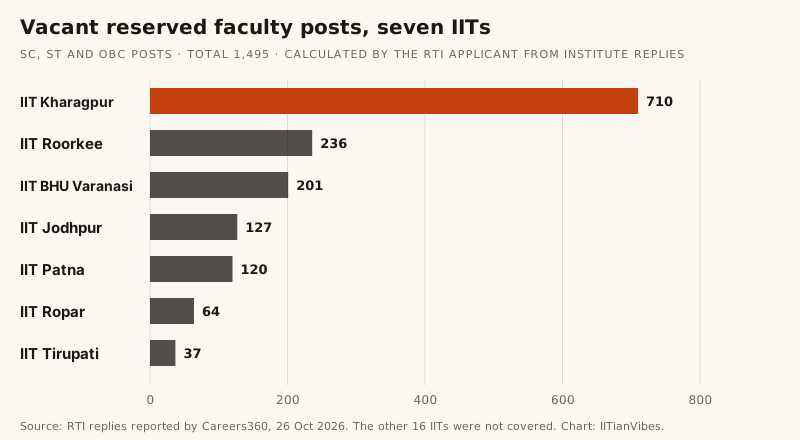
Two RTI stories published on Monday put numbers to what the protesters are asking for. Across seven IITs that answered, "1,495 such posts remain empty", meaning faculty positions reserved for SC, ST and OBC candidates; IIT Kharagpur alone has 710 (Careers360). The totals are the RTI applicant's own calculation from the institutes' replies, and the data covers only the seven IITs that replied. The same applicant's data on counselling: "IIT Kharagpur is functioning with one counsellor for every 1,136 students, IIT Roorkee has one counsellor for every 1,317 students, and the IIT in Varanasi (BHU) is operating with one counsellor for every 4,750 students." (The Hindu). The UGC norm is one per 500.
IIT (ISM) Dhanbad
A final-year petroleum engineering student died on the IIT (ISM) Dhanbad campus on the morning of Saturday 31 October (New Indian Express). The police station in charge told the Times of India: "Preliminary findings suggest suicide, but the exact circumstances are yet to be established" (Times of India). Dhanbad's senior superintendent of police said the student's phone has been seized and an autopsy will follow (PTI via ThePrint). We are not naming the student. If you are struggling, Tele MANAS is free on 14416, at any hour.
IIT Patna's registrar
IIT Patna is examining social media posts against reservation that were attributed to its registrar and dated 24 September; an activist has asked for a case under the SC/ST Act. The director told The Telegraph: "Once the allegation is proved, necessary action will be taken", and later told HT the matter was with "the higher authorities". The registrar says the screenshots are fake: "Artificial intelligence has been misused to defame me." (The Telegraph, Hindustan Times). Nothing has been proved either way.
The research week: a cancer heater that holds for an hour, plants that rewire in drought, faults under the Ganga
TL;DR: Six results from five IITs, from a microwave applicator for cancer therapy to a soil from Kutch that helps read Mars. Most are lab-stage; each line says how far along it is.
- A microwave applicator that does not overheat (IIT Madras, International Journal of Thermal Sciences). Hyperthermia heats tumours to make other treatments work better, but standard applicators trip their own safety cut-offs in eight to ten minutes. The IIT Madras design uses fins to cool its water cushion: "The fin-assisted cooling slashed the temperature variation within the water bolus from 5.13 degrees to 0.38 degrees." "Power coupling remained above 96% across the entire sixty-minute clinical target window, allowing the device to send therapeutic heating down to a depth of 31 millimetres." It was tested only on flat synthetic tissue models (Research Matters, paper). The paper has been online since September; the write-up is this week.
- How plants rewire their plumbing in a drought (IIT Guwahati, Applied Physics Reviews). Prof Pranab Kumar Mondal's team combined measurements on Indian mustard stems with 3D simulations. "The study found that during acute water shortages, the xylem tubes become narrower and the pits shrink, increasing resistance to fluid flow." That slows water loss, and the team says it could help breed drought-tolerant crops (India Today NE).
- Buried faults under the Ganga plains (IIT Roorkee with two universities, Geoscience Frontiers). Rivers bend where faults lie below them: "across the Mahendragarh-Dehradun Fault, the Yamuna is shifted by about 6 km, the Ganga shows a shift of about 5.8 km across the Moradabad Fault, and the Punpun River about 12.7 km along the East Patna Fault." The authors argue these hidden faults carry earthquake risk for one of India's most crowded regions (Research Matters, paper).
- A patch that checks your gym form (IIT Gandhinagar). Prof Biswajit Saha's group built a wearable that reads movement through piezoresistive sensing and machine learning. "The prototype is at Technology Readiness Level 5 with a patent filing in progress, and is being tested for strength training, tennis and swimming." (Indian Express). IIT Gandhinagar and AIIMS New Delhi also built CHASP, a Hindi screening tool for speech loss after stroke (Times of India).
- Kutch soil as a stand-in for Mars (IIT Gandhinagar with PRL Ahmedabad, Icarus). The study measures how natrojarosite, a mineral found on Mars, reflects light, using samples from Matanomadh in Kutch, to help read orbiter data (Times of India).
- Cheaper antibodies (IIT Delhi). Prof Anurag Rathore's team is chasing a Gates Foundation target of $10 a gram for monoclonal antibodies. "We started ourselves at around $35 a gram," he told BioPharm International. "Today we are roughly around $12 a gram." That is his own figure, from a trade-press interview (BioPharm International).
One more from IIT Madras that is a claim rather than a result: Prof Satya Chakravarthy, founder of The ePlane Company, told India Today that its E200X electric aircraft has about seven layers of safety and that an air-ambulance version could be ready as early as the second quarter of 2028. "The E200X has not yet been certified to carry passengers." (India Today).
Careers Watch: fewer IIT founders on paper, more deep-tech cheques
TL;DR: Tracxn counts 79 IIT alumni who founded tech startups in January to August 2026, against 307 in all of 2025, but the numbers are not like for like. The week's money went to hardware and infrastructure: infrared chips, a state cyber centre, semiconductor packaging and a propulsion startup.
The headline number: "Just 79 IIT alumni and 20 IIM alumni founded new technology startups between January and August 2026, compared with 307 IIT graduates and 71 IIM graduates who launched startups during the whole of 2025, according to Tracxn data collated for ET." (Mint, Business Standard). Over the same months, 6,353 tech startups were founded in India against 3,969 in all of 2025.
Before you read it as IITians giving up on startups, read Mint's own caveat: "However, the figures are not directly comparable, as Tracxn tracks startups based on their year of incorporation and does not have corresponding data for January-August 2025." Tracxn notes that incorporating a company takes time, so the 2026 count could still change. Tracxn also counted only 13 IITs, leaving out Patna, Gandhinagar, Indore, Ropar, Tirupati, Palakkad, Jammu, Dharwad, Bhilai and Goa (Mint).
| Signal | IIT link | Amount | What it says about jobs |
|---|---|---|---|
| Nova Spectral AI | Founders are IIT Kanpur alumni | ₹21.15 cr, led by Shastra VC | Infrared image sensors for drones and surveillance; a prototype within 18 months, then a technical team and a manufacturing process in India |
| Carbelim | IIT Madras Unicorn Frontier Fund | ₹10 cr | Deep-tech with 13 patents; among the first four companies the fund backed |
| Viridian Ingni Propulsion | Incubated at IIT Madras Research Park | ₹1.47 cr pre-seed, led by IPV | Propulsion hardware; a five-person engineering team, pre-revenue |
| Made in Fire Fund | IIT Kanpur graduating batches | ₹1 cr: 10 startups × ₹10 lakh, non-dilutive | Prototype money plus mentorship and a Demo Day after 6 to 12 months |
| UP Cyber Security Operations Centre | IIT Kanpur C3iHub runs it for 3 years | ₹104.28 cr, state cabinet approved | Round-the-clock monitoring of state government networks, applications and data |
| Semiconductor packaging Centre of Excellence | IIT Guwahati with Tata Electronics | Not disclosed | Semiconductor packaging skills; diploma and BTech courses planned |
Sources linked in each row; Tata Electronics MoU also in Economic Times.
The pattern: every cheque this week went to something you can hold or something that guards a network, and none to consumer apps. ixigo co-founder Rajnish Kumar's fund is the most direct bet on students: "The fund will support 10 technology-led startups from each graduating batch, with Rs 10 lakh in non-dilutive prototype funding for every selected startup." (Moneycontrol). IIT Kanpur director Manindra Agrawal is building the people pipeline for the cyber centre from the other end: the BCyber programme pairs two years of coursework with a two-year internship, mostly at government security organisations (EdexLive).

For a founder who built a hardware company out of IIT Madras, read our profile publishing this evening: Tarun Mehta: From IIT Madras to Ather's First Profit. For the placement season opening in December, see how the new AIPC rules change Day 1.
Exams and admissions: GATE 2027 is not postponed, UCEED gets five more days
- GATE 2027 (IIT Madras). Despite headlines on exam-news sites this weekend, the official site shows no postponement. The exam is on 6 and 7, 13 and 14, and 20 and 21 February 2027, results on 19 March. Registration is closed; the window to fix scrutiny defects in your form was extended twice and now closes on Tuesday 3 November (GATE 2027, GATE 2027 home). Background: the new Robotics paper and the DigiLocker requirement.
- UCEED and CEED 2027 (IIT Bombay). "The last date for online registration with regular fee has been extended till Thursday, 5th November 2026." The late-fee window runs to 5 pm on Tuesday 10 November, and the exam is on Sunday 17 January 2027 (UCEED, CEED).
- JEE Main 2027 Session 1. Applications close on 22 November at 11:50 pm (NTA notice). A 30 October NTA notice confirms fresh applications must be completed with fee payment by then (NTA notice).
- JEE Advanced third attempt. Nothing official has changed. The Change.org petition, which we covered three weeks ago, reached about 13,000 signatures by 31 October; it asks for a third attempt for second-droppers, or two attempts across three consecutive years (Telangana Today).
- JAM 2027 (IIT Kharagpur). Registration closed on 24 October; the exam is on 14 February 2027 (JAM 2027).
The trend: the IITs are deciding that a degree should prove you can build
Put the week's announcements side by side and they argue the same thing. Kharagpur's director wants engineers who understand the physics under the model, not users of a black box. Ropar will give a doctorate for a product that sells. IIT Kanpur's BCyber admits students on prior work and an on-campus hackathon as well as JEE Main (EdexLive). IIT Delhi's continuing education arm opened a six-month Agentic AI certificate for working professionals at ₹1,45,000 plus tax (Careers360), and IIT Madras briefed 3,179 Chennai corporation-school students on its BSc programmes that need no JEE score (New Indian Express).
Underneath is the IIT Madras paper's warning. If AI eats the junior tasks that used to train people, an institute that only certifies you passed an exam is selling the part of the career that is disappearing. The IITs' answer this week is to certify the next rung instead: a system you designed, a product someone paid for, a model you can explain. Whether that reaches the 2027 BTech batch or stays in master's, certificates and PhDs is the thing to watch. So far it is mostly the second.
What students are saying: is DSA still worth it?
The question on the campus subreddits this week was the paper's question, asked by students. On r/IITDelhi a post titled "Is doing DSA still worth in the age of AI?" drew replies on both sides. One: "Doing DSA and getting into it jobs now feels scary as hell. Might as well become a prof or something. They have the best lives." Another reply said fundamentals matter more, not less: "In a few years, companies will fire those who don't have a strong command of fundamentals & who don't even now how ai works and what is LLMs. This applies not just to DSA, but to any domain." (r/IITDelhi, 13 points).
A month before Day 1, placement nerves are showing. On r/iitbombay a poster claimed, without evidence, that students with low CPIs were making a consulting firm's shortlist through connections; one reply: "If you haven't realized already, network is massively important in corporate" (r/iitbombay, 10 points). On r/iitkgp a student asked why they were not getting shortlisted through the career development centre, and one reply was "Do masters bro, kuch nahi rakha placements mai" (r/iitkgp, 12 comments). Further down the pipeline, on r/Indian_Academia, a school student wrote "i regret going into tech because of AI and feel like i should have taken healthcare" (r/Indian_Academia). These are single posts, not surveys.
Across the 23 IITs this week
Stories that did not earn a full section but round out the 23-IIT picture.
Older IITs (Bombay to Kharagpur)
- IIT Bombay: The High Court petition and panels are above. Techfest launched AyushTech Innovate, a national Ayurveda AI challenge with the Ministry of Ayush, built on IIT Bombay's open-source Ayurveda language model AyurParam (DD News).
- IIT Delhi: The 19th Open House on 31 October had more than 500 technology presentations, 225 posters and 80 lab demonstrations; "The event witnessed the participation of approximately 3,000 school and college students and over 1,500 other visitors." (Careers360). It also hosted the RAKSHAM AI-cybersecurity hackathon with Amazon and I4C: nearly 5,000 submissions from 14 states, five winning teams (The CSR Universe).
- IIT Madras: AI-jobs paper, Google prize, microwave applicator and Carbelim are above. It also handed Vallipuram village three water treatment plants and a waste facility, a ₹70 lakh project (The Hindu).
- IIT Kanpur: Antaragni 26, its 61st cultural festival, ran 29 October to 1 November under the theme "A Prismatic Realm", with KR$NA at hip-hop night on Saturday (Times of India, Times of India, our guide). The fifth Akshar literary festival ran 29 to 31 October (Times of India).
- IIT Kharagpur: Physical AI and the Viasat win are above. It also signed a letter of intent with Tripura for a five-year plan for the state's universities and colleges (The Statesman), and leads the Indian team on Smart Scout, an AI system for soybean fields, in the first Quad AI-ENGAGE cohort (BusinessLine).
Second-gen IITs (Roorkee, Guwahati, BHU, Hyderabad, Indore, Bhubaneswar, Gandhinagar, Ropar, Jodhpur, Mandi, Patna, Dhanbad)
- IIT Roorkee: Aryan Gupta's Viasat third place and the Ganga faults paper are above. Northeast Frontier Railway signed an MoU on 27 October for AI crack detection on ageing railway steel bridges (The Sentinel).
- IIT Guwahati: The Tata Electronics semiconductor centre and the drought study are above (Indian Express).
- IIT (BHU) Varanasi: Besides its own Physical AI school, its 15th convocation on 31 October "awarded 2,048 degrees", including 1,106 BTech and 182 PhD; Kumar Mangalam Birla was chief guest and told graduates AI will reshape careers (Hindustan Times, Times of India).
- IIT Hyderabad: WiSig is above. CISF signed an MoU with its TiHAN hub for drone training for its personnel and support for a planned CISF drone and anti-drone centre (Deccan Chronicle). Students allege action against dog feeders after dog deaths on campus; the HCU chair, Gopinath Muvvala, replied "I can guarantee that no student has been removed. Not even one. Where is the proof?", and police are investigating two dog-death cases (The Hindu).
- IIT Indore: Anil Kakodkar inaugurated Srijan Kendra, a craft centre, and a 750-student hall of residence (Free Press Journal).
- IIT Bhubaneswar: Quiet week: no release on its site or in regional news dated in the window.
- IIT Gandhinagar: Viasat second place, the gym patch, CHASP and the Mars soil study are above.
- IIT Ropar: The thesis-free PhD is above; 64 of 97 reserved faculty posts are vacant, per the RTI data.
- IIT Jodhpur: In the RTI data it filled 74 reserved faculty posts from 3,043 applications since 2025, with 127 still vacant (Careers360). Its site lists the ICWS 2026 water conference, 28 to 30 October.
- IIT Mandi: With Plaksha University and the IDYM Foundation it is running Science on Wheels for about 50 Himachal schools; the state leg launched on 17 October and was announced this week (Indian Express).
- IIT Patna: The Flipkart GRiD win and the registrar inquiry are above.
- IIT (ISM) Dhanbad: A final-year student died on campus on 31 October; see above.
Newest IITs (Bhilai, Dharwad, Jammu, Palakkad, Goa, Tirupati)
- IIT Bhilai: Quiet week after its sixth convocation on 24 October, covered in last week's roundup; nothing dated in the window on its site or in regional news.
- IIT Dharwad: Hosted Yamini 2026, five Hindustani and Carnatic concerts through the night of Saturday 31 October, with no entry fee (The Hindu). At a pre-conference, a dean said AI could reduce direct human involvement in many activities to about 40% (Times of India).
- IIT Jammu: Ran Aarohan 2026, a two-day regional workshop on student mental health and wellbeing with the Ministry of Education (Daily Excelsior).
- IIT Palakkad: Its technology foundation TECHIN closed SAMAGRA 2.0, an innovation summit in Thiruvananthapuram, on 29 October (IIT Palakkad).
- IIT Goa: A Ponda court refused bail to two men accused in an impersonation racket at the institute's recruitment exam for administrative assistants; one local report (Prudent Media). Otherwise quiet.
- IIT Tirupati: Held an industry-academia conclave with IISER Tirupati on curricula, startups and training farmers as entrepreneurs (Deccan Chronicle). In the RTI data, 37 of its 79 reserved faculty posts are vacant.
Coming next
- 2 Nov: The Wakode petition is due to be mentioned in the Bombay High Court (Hindustan Times).
- 3 Nov: GATE 2027 form defect correction closes (GATE 2027).
- 4 Nov: CAT 2026 admit cards; the test is on 29 Nov (iimcat.ac.in).
- 5 Nov: UCEED and CEED 2027 regular-fee registration closes; late fee to 10 Nov, 5 pm (UCEED).
- 12 Nov: IIT Hyderabad faculty applications close (IIT Hyderabad).
- 22 Nov: JEE Main 2027 Session 1 applications close; late fee 23 to 26 Nov, corrections 27 to 29 Nov (NTA).
- 17 Jan 2027: UCEED and CEED (CEED). 20 to 28 Jan: JEE Main Session 1 (NTA). 6 to 21 Feb: GATE 2027 (GATE 2027). 14 Feb: JAM 2027 (JAM).
FAQ
Which IIT has a School of Physical AI?
Two do. IIT Kharagpur signed an MoU on 26 October 2026 for the Benjamin Gupta School of Physical AI, a ₹35 crore project with ₹22.5 crore from two alumni. IIT (BHU) Varanasi set up a School of Physical AI and Autonomous Systems by institute notice in July 2026.
What physical AI courses are available in India at the IITs?
None is open for applications yet. IIT Kharagpur plans hybrid master's programmes, executive education and certificates from the upcoming academic session, with no intake or fees published. IIT BHU's four-year BTech through JEE Advanced in 2027 has been reported by the press but not confirmed by the institute.
What did the IIT Madras paper say about AI and jobs?
The Centre for Responsible AI paper, released on 26 October 2026, says AI's impact should be measured task by task and that entry-level roles are most exposed because their routine tasks used to train junior staff. It gives no job-loss percentage and calls its classification a hypothesis for future testing.
Does IIT Ropar offer a PhD without a thesis?
Yes. IIT Ropar's Product/Startup-Driven PhD awards the degree for research that leads to a product, a technology transfer or a startup, with no thesis required. The institute may take 2% to 4% equity in startups it incubates. Shortlisted candidates may face a written test and interview.
Has GATE 2027 been postponed?
No. The official GATE 2027 site shows the exam on 6, 7, 13, 14, 20 and 21 February 2027, with results on 19 March. Registration is closed. The window to correct scrutiny defects in application forms closes on 3 November 2026.
What is the UCEED 2027 last date?
IIT Bombay extended UCEED and CEED 2027 regular-fee registration to 5 November 2026. The late-fee window closes at 5 pm on 10 November 2026, and both exams are on 17 January 2027.
Who won the Viasat Space for Good India Challenge 2026?
Adeetya Uppal, a fourth-year aerospace dual-degree student at IIT Kharagpur, won ₹5 lakh for DRISHTI, an AI system for avoiding space debris. Shashank Kumar Singh of IIT Gandhinagar was second and Aryan Gupta of IIT Roorkee third.
Your IIT had a week? Campus hoodies for every IIT: Kharagpur, Madras, Ropar, Patna, Gandhinagar, Roorkee, and the rest of the 23.
Support: Tele MANAS, the national mental health helpline, is free and available 24/7 on 14416.
By Arun Raghav S · Co-founder, IITian Vibes · Facts retrieved 1 November 2026 from the linked official pages and documents. Corrections to hello@iitianvibes.com.