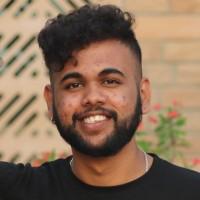

In early 2026, Perplexity AI was valued at ₹1.75 lakh crore ($21B). Its founder is a 31-year-old former IIT Madras Electrical Engineering student who missed the Computer Science cutoff by, per family lore, a fraction of a point. Aravind Srinivas — CEO of the AI answer engine that Jeff Bezos, NVIDIA, IVP, NEA, SoftBank, Andrej Karpathy, Naval Ravikant, Tobias Lütke, and Cristiano Ronaldo have all backed — was born in Chennai on 7 June 1994. He is going after Google out loud. His verbatim call: "In a world where everyone gets answers and doesn't have to click on links, the biggest loser is Google."
This is the arc from AIR 980, IIT Madras Electrical Engineering 2012 cohort, dual-degree class of 2017 — to a $21B startup that signed a $750 million, three-year GPU commitment with Microsoft Azure in January 2026. What actually happened in between, sourced.
Chennai, IIT Madras, and the Computer Science cutoff he missed
Aravind grew up in Chennai — the same city that Sundar Pichai left for IIT Kharagpur two decades earlier. That geographic overlap gets cited in a Contrary Research profile as narrative context, though the "Pichai as inspiration" line is soft signal, not hard quote.
What is verifiable: JEE Advanced 2012 landed Aravind at IIT Madras with an AIR reportedly around 980 (secondary-sourced; primary confirmation not found). The rank got him Electrical Engineering, not Computer Science. He tried to switch. He couldn't. So he did what an ambitious IITian does when the system won't rearrange itself for you — he crossed departmental lines on his own.
His own words, verbatim, on why the campus mattered: "IIT Madras was probably the only campus at that time that even had a professor working in AI and machine learning. So that clearly made a big difference in my life." (Cited across askiitm.com and skillnation.in.)
The professor was Balaraman Ravindran, head of the Robert Bosch Centre for Data Science and AI and one of India's leading reinforcement learning researchers. Aravind's second mentor was Mitesh Khapra. From an Electrical Engineering student's official curriculum, Aravind pivoted into the AI lab, sat in on CS courses, learned Python from what he later described as a "forward-thinking professor," and built peer relationships with CS students.
The output between 2012 and 2017 is the number that matters most from his IITM years: nine papers at ICLR, AAAI, and NeurIPS — top-tier machine-learning venues where senior PhDs get rejected. This is an undergrad research output most IIT professors would consider a career milestone for a doctoral student, let alone a dual-degree kid. It's how he got into UC Berkeley for a PhD immediately after IITM. It's also how he later got into OpenAI, DeepMind, and Google Brain for internships without ever needing to interview through the front door.
His own explanation for why this hunger existed, verbatim: "I come from a background where being smarter was more valued than being rich." (From Perplexity investor NEA's November 2024 Q&A.)
Berkeley PhD: representation learning, and the internships that mattered
September 2017: Aravind enrolls at UC Berkeley for a PhD in Computer Science. Advisor: Professor Pieter Abbeel (chair). Committee: Ken Goldberg, Trevor Darrell. Dissertation title, filed in Berkeley eScholarship: "Representation Learning for Perception and Control." Areas of work: contrastive learning for computer vision, transformers for image generation, reinforcement learning.
Along the way he did what most Berkeley PhDs do — three summer internships at three places that don't take everyone. OpenAI (2018) was first, reportedly on the recommendation of John Schulman, OpenAI co-founder. DeepMind (2019) next. Then Google Brain (2020–2021). That order matters — most of his PhD peer group at Berkeley intern at one of those three; Aravind hit all three in three years.
He also co-taught, before generative AI became mainstream. CS294: Deep Unsupervised Learning (2020) — a graduate course he built with Pieter Abbeel, Peter Chen, and Jonathan Ho, per Berkeley's Sutardja Center recap. That course predated ChatGPT by two years.
Two Aravind quotes from that Berkeley period, from the same Sutardja Center piece:
"Being at the very frontier of research puts you in the best position to build some of the frontier."
"If you cannot explain it to people who don't know anything about it, then you don't understand it."
The most consequential relationship formed in the Berkeley years, though, was not with a professor. Denis Yarats — a PhD student at NYU working on nearly identical reinforcement-learning problems — reached out to Aravind by email after their two labs kept publishing overlapping papers. Per Wikipedia's Perplexity entry and EntrepreneurLoop's founding story, that email became the foundation of a co-founder relationship. When Perplexity got incorporated four years later, Yarats was CTO on day one.
OpenAI, and the founding moment
Aravind finished his PhD in Summer 2021 and joined OpenAI as a Research Scientist. He stayed about a year. In August 2022, he left to co-found Perplexity AI in San Francisco.
The founding thesis is worth pinning down exactly, because most of the AI industry mis-quotes it. Aravind's own version, verbatim from the NEA investor Q&A: "Perplexity is a marriage of Wikipedia and ChatGPT. You get answers, you converse." Not a search engine. Not an assistant. An answer engine — with citations underneath every claim, and a follow-up conversation on top.
The three co-founders alongside him:
- Denis Yarats (CTO) — PhD NYU, former AI Research Scientist at Meta/Facebook, the email correspondent from Berkeley days
- Johnny Ho (Chief Strategy Officer) — former Quora engineer and quantitative trader at Tower Research Capital
- Andy Konwinski (President/Board) — co-founder of Databricks, UC Berkeley alumnus
An early product called "Bird SQL" (natural language to SQL using OpenAI Codex) launched first as a technical showcase. The public search engine went live 7 December 2022. Then the January 2023 "Ask" release added citations and follow-up questions — Perplexity called it "the world's first conversational search engine." Within four months, it hit 2 million monthly active users.
Aravind on being new to the game, verbatim from the Lex Fridman Podcast #434 (19 June 2024): "When we started the startup, there were so many questions all of us had because we were complete noobs, never built a product before, never built a startup before."
The ascent — from ~$100M to ~$21B in three years
Perplexity's funding trajectory, cross-checked across Wikipedia, Contrary Research, and Tracxn:
| Round | Date | Amount | Valuation | Lead / notable |
|---|---|---|---|---|
| Series A | April 2023 | $26M | ~$150M | NEA-led |
| Series B | January 2024 | $73.6M | $520M | NVIDIA-led |
| Extension | April 2024 | $63M | >$1B (unicorn) | IVP participated |
| Series C | June 2024 | $250M | $3B | SoftBank-led |
| Series D1 | December 2024 | $500M | $9B | IVP-led |
| Series D2 | May 2025 | $500M | $14B | Accel-led |
| Extension | July 2025 | $100M | $18B | NVIDIA, SoftBank, NEA |
| Extension | September 2025 | $200M | $20B | — |
| Series E | Early 2026 | disclosed | $21.21B | Total raised >$1.5B |
The investor list on the cap table. Jeff Bezos (personal), NVIDIA, SoftBank Vision Fund 2, IVP, Accel, NEA, Databricks, Bessemer, Elad Gil, Naval Ravikant, Andrej Karpathy, Tobias Lütke (Shopify CEO), Nat Friedman, 1789 Capital (Donald Trump Jr.'s fund), and — most publicly — Cristiano Ronaldo, who took an undisclosed stake in December 2025. That last one is not a joke. It is the reality of what a $20B AI startup's cap table now looks like in the 2020s attention economy.
The revenue signals (per Contrary Research, reported estimates not audited): $20M ARR (April 2024) → $150M ARR (July 2025). Gross margins improved from ~30% (January 2024) to ~75% (December 2024). By May 2025: 780 million monthly queries, 30 million monthly active users, 240K premium subscribers.
The Google narrative — Aravind, verbatim, four data points:
- "Google is going to be viewed as something that's legacy and old." (January 2024)
- "In a world where everyone gets answers and doesn't have to click on links, the biggest loser is Google." (May 2024, per Axios)
- "Search is an AI complete problem, meaning you can only truly solve the mission of search if you fully solve AI." (November 2024, per NEA)
- "I think of Perplexity as a knowledge discovery engine, neither a search engine. Of course, we call it an answer engine, but everything matters here." (Lex Fridman #434, June 2024)
He has been consistent for two years about the target being Google. And that target is now roughly six months into responding aggressively — Google's AI Overviews and Gemini in Search are direct reactions to what Perplexity proved was possible.
Comet, Pages, Finance — and the copyright lawsuits
Perplexity Pages (May 2024) shipped structured long-form summaries. Perplexity Finance (October 2024) added real-time stock data. And the biggest bet: Comet, an AI-native web browser, launched July 2025 at $200/month (per TechCrunch), and then made free worldwide on 2 October 2025 (per CNBC). Comet on Android followed in November 2025. This is Perplexity moving from being a website you visit to being the browser you live in — and the strategic play against Chrome is unmissable.
The legal side matters more than most fans admit. A June 2024 Wired investigation and researcher Robb Knight found that Perplexity was ignoring robots.txt exclusion directives — using undisclosed IP addresses and spoofed user-agent strings to scrape sites that had opted out. Since then, the lawsuit stack has grown fast:
- Dow Jones / New York Post — June 2024
- New York Times — cease-and-desist October 2024, then full lawsuit 5 December 2025 alleging "large-scale, unlawful copying" (per TechCrunch)
- BBC (June 2025), Yomiuri Shimbun (August 2025), Asahi Shimbun and Nikkei (2025), Reddit (October 2025), Encyclopedia Britannica and Merriam-Webster (2025)
Aravind's defence, verbatim: "Citations are a great way to marry search and LLMs." The publishers argue that citation with excerpting still constitutes unauthorised use. The unresolved question — worth billions of dollars for both sides — is which framing survives US copyright case law over the next 24 months.
Current + personal: the $750M Azure deal
January 2026: Perplexity signs a $750 million, three-year commitment with Microsoft Azure for GPU infrastructure. That is infrastructure-decade signal — Perplexity is now operating at a size where Azure's account team pays personal attention.
On the personal side, sources thin out honestly. Aravind married Sharmada Vishwanath in November 2021. Sharmada's professional footprint is in Indian classical dance, music and entertainment. In a March 2025 podcast Aravind mentioned that she keeps him "back to earth" when he feels "on top of the world."
From the Fortune profile of his 2025 Y Combinator AI Startup School talk: "Work incredibly hard. There is no substitute for it. I don't do anything other than working, sadly. I listen to podcasts and audiobooks whenever I can. I spend a lot of time on X (which is both good and bad)."
The most quotable Aravind, from Stanford GSB: "Knowledge is more valuable than wealth. You can focus on wealth, but at some point it taps out. There is no end to knowledge."
And the most useful Aravind for anyone in an IIT thinking about what to build — from the same Y Combinator 2025 talk:
"You should assume that if you have a big hit, if your company is something that can make revenue on the scale of hundreds of millions of dollars or potentially billions of dollars, you should always assume that a model company will copy it. There's real benefit from embracing that fear and sleeping with that fear and waking up every day and feeling excited about what you're doing to build because that's the only thing that'll keep you going."
What the community actually says — the honest read from Reddit
You cannot profile Aravind without engaging with how the AI community actually talks about him. It is not fawning. Across r/perplexity_ai, r/OpenAI, r/singularity and r/developersIndia, the sentiment is more critical than celebratory — and that pattern is itself part of the story.
The sharpest one-liner on his public communication, from a Perplexity user in an April 2025 thread about Comet's ad-tracking announcement — 207 upvotes on r/perplexity_ai:
"why would you say that publicly though?"
— u/Sakina_Chaser
That is the community's read on Aravind's habit of announcing controversial product decisions (surveillance-ad targeting, robots.txt bypass) before shipping them. The comment sits in a 385-upvote thread that captures the moment Perplexity's user base started openly critiquing its own CEO.
The most-upvoted individual critique found across the entire Reddit sweep — 198 upvotes on the r/OpenAI cross-post of Aravind's March 2026 Nvidia GTC remarks that AI job displacement is "fine" because displaced workers can "start mini businesses":
"Most people don't enjoy their jobs, but they enjoy their paychecks?? Start their own mini businesses like what? herbalife? doordash? These people have never talked to someone with a net worth less than a million dollars, I'm convinced of it."
— u/Morganrow
The nuanced defence — from a February 2025 r/singularity thread comparing Aravind to Sam Altman, 101 upvotes — is the most interesting read on his strategy:
"I think he's just doing his best to not get steamrolled, even if he has to make up his own hype. Perplexity was one of the first popular chatgpt wrappers, and Sam has said time and time again that those type of companies are going to get steamrolled as the models get better and better until the wrappers lose their unique features."
— u/Late_Pirate_5112
That is the read Aravind himself confirmed in the Y Combinator 2025 talk quoted earlier — "you should always assume that a model company will copy it" — and it explains the aggression. Public-marketing volume is a survival tactic when the underlying moat is contested.
The Indian community reads him separately from the American AI community. From r/developersIndia, on why Indians don't rally behind Perplexity:
"Perplexity is very American what is Indian here? The CEO studied in a premium Indian institute that gets subsidized by Indian tax payer money, did research affiliating to a US university, got his Ph.D. there, created a US-based company, and pays tax to the US. What does India gain from this?"
— u/nifty100k
That is the brain-drain critique that surfaces every time Aravind is cited as an IIT success story. It is not universal — but it is present, and any honest profile of an IIT-to-Bay-Area founder has to name it.
And the lone contrarian defence, also from the "Sama vs Aravind" thread, 33 upvotes — the highest-upvoted non-negative Aravind comment the sweep surfaced:
"I've never heard a good explanation for the hate he gets. I think most people project all the worst qualities of Elon, Zuck and Bezos onto him and assume there's a lot of shit going on behind closed doors because of the people who quit to join other companies. But there really aren't comments or concrete actions anyone can point to."
— u/MaxDentron
Read together, the community's read on Aravind is: brilliant technically, aggressive publicly, ethically questionable on data, culturally distant from the Indian ecosystem that produced him, and defensively hyped because his product's moat is contested. None of that is invalidating. All of it is context most founder-worship pieces flatten out.
The IIT Madras through-line, in one sentence
From missing the CS cutoff at IIT Madras in 2012 to being courted by Microsoft Azure for $750M in 2026: the through-line is Aravind refusing to accept the department the system put him in. He crossed lines in year one of college. He crossed continents to Berkeley. He crossed OpenAI to found his own thing. He is now crossing Google. That is not luck. That is a specific personality trait that IIT Madras happened to give a lab and a professor to. The lab was Prof. Balaraman Ravindran's. The trait was already there.
For a per-IIT view on Madras placements today, read our IIT Madras Placements 2025-26 deep-dive. For the other alumni-founder profiles in this series, see Deepinder Goyal (IIT Delhi → Zomato), Sridhar Vembu (IIT Madras → Zoho), Bhavish Aggarwal (IIT Bombay → Ola), and Sundar Pichai (IIT Kharagpur → Google).
Sourcing note: primary quotes are from Aravind's own words in named venues — Lex Fridman #434 (June 2024), NEA Q&A (Nov 2024), Stanford GSB, Berkeley Sutardja Center, Fortune's Y Combinator coverage. Funding data cross-checked across Wikipedia, Contrary Research, Tracxn, TechCrunch, CNBC. Personal details deliberately understated where primary verification was not available. Corrections (especially from IIT Madras 2012 batch or current Perplexity team) to hello@iitianvibes.com.
By Arun Raghav S · Co-founder, IITian Vibes · B.Tech, IIT Jodhpur · Published 20 July 2026.