
Founder Stories · IIT Delhi · Mechanical Engineering, 1995
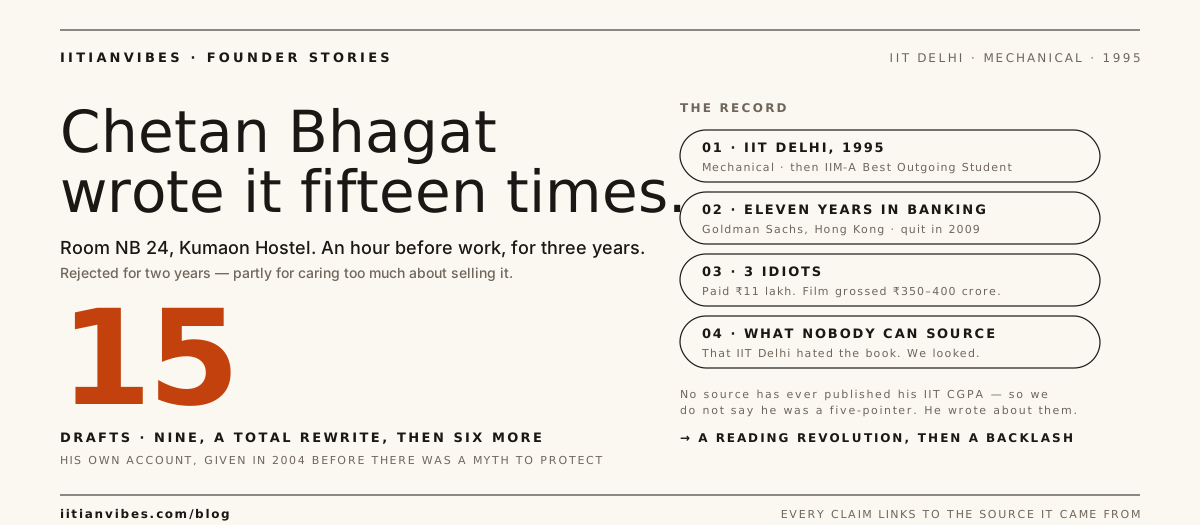
There is a room in Kumaon Hostel at IIT Delhi — NB 24 — that students point at. A 1982 mechanical engineering alumnus called SV Divvaakar once found people watching him stand outside it and learned why: "students asked me why I was standing outside Bhagat's room and that's when I found out that he, too, lived in the same room in 1994."
The hostel warden, asked about the room's reputation, was less impressed. "It's like any other room for me," said PM Pandey, "but students call it lucky."
That gap — between what students make of Chetan Bhagat and what the institution says about him — runs through this entire story. He is the most commercially successful writer any IIT has produced, his first novel is set inside IIT Delhi, and it became 3 Idiots. He is also, in 2026, the writer Indian book forums most enjoy dismissing. Both things are true, and the interesting question is what actually happened in between.
The record
| Year | What happened | Source |
|---|---|---|
| 1994 | Living in room NB 24, Kumaon Hostel, IIT Delhi | Hindustan Times, via a fellow alum |
| 1995 | B.Tech, Mechanical Engineering, IIT Delhi | Three mastheads agree on the year |
| 1997 | MBA, IIM Ahmedabad — Best Outgoing Student | The Tribune |
| 1997–2008 | ~11 years in investment banking: Peregrine, then Goldman Sachs (Hong Kong), then Deutsche Bank | Wikipedia; NYT places him at Deutsche Bank in March 2008 |
| 1 May 2004 | Five Point Someone published by Rupa, after ~2 years of rejections | Publisher record |
| Dec 2009 | 3 Idiots releases. Credit dispute begins the following week | Contemporaneous reporting |
| 2009 | Quits banking to write full time | Times of India interview |
| 2025 | 12 Years: My Messed-Up Love Story — eleventh novel | Indian Express |
What IIT actually gave him
It was not the engineering. Asked in 2006, while still a banker in Hong Kong, where the book came from, he was direct about it:
"Writing a book was always a dream, but I was worried my life would never have something so spectacular that I would have a story to tell. But hostel life in IIT was quite something and it touched me (and anyone else who has been there) like nothing else in my life. Maybe it was just the age, but it was very special."
— The Sunday Tribune, June 2006
His fuller version, written around the book's publication, is the best thing he has ever said about the place, and anyone who has lived in an IIT hostel will recognise the mechanism he is describing:
"Life at IIT transforms your personality completely, leaving permanent changes – as if you have had genetic mutations. Yet, I say this in a good way. You have never been around such smart people and such workload. And all the while, your pent-up hormones are just about getting started. It is a very special age. In this system, all you have is your friends – you find respite in the same people you compete with. And soon, you bond like you never will with anyone else in life. Yes, I would go to the extent of saying that you bond better with your IIT friends than to your spouse (big statement, know I am going to regret this one)."
"You find respite in the same people you compete with" is a genuinely precise description of an IIT hostel wing, and the parenthetical at the end is the whole man in one bracket.
One thing to be careful about, because the internet is not: nobody has ever published Chetan Bhagat's IIT Delhi CGPA. The title Five Point Someone invites you to assume he was writing autobiography, and the Best Outgoing Student award at IIM Ahmedabad two years later cuts hard the other way. He wrote about five-pointers. Whether he was one is not on the record, and we are not going to invent it.
His background was not the stereotype either. His father was a lieutenant colonel; his mother a scientist at the Indian Agricultural Research Institute. He had been chasing print since primary school: "I have loved writing since my first four line joke came out in the school magazine when I was in Class V. I was so excited on seeing my name in print, I would show the magazine to random people on DTC buses."
Nine drafts, a total rewrite, then six more
The myth is that he dashed off a novel during office hours at Goldman Sachs. His own account from 2004, before there was any myth to protect, is considerably less romantic:
"You have to remember that I have a day job. Mostly it meant waking up an hour early in the morning and writing – every day, day after day; and sometimes, I wrote at night as well. First draft, second draft and so on until the ninth draft. Some people then said it doesn't work. Back to the drawing board, a complete re-write, first draft, second draft and so on upto sixth draft. Then it worked!"
Fifteen drafts, one of them a full teardown, written an hour at a time before work over roughly three years. Whatever you think of the prose, that is not a man who got lucky.
The trigger, by his own telling, was a bad night after being passed over for promotion: "I was very low. I missed my college, I missed my friends. I wrote a few pages. Then it became a book. It may not have happened if I had gone out for drinks that night."
The rejection that explains his entire career
Indian publishers turned the manuscript down for about two years. That much is standard origin-story material. What makes it interesting is that one of the editors who rejected it later wrote about why — and the reason was not the writing.
Bhagat had submitted a marketing plan along with the manuscript. According to that editor's account, published in Open magazine and quoted by the financial journalist Vivek Kaul, the response in the room was: "If only he had written his manuscript with half the dedication he had put into his marketing plan!"
The same editor recorded the aftermath with some bitterness: "He later went to a rival firm and became a publishing sensation overnight, and to this day, our boss complains bitterly that he missed out on the biggest bestseller of the decade because he went by the judgement of three Bengali women—a flawed demographic, if there ever was one!"
Sit with that for a second. In 2002 or so, an unpublished engineer-banker was rejected by the Indian literary establishment partly for thinking commercially about his own book. Every criticism levelled at him for the next twenty years — that he is a marketer more than a writer, a product rather than an author — was pre-loaded into the rejection letter. He was refused for the exact quality that made him the best-selling English-language novelist in the country.
He never pretended otherwise. In 2009, needled by the Times of India with a comparison to Karan Johar and Ekta Kapoor, he did not flinch: "So what if I write for the masses? So did Shakespeare. He was probably the Ekta Kapoor of his time."
Did IIT Delhi hate the book? Nobody can actually show you
Here is a claim you will find in almost every article about Chetan Bhagat: that IIT Delhi resented Five Point Someone, that faculty were offended, that the campus turned on him.
We went looking for a source. There isn't one. Searches for an institutional statement, a faculty objection, an alumni-association response, a ban, a withdrawn invitation — all of it returns nothing but book summaries and SEO filler. The "IIT hated it" story is repeated far more often than it is evidenced.
What does exist is thinner and more interesting. Before publication, Bhagat was already being asked defensive questions — "It is said your book explores the dark side of IIT as well. Is that true?" — and his answer hedged: "Well, yes and no… it is not just a praise-filled work about IIT. It is more real – and real life doesn't work that way." He framed his hope for the book as contributing "to a richer legacy of the institute – to provide something on IIT that tells you that there is a heart along with the brain."
And in 2009, asked by the Times of India whether he had given anything back to IIT, his answer was not about money or a building. It was: "Well, I have made them more human. But I'm sure I can do more."
That is a man answering a question about an institution's opinion of him, and choosing to talk about image repair. Read it however you like — but it is evidence of a mood, not proof of a campus revolt, and we would rather hand you the ambiguity than a tidy story we cannot stand behind.
3 Idiots: what he was paid, and what he actually objected to
The popular version — that the filmmakers stole his book and denied him credit — is wrong in both halves, and Bhagat himself said so at the time.
The day after the film opened, before any dispute, his public position was this: "The film retains the soul of the book. 3 Idiots is different from the book but at the same time, it does borrow many things from the book. The core theme and message of the film are coming from the book itself. And that's why the makers have officially credited the film as 'Based on a novel by Chetan Bhagat.'"
Within days he had shifted. His grievance, stated precisely, was never that credit was absent: "They had bought the rights, made the payment, and committed to a credit in the contract. It's there, but it's not about it being there, it's about the placement and the prominence." He had expected an opening credit; he got a closing one.
Rajkumar Hirani's answer was contractual and, on the documents, strong: "With open eyes, he had seen the contract, consulted his lawyer, and signed the agreement… In the contract, we have said that the title would be given in the rolling credits. We haven't changed the font size. We haven't increased the speed of the title. It's exactly there where it was agreed to be." The production company published the paperwork on its own website.
Hirani had also, before the film released, described telling Bhagat the adaptation would diverge: "I told him that if he did not like the script, I would stop the project. But he was okay with it."
Producer Vidhu Vinod Chopra lost his temper at a reporter over the question, then apologised for it in terms most people never manage: "I saw myself on TV and saw how I was shouting 'shut up, shut up' like an animal. I told myself — 'what nonsensical behavior'." Bhagat also apologised, and asked his own fans to stand down: "I don't want them to turn against anyone especially Aamir."
Then, a decade later in 2020, he reopened it on completely different grounds — not credit placement, but awards and power: "The film won every story award that year. I was not given any of those story awards. They took them all. As a powerless newcomer I was bullied and was deeply affected."
The money is the part people get most wrong. He was paid ₹1 lakh for the rights, with a contractual ₹10 lakh bonus if the film succeeded. It succeeded; the bonus was paid. Total: ₹11 lakh, against a film that grossed somewhere between ₹350 and ₹400 crore depending on which masthead you believe.
3 IDIOTS · WHAT THE STORY COST Film gross₹350–400 crore Paid to Bhagat₹11 lakh The orange bar is drawn to scale. It is roughly 0.03% of the black one. He says he does not regret the deal.And this is the part that complicates the grievance narrative, so it belongs here: he says he does not regret it. He has described it as a fair deal for a newcomer at a time when nobody could have predicted the film's scale. Both things can sit in the same man — the 2020 anger about awards, and the 2026 shrug about the money.
Quitting: the mother-in-law problem
He left Deutsche Bank in 2009, eleven years into a banking career, at the point where he was already the country's best-selling English-language novelist. It was not an easy call, and the most honest thing he has said about it is not about money at all:
"Quitting was a decision I spent sleepless nights over but it had to be done. […] Thank god I'm successful. Because sitting across the breakfast table from your mother-in-law, and waving to your wife as she goes to her Swiss bank job isn't easy."
— Times of India, September 2009
That was said months after quitting, by a man the same paper described as a "full-time writer, house husband and father to his twin boys", working off two Macs with no writing desk and decamping to a coffee shop when the children got loud. For anyone at an IIT weighing a stable job against something riskier, that quote is worth more than any commencement speech: the hard part was not the salary. It was being looked at.
What he actually unlocked
Within eight years of Five Point Someone, IIT campus fiction was a recognisable publishing category. A 2012 news agency piece listed the wave by name — Anything for You, Ma'am, Zero Percentile: Missed IIT, Kissed Russia, Above Average, and more — noting the genre "took off with Bhagat's 'Five Point Someone' eight years ago and is fast becoming an independent genre of popular fiction."
That genre is now so ordinary nobody remarks on it. Which is the actual measure of what he did.
The clearest statement of his significance came, fittingly, from a reader on Reddit rather than a critic — and it doubles as the sharpest verdict on his present:
"For those who were possibly not born, Chetan bhagat created a 'reading revolution', when he wrote and published the original 'Five point someone'. I recall accidentally finding the book and reading it in a single sitting. It is true that before this book, authors generally catered to a niche, previliged [sic], english savvy audience. Chetan bhagat changed it over night… By the time, i read his fourth book, i was done. I never stepped back to read another Chetan Bhagat book, again. Problem is.. The world has evolved and changed since then. Chetan bhagat's thinking hasn't."
— r/india, November 2025
What IIT-adjacent readers say in 2026
Worth noting before the quotes: the per-IIT subreddits barely discuss him at all. The argument lives in r/IndianBooks, r/india and r/books — largely the same demographic, a few years older.
The most structural explanation of his decline came from someone sympathetic to him. Rather than a collapse in quality, they described his audience simply splitting: "Avid readers who have better casual reading options" on one side, and "the ones who still enjoy romantic dramas but have moved on to OTT video apps for their entertainment fix" on the other. He did not get worse; the alternatives got better.
The critical case is blunter, and one commenter put the credential question directly: "he became popular partly because of the brand value associated with his college and the novelty of someone from that background becoming a writer." A thread titled "Why is Chetan Bhagat so hated?" drew the sharpest line of all: "Chetan Bhagat is what happens when the average Indian reader who reads fiction from this sub starts writing."
But the gratitude is durable, and it comes from exactly the readers our audience is made of. One, from a small town in UP: "growing up in a small town of UP, there was never much attention given to reading, a novel was passed around among cousins from one of them who went to Delhi for studies." Another, defending him in a hostile thread: "Chetan Bhagat is alright for BEGINNER readers."
And the book itself still works on people meeting it fresh. A reader in 2026 who came to it via 3 Idiots expected a novelisation and did not get one: "I speedran that book in 3 days… And I loved it. Probably my favourite book of all time (for now)."
That is the honest shape of it. Five Point Someone is judged far more kindly than the fourteen books after it.
Where he is now
In 2025 he published 12 Years: My Messed-Up Love Story, his eleventh novel and first love story in over a decade, built on a deliberately awkward premise — a 33-year-old divorced man and a 21-year-old woman. His pitch was generational: "There was a time (2009) when a story like Two States was relevant, but today we live in a different world. We are not living in simple times; we are living in the time of situationships."
At the launch he made an argument about AI that is more interesting than most of what gets said on the subject, and characteristically routed it through himself: "AI hasn't had its heart broken. My heart was broken. ChatGPT doesn't have childhood trauma. I do… If you don't feel anything yourself, fiction won't work."
And in August 2026, at 52, he went viral for a staircase dance reel filmed with three IIT Delhi batchmates. His caption: "We don't have the acting chops to match Anupam Kher. But we do have old IIT Delhi friends willing to embarrass themselves together."
The comments split precisely the way his career splits. Some affectionate, some variations on "Why Chetan why?", and one that landed for anyone who has ever done a group project: "Fourth person is the one who's present but contributes zero in group projects."
Twenty-two years after a book about IIT hostel friendship made him famous, the thing that went viral was him, still hanging out with the people from that hostel. Say what you like about the prose. He was telling the truth about that part.
FAQ
Which IIT did Chetan Bhagat go to, and what did he study?
IIT Delhi, Mechanical Engineering, graduating in 1995. He then took an MBA at IIM Ahmedabad, finishing in 1997, where he was named Best Outgoing Student.
Was Chetan Bhagat himself a "five-pointer"?
Unknown, and widely assumed. No source has ever published his IIT Delhi CGPA or academic standing. The book's title invites the inference, but his Best Outgoing Student award at IIM Ahmedabad points the other way. He wrote about five-pointers; whether he was one is not on the record.
How much was Chetan Bhagat paid for 3 Idiots?
₹11 lakh in total — ₹1 lakh for the story rights plus a contractual ₹10 lakh success bonus that was paid out after the film became a hit. The film grossed somewhere between ₹350 and ₹400 crore. He has said he does not regret the deal.
Did IIT Delhi object to Five Point Someone?
There is no documented institutional reaction. The claim that IIT Delhi resented the book is repeated constantly but we could not find a statement, objection or any primary source behind it. Bhagat was fielding defensive questions about the book's portrayal of IIT before it was even published, and in 2009 said his contribution to IIT was that he had "made them more human" — but that is a mood, not evidence of a campus revolt.
How long did Five Point Someone take to write?
About three years, written before work while he was employed as an investment banker. By his own account it went through nine drafts, then a complete rewrite, then six more — fifteen in total. Indian publishers rejected it for roughly two years before Rupa took it.
More IIT founder stories: Sundar Pichai's metallurgy years at Kharagpur, and Vinod Khosla, IIT Delhi '76. If you'd rather wear your campus than read about it, the IIT Delhi collection is here.